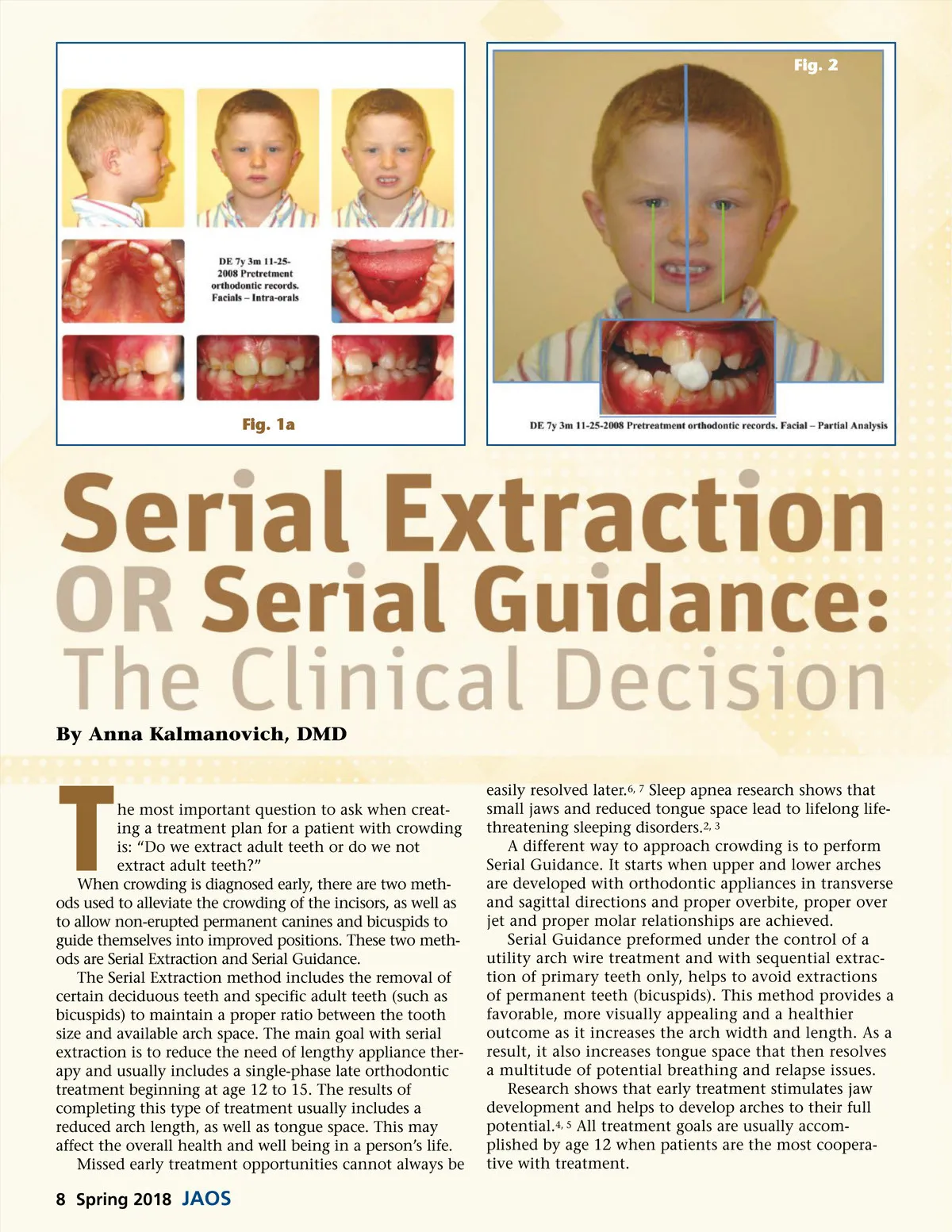
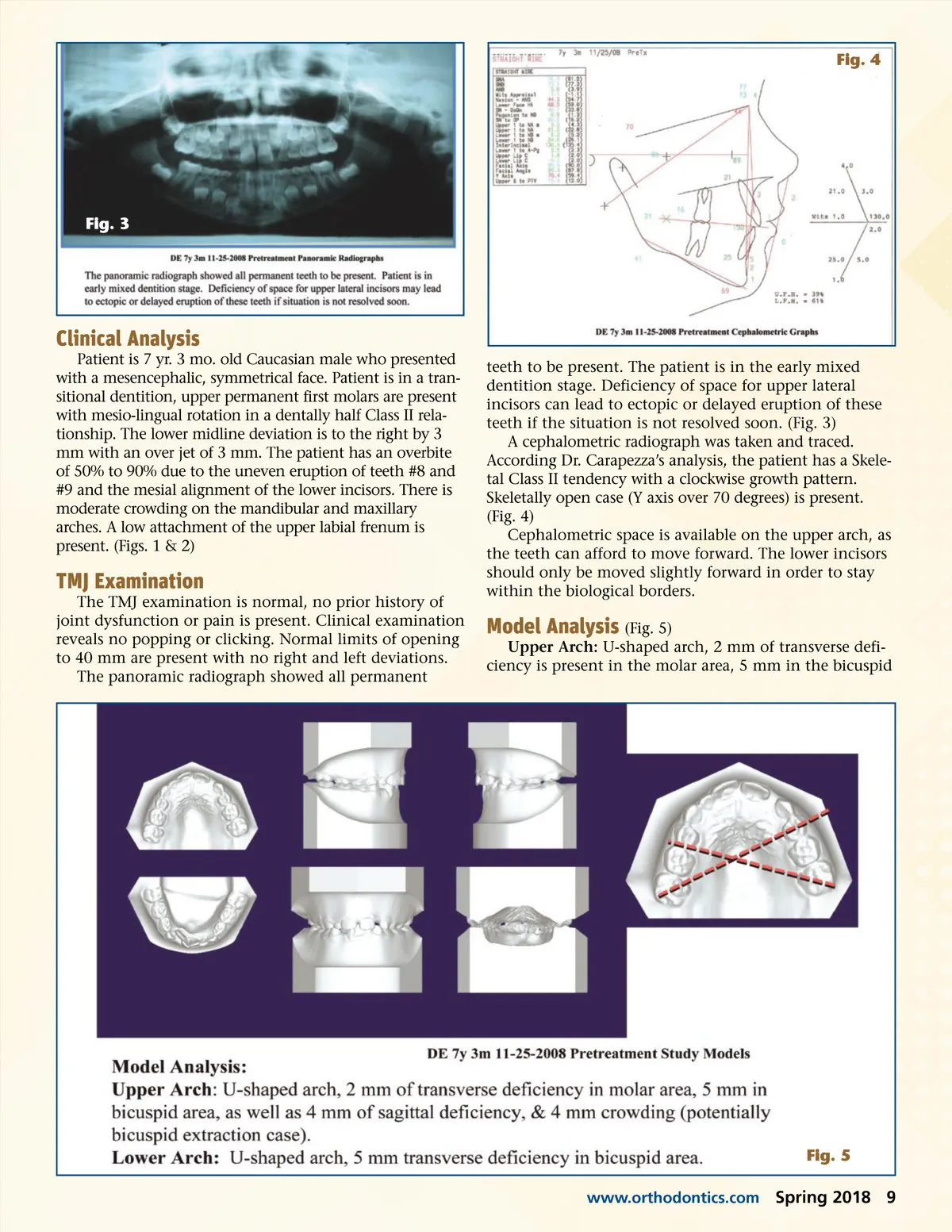
Fig. 2 Fig. 1a By Anna Kalmanovich, DMD he most important question to ask when creat-ing a treatment plan for a patient with crowding is: “Do we extract adult teeth or do we not extract adult teeth?” When crowding is diagnosed early, there are two meth-ods used to alleviate the crowding of the incisors, as well as to allow non-erupted permanent canines and bicuspids to guide themselves into improved positions. These two meth-ods are Serial Extraction and Serial Guidance. The Serial Extraction method includes the removal of certain deciduous teeth and specific adult teeth (such as bicuspids) to maintain a proper ratio between the tooth size and available arch space. The main goal with serial extraction is to reduce the need of lengthy appliance ther-apy and usually includes a single-phase late orthodontic treatment beginning at age 12 to 15. The results of completing this type of treatment usually includes a reduced arch length, as well as tongue space. This may affect the overall health and well being in a person’s life. Missed early treatment opportunities cannot always be T easily resolved later. 6, 7 Sleep apnea research shows that small jaws and reduced tongue space lead to lifelong life-threatening sleeping disorders. 2, 3 A different way to approach crowding is to perform Serial Guidance. It starts when upper and lower arches are developed with orthodontic appliances in transverse and sagittal directions and proper overbite, proper over jet and proper molar relationships are achieved. Serial Guidance preformed under the control of a utility arch wire treatment and with sequential extrac-tion of primary teeth only, helps to avoid extractions of permanent teeth (bicuspids). This method provides a favorable, more visually appealing and a healthier outcome as it increases the arch width and length. As a result, it also increases tongue space that then resolves a multitude of potential breathing and relapse issues. Research shows that early treatment stimulates jaw development and helps to develop arches to their full potential. 4, 5 All treatment goals are usually accom-plished by age 12 when patients are the most coopera-tive with treatment. 8 Spring 2018 JAOS
Journal of the American Orthodontic Society Spring 2018: Page 8