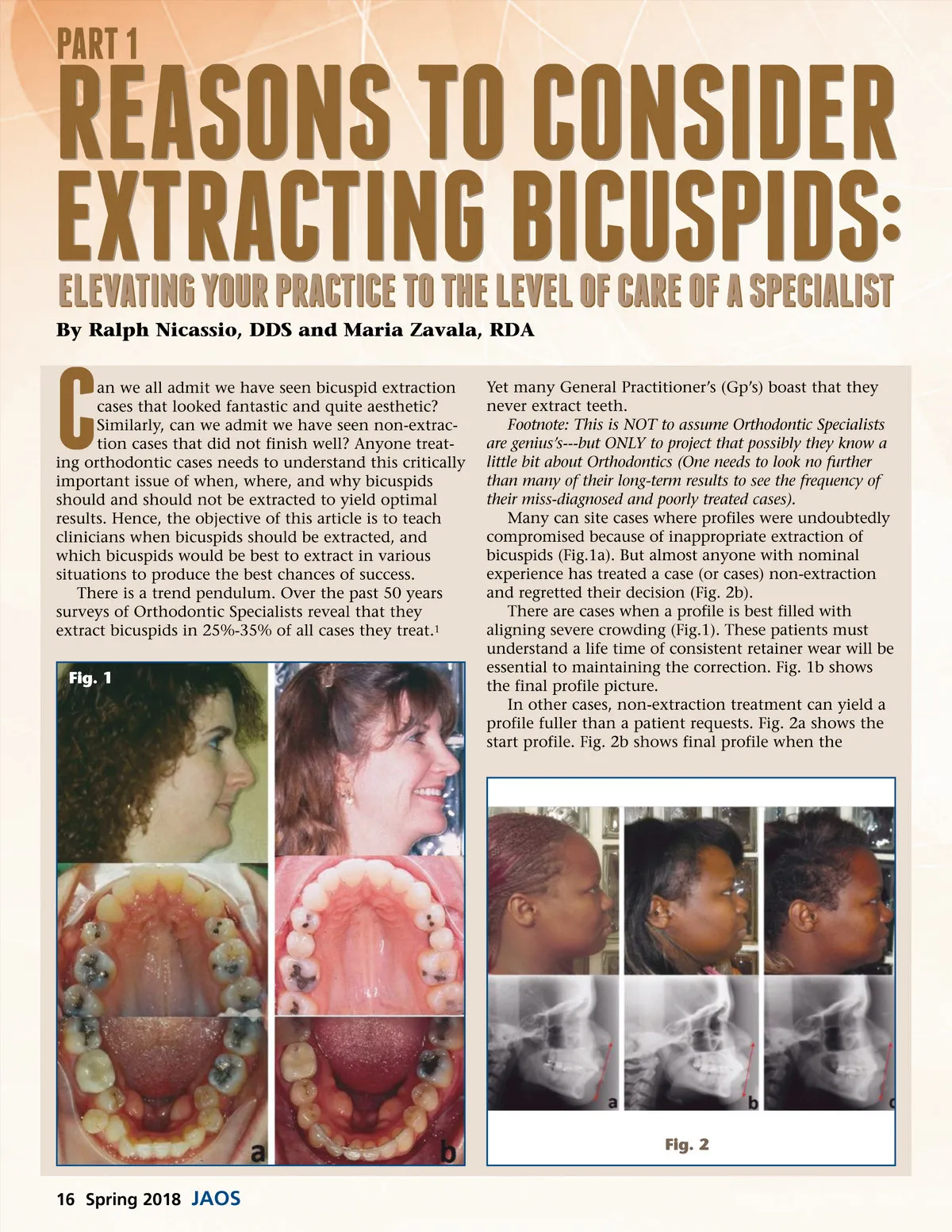
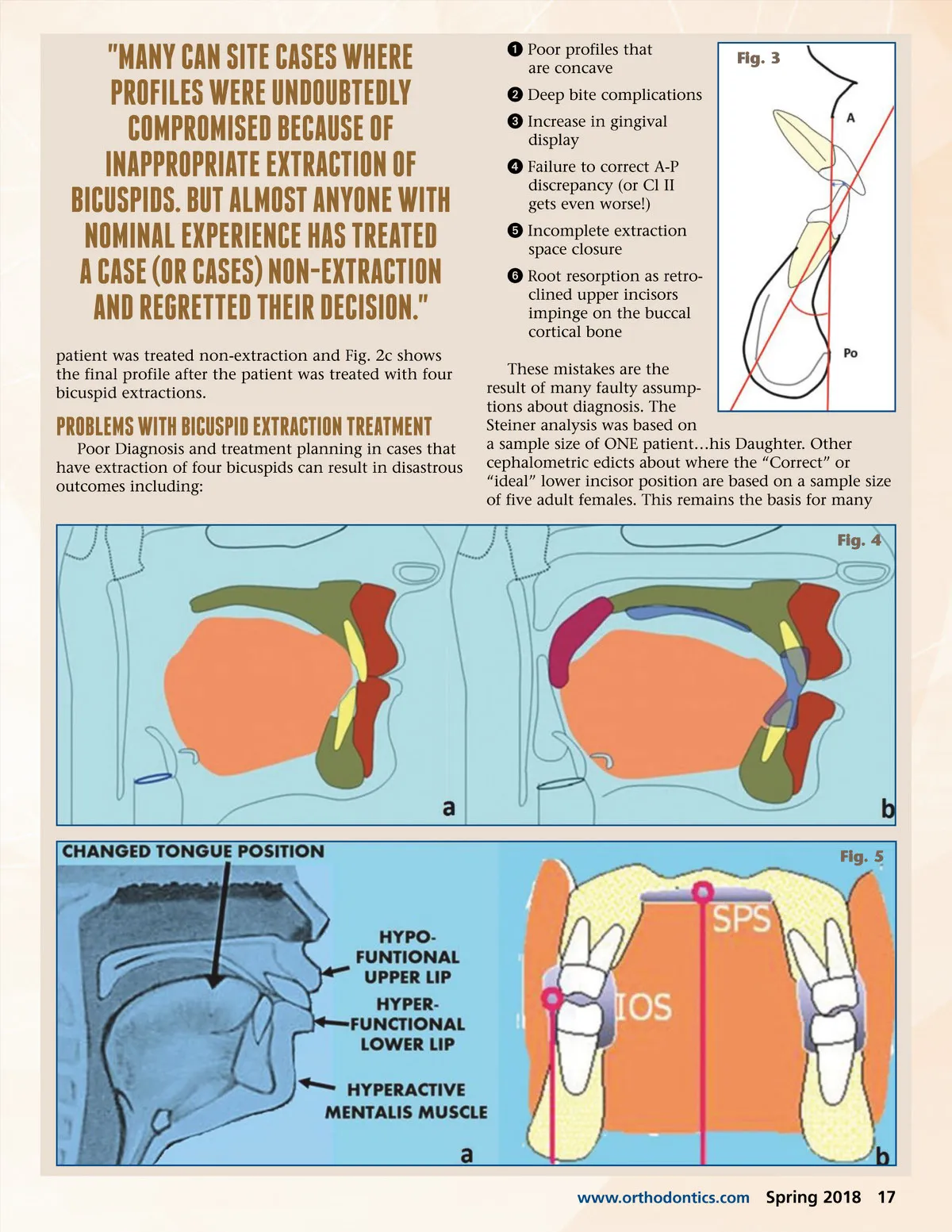
REASonS To ConSiDER EXTRACTing BiCuSPiDS: ElEvATing YouR PRACTiCE To ThE lEvEl of CARE of A SPECiAliST Yet many General Practitioner’s (Gp’s) boast that they never extract teeth. Footnote: This is NOT to assume Orthodontic Specialists are genius’s---but ONLY to project that possibly they know a little bit about Orthodontics (One needs to look no further than many of their long-term results to see the frequency of their miss-diagnosed and poorly treated cases). Many can site cases where profiles were undoubtedly compromised because of inappropriate extraction of bicuspids (Fig.1a). But almost anyone with nominal experience has treated a case (or cases) non-extraction and regretted their decision (Fig. 2b). There are cases when a profile is best filled with aligning severe crowding (Fig.1). These patients must understand a life time of consistent retainer wear will be essential to maintaining the correction. Fig. 1b shows the final profile picture. In other cases, non-extraction treatment can yield a profile fuller than a patient requests. Fig. 2a shows the start profile. Fig. 2b shows final profile when the PART 1 By Ralph Nicassio, DDS and Maria Zavala, RDA an we all admit we have seen bicuspid extraction cases that looked fantastic and quite aesthetic? Similarly, can we admit we have seen non-extrac-tion cases that did not finish well? Anyone treat-ing orthodontic cases needs to understand this critically important issue of when, where, and why bicuspids should and should not be extracted to yield optimal results. Hence, the objective of this article is to teach clinicians when bicuspids should be extracted, and which bicuspids would be best to extract in various situations to produce the best chances of success. There is a trend pendulum. Over the past 50 years surveys of Orthodontic Specialists reveal that they extract bicuspids in 25%-35% of all cases they treat. 1 Fig. 1 C Fig. 2 16 Spring 2018 JAOS
Journal of the American Orthodontic Society Spring 2018: Page 16