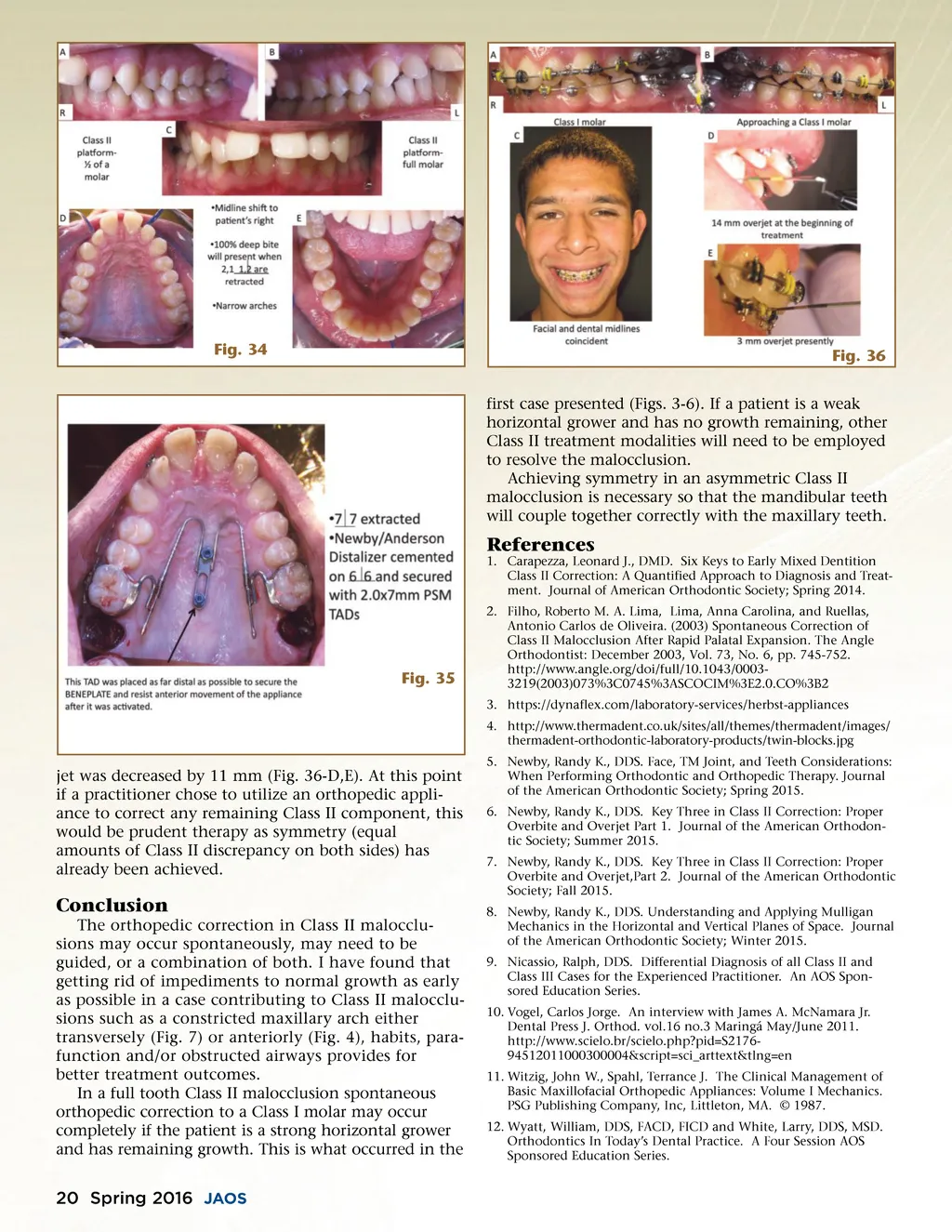
Fig. 34 Fig. 36 first case presented (Figs. 3-6). If a patient is a weak horizontal grower and has no growth remaining, other Class II treatment modalities will need to be employed to resolve the malocclusion. Achieving symmetry in an asymmetric Class II malocclusion is necessary so that the mandibular teeth will couple together correctly with the maxillary teeth. References 1. Carapezza, Leonard J., DMD. Six Keys to Early Mixed Dentition Class II Correction: A Quantified Approach to Diagnosis and Treat-ment. Journal of American Orthodontic Society; Spring 2014. 2. Filho, Roberto M. A. Lima, Lima, Anna Carolina, and Ruellas, Antonio Carlos de Oliveira. (2003) Spontaneous Correction of Class II Malocclusion After Rapid Palatal Expansion. The Angle Orthodontist: December 2003, Vol. 73, No. 6, pp. 745-752. http://www.angle.org/doi/full/10.1043/0003-3219(2003)073%3C0745%3ASCOCIM%3E2.0.CO%3B2 3. https://dynaflex.com/laboratory-services/herbst-appliances 4. http://www.thermadent.co.uk/sites/all/themes/thermadent/images/ thermadent-orthodontic-laboratory-products/twin-blocks.jpg Fig. 35 jet was decreased by 11 mm (Fig. 36-D,E). At this point if a practitioner chose to utilize an orthopedic appli-ance to correct any remaining Class II component, this would be prudent therapy as symmetry (equal amounts of Class II discrepancy on both sides) has already been achieved. 5. Newby, Randy K., DDS. Face, TM Joint, and Teeth Considerations: When Performing Orthodontic and Orthopedic Therapy. Journal of the American Orthodontic Society; Spring 2015. 6. Newby, Randy K., DDS. Key Three in Class II Correction: Proper Overbite and Overjet Part 1. Journal of the American Orthodon-tic Society; Summer 2015. 7. Newby, Randy K., DDS. Key Three in Class II Correction: Proper Overbite and Overjet,Part 2. Journal of the American Orthodontic Society; Fall 2015. 8. Newby, Randy K., DDS. Understanding and Applying Mulligan Mechanics in the Horizontal and Vertical Planes of Space. Journal of the American Orthodontic Society; Winter 2015. 9. Nicassio, Ralph, DDS. Differential Diagnosis of all Class II and Class III Cases for the Experienced Practitioner. An AOS Spon-sored Education Series. 10. Vogel, Carlos Jorge. An interview with James A. McNamara Jr. Dental Press J. Orthod. vol.16 no.3 Maringá May/June 2011. http://www.scielo.br/scielo.php?pid=S2176-94512011000300004&script=sci_arttext&tlng=en 11. Witzig, John W., Spahl, Terrance J. The Clinical Management of Basic Maxillofacial Orthopedic Appliances: Volume I Mechanics. PSG Publishing Company, Inc, Littleton, MA. © 1987. 12. Wyatt, William, DDS, FACD, FICD and White, Larry, DDS, MSD. Orthodontics In Today’s Dental Practice. A Four Session AOS Sponsored Education Series. Conclusion The orthopedic correction in Class II malocclu-sions may occur spontaneously, may need to be guided, or a combination of both. I have found that getting rid of impediments to normal growth as early as possible in a case contributing to Class II malocclu-sions such as a constricted maxillary arch either transversely (Fig. 7) or anteriorly (Fig. 4), habits, para-function and/or obstructed airways provides for better treatment outcomes. In a full tooth Class II malocclusion spontaneous orthopedic correction to a Class I molar may occur completely if the patient is a strong horizontal grower and has remaining growth. This is what occurred in the 20 Spring 2016 JAOS
Journal of the American Orthodontic Society Spring 2016: Page 20