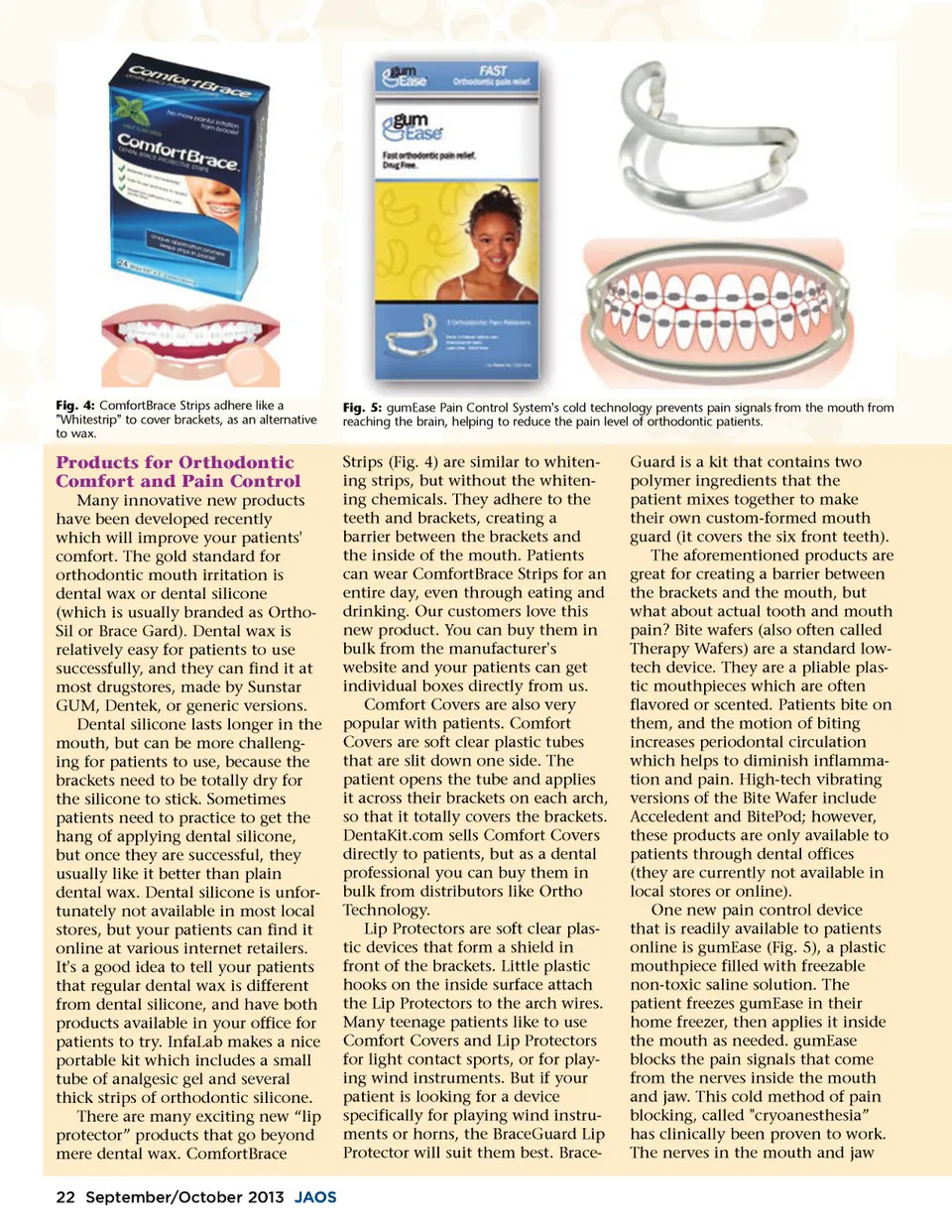
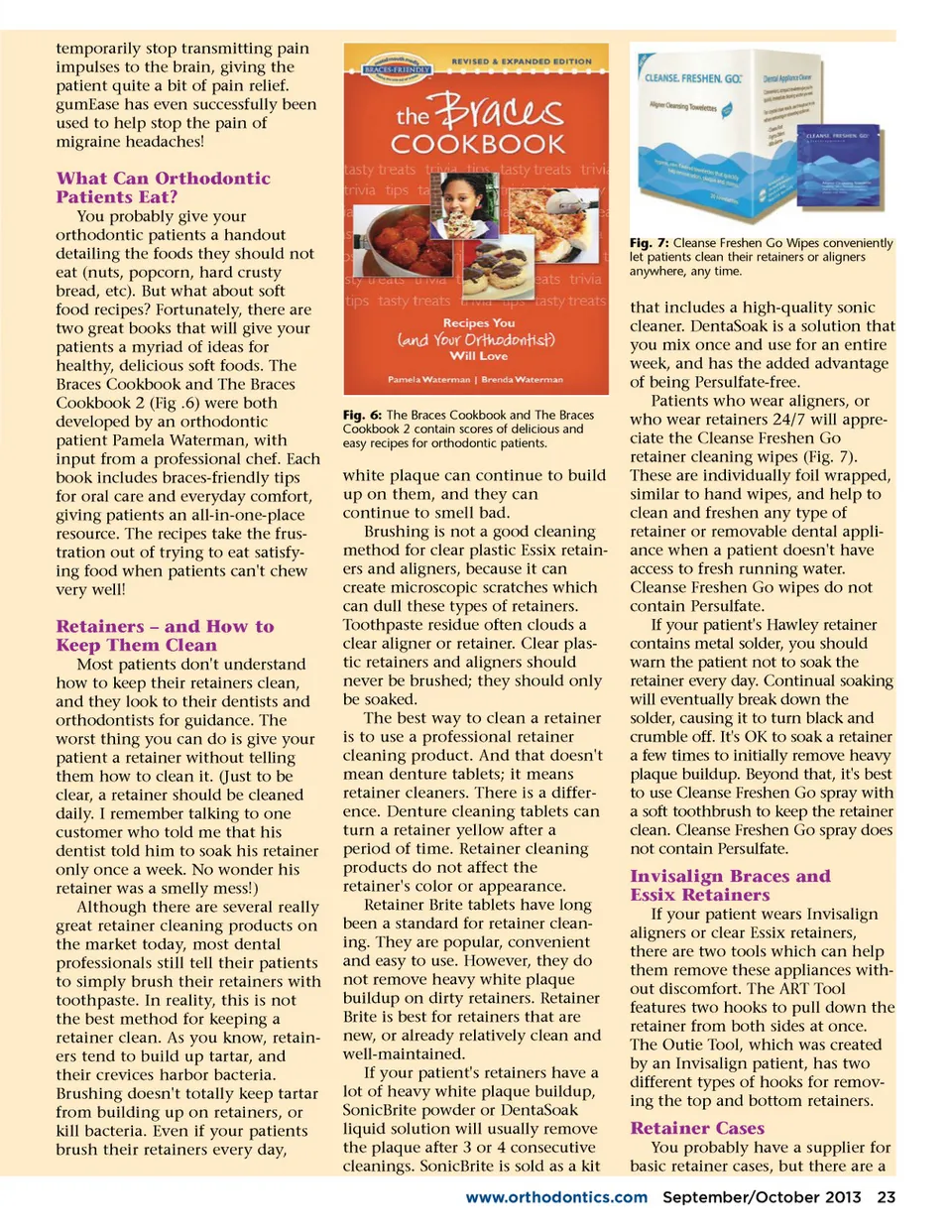
Fig. 4: ComfortBrace Strips adhere like a "Whitestrip" to cover brackets, as an alternative to wax. Fig. 5: gumEase Pain Control System's cold technology prevents pain signals from the mouth from reaching the brain, helping to reduce the pain level of orthodontic patients. Products for Orthodontic Comfort and Pain Control Many innovative new products have been developed recently which will improve your patients' comfort. The gold standard for orthodontic mouth irritation is dental wax or dental silicone (which is usually branded as Ortho-Sil or Brace Gard). Dental wax is relatively easy for patients to use successfully, and they can find it at most drugstores, made by Sunstar GUM, Dentek, or generic versions. Dental silicone lasts longer in the mouth, but can be more challeng-ing for patients to use, because the brackets need to be totally dry for the silicone to stick. Sometimes patients need to practice to get the hang of applying dental silicone, but once they are successful, they usually like it better than plain dental wax. Dental silicone is unfor-tunately not available in most local stores, but your patients can find it online at various internet retailers. It's a good idea to tell your patients that regular dental wax is different from dental silicone, and have both products available in your office for patients to try. InfaLab makes a nice portable kit which includes a small tube of analgesic gel and several thick strips of orthodontic silicone. There are many exciting new “lip protector” products that go beyond mere dental wax. ComfortBrace 22 September/October 2013 JAOS Strips (Fig. 4) are similar to whiten-ing strips, but without the whiten-ing chemicals. They adhere to the teeth and brackets, creating a barrier between the brackets and the inside of the mouth. Patients can wear ComfortBrace Strips for an entire day, even through eating and drinking. Our customers love this new product. You can buy them in bulk from the manufacturer's website and your patients can get individual boxes directly from us. Comfort Covers are also very popular with patients. Comfort Covers are soft clear plastic tubes that are slit down one side. The patient opens the tube and applies it across their brackets on each arch, so that it totally covers the brackets. DentaKit.com sells Comfort Covers directly to patients, but as a dental professional you can buy them in bulk from distributors like Ortho Technology. Lip Protectors are soft clear plas-tic devices that form a shield in front of the brackets. Little plastic hooks on the inside surface attach the Lip Protectors to the arch wires. Many teenage patients like to use Comfort Covers and Lip Protectors for light contact sports, or for play-ing wind instruments. But if your patient is looking for a device specifically for playing wind instru-ments or horns, the BraceGuard Lip Protector will suit them best. Brace-Guard is a kit that contains two polymer ingredients that the patient mixes together to make their own custom-formed mouth guard (it covers the six front teeth). The aforementioned products are great for creating a barrier between the brackets and the mouth, but what about actual tooth and mouth pain? Bite wafers (also often called Therapy Wafers) are a standard low-tech device. They are a pliable plas-tic mouthpieces which are often flavored or scented. Patients bite on them, and the motion of biting increases periodontal circulation which helps to diminish inflamma-tion and pain. High-tech vibrating versions of the Bite Wafer include Acceledent and BitePod; however, these products are only available to patients through dental offices (they are currently not available in local stores or online). One new pain control device that is readily available to patients online is gumEase (Fig. 5), a plastic mouthpiece filled with freezable non-toxic saline solution. The patient freezes gumEase in their home freezer, then applies it inside the mouth as needed. gumEase blocks the pain signals that come from the nerves inside the mouth and jaw. This cold method of pain blocking, called "cryoanesthesia” has clinically been proven to work. The nerves in the mouth and jaw
Journal of the American Orthodontic Society September-October 2013: Page 22