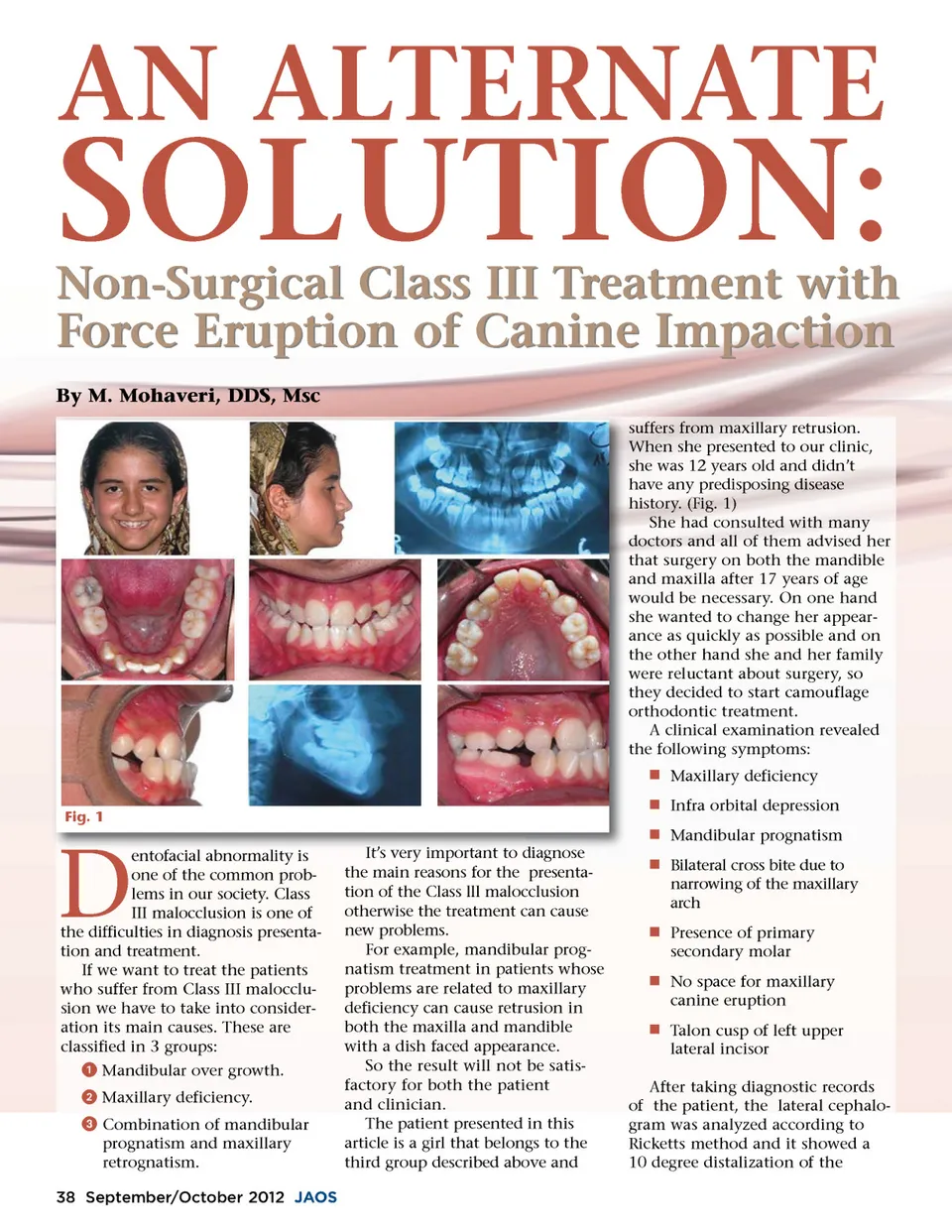
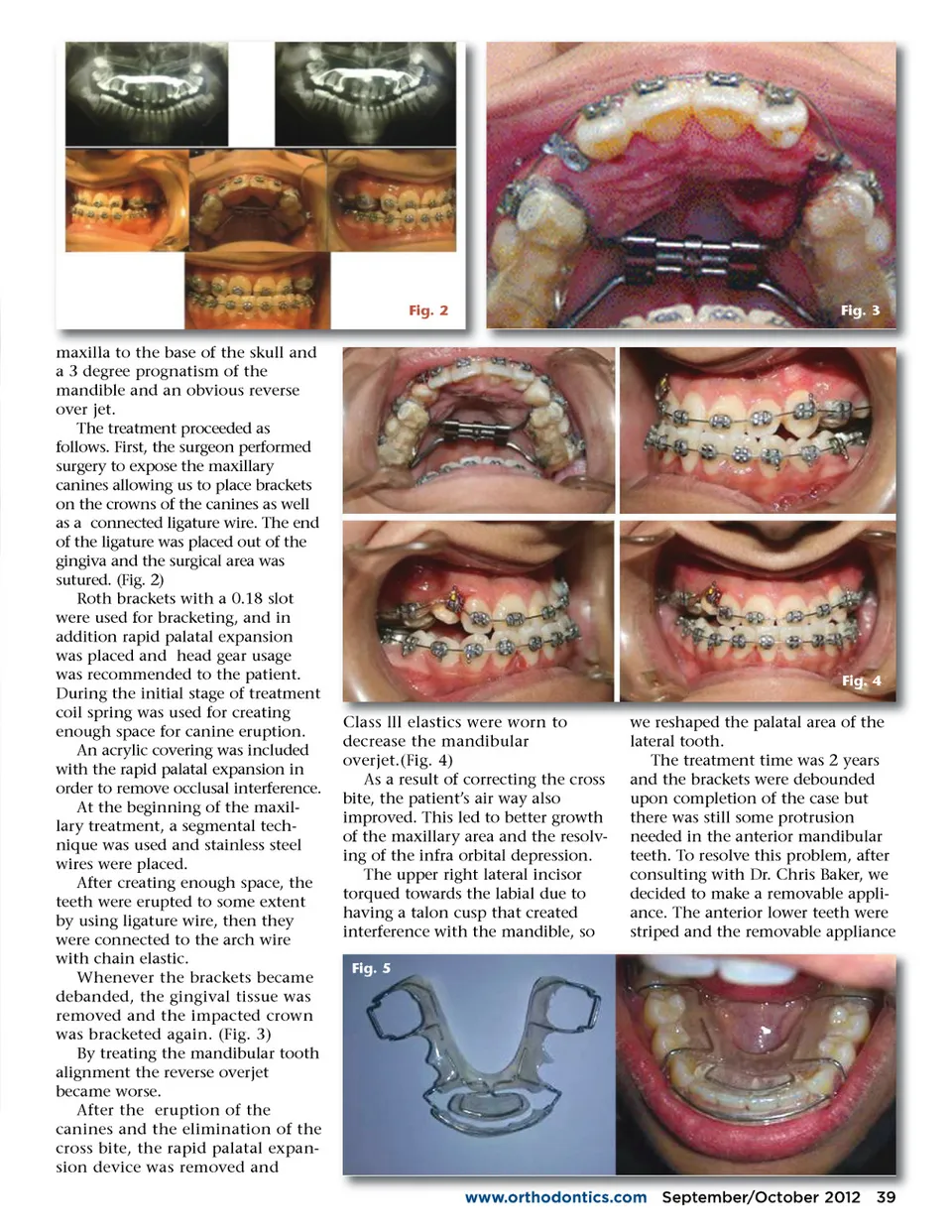
AN ALTERNATE By M. Mohaveri, DDS, Msc Non-Surgical Class III Treatment with Force Eruption of Canine Impaction suffers from maxillary retrusion. W When she presented to our clinic, she was 12 years old and didn’t h have any predisposing disease h history. (Fig. 1) She had consulted with many d doctors and all of them advised her t that surgery on both the mandible a and maxilla after 17 years of age w would be necessary. On one hand she wanted to change her appear-a ance as quickly as possible and on t the other hand she and her family w were reluctant about surgery, so t they decided to start camouflage o orthodontic treatment. A clinical examination revealed t the following symptoms: Maxillary deficiency Fig. 1 SOLUTION: Infra orbital depression Mandibular prognatism It’s very important to diagnose the main reasons for the presenta-tion of the Class lll malocclusion otherwise the treatment can cause new problems. For example, mandibular prog-natism treatment in patients whose problems are related to maxillary deficiency can cause retrusion in both the maxilla and mandible with a dish faced appearance. So the result will not be satis-factory for both the patient and clinician. The patient presented in this article is a girl that belongs to the third group described above and Bilateral cross bite due to narrowing of the maxillary arch Presence of primary secondary molar No space for maxillary canine eruption Talon cusp of left upper lateral incisor After taking diagnostic records of the patient, the lateral cephalo-gram was analyzed according to Ricketts method and it showed a 10 degree distalization of the D entofacial t f i l abnormality b lit i is one of the common prob-lems in our society. Class III malocclusion is one of the difficulties in diagnosis presenta-tion and treatment. If we want to treat the patients who suffer from Class III malocclu-sion we have to take into consider-ation its main causes. These are classified in 3 groups: ᕡ Mandibular over growth. ᕢ Maxillary deficiency. ᕣ Combination of mandibular prognatism and maxillary retrognatism. 38 September/October 2012 JAOS
Journal of the American Orthodontic Society September-October 2012: Page 38