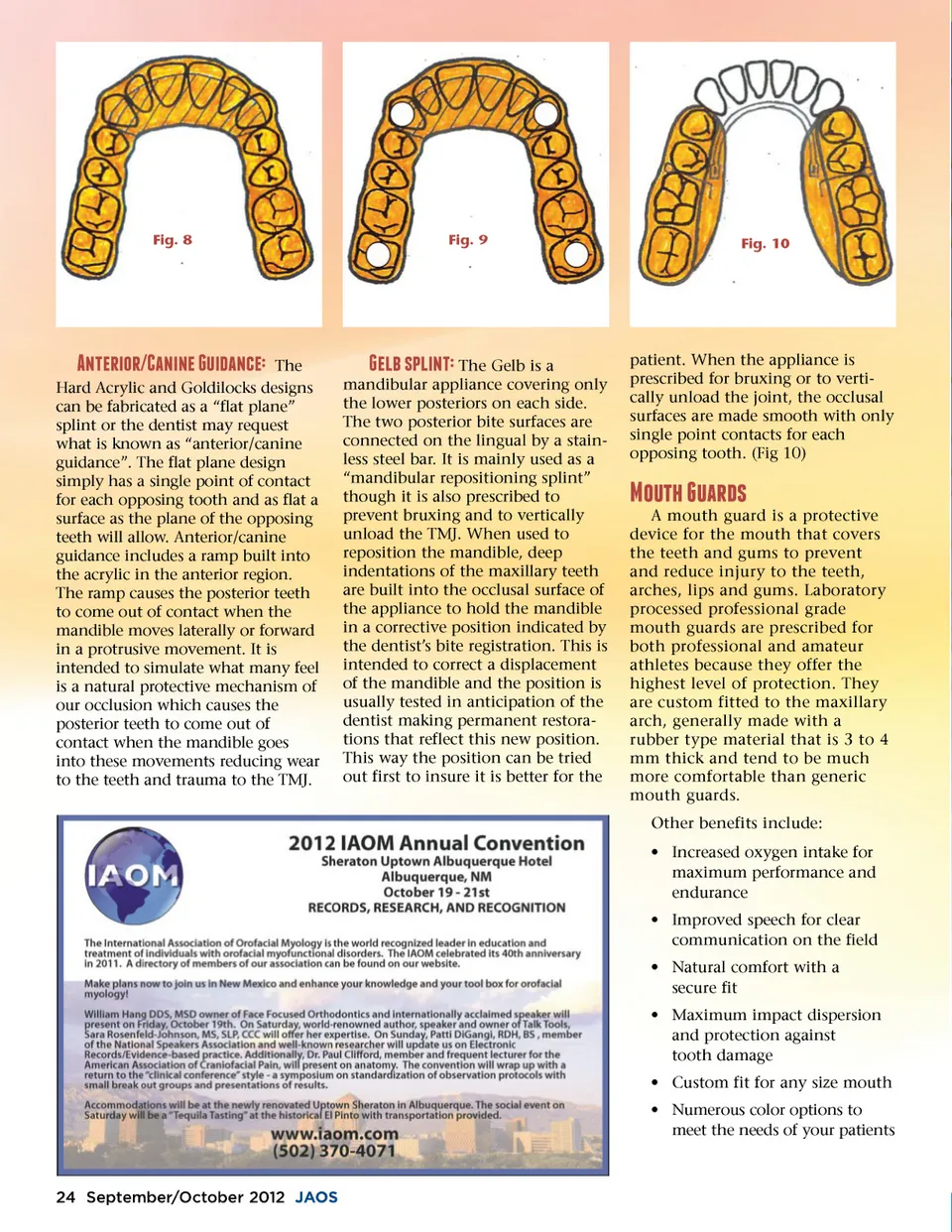
Fig. 8 Fig. 9 Fig. 10 The Hard Acrylic and Goldilocks designs can be fabricated as a “flat plane” splint or the dentist may request what is known as “anterior/canine guidance”. The flat plane design simply has a single point of contact for each opposing tooth and as flat a surface as the plane of the opposing teeth will allow. Anterior/canine guidance includes a ramp built into the acrylic in the anterior region. The ramp causes the posterior teeth to come out of contact when the mandible moves laterally or forward in a protrusive movement. It is intended to simulate what many feel is a natural protective mechanism of our occlusion which causes the posterior teeth to come out of contact when the mandible goes into these movements reducing wear to the teeth and trauma to the TMJ. anterior/Canine Guidance: Gelb splint: The Gelb is a mandibular appliance covering only the lower posteriors on each side. The two posterior bite surfaces are connected on the lingual by a stain-less steel bar. It is mainly used as a “mandibular repositioning splint” though it is also prescribed to prevent bruxing and to vertically unload the TMJ. When used to reposition the mandible, deep indentations of the maxillary teeth are built into the occlusal surface of the appliance to hold the mandible in a corrective position indicated by the dentist’s bite registration. This is intended to correct a displacement of the mandible and the position is usually tested in anticipation of the dentist making permanent restora-tions that reflect this new position. This way the position can be tried out first to insure it is better for the patient. When the appliance is prescribed for bruxing or to verti-cally unload the joint, the occlusal surfaces are made smooth with only single point contacts for each opposing tooth. (Fig 10) mouth Guards A mouth guard is a protective device for the mouth that covers the teeth and gums to prevent and reduce injury to the teeth, arches, lips and gums. Laboratory processed professional grade mouth guards are prescribed for both professional and amateur athletes because they offer the highest level of protection. They are custom fitted to the maxillary arch, generally made with a rubber type material that is 3 to 4 mm thick and tend to be much more comfortable than generic mouth guards. Other benefits include: • Increased oxygen intake for maximum performance and endurance • Improved speech for clear communication on the field • Natural comfort with a secure fit • Maximum impact dispersion and protection against tooth damage • Custom fit for any size mouth • Numerous color options to meet the needs of your patients 24 September/October 2012 JAOS
Journal of the American Orthodontic Society September-October 2012: Page 24