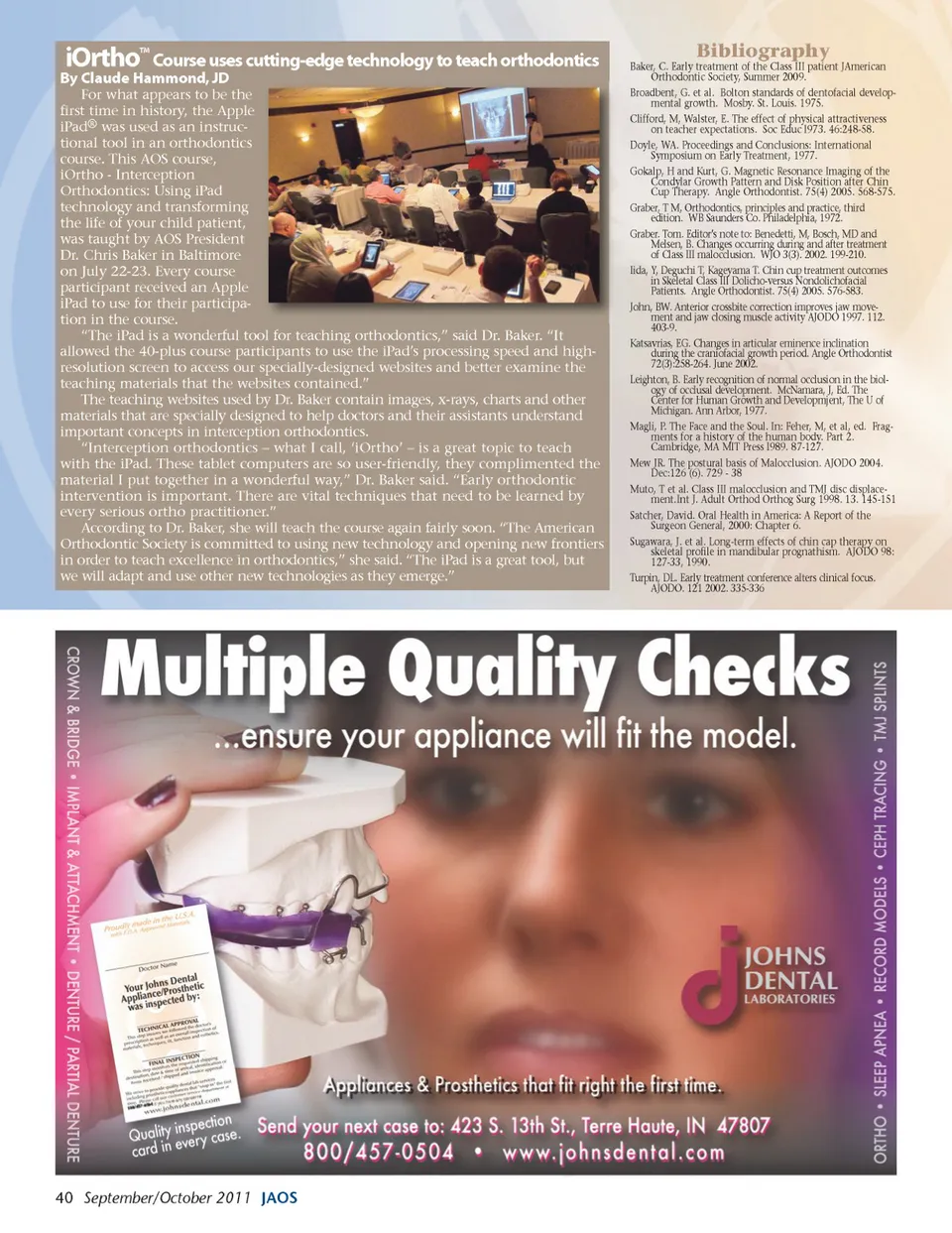
By Claude Hammond, JD For what appears to be the first time in history, the Apple iPad ® was used as an instruc-tional tool in an orthodontics course. This AOS course, iOrtho -Interception Orthodontics: Using iPad technology and transforming the life of your child patient, was taught by AOS President Dr. Chris Baker in Baltimore on July 22-23. Every course participant received an Apple iPad to use for their participa-tion in the course. “The iPad is a wonderful tool for teaching orthodontics,” said Dr. Baker. “It allowed the 40-plus course participants to use the iPad’s processing speed and high-resolution screen to access our specially-designed websites and better examine the teaching materials that the websites contained.” The teaching websites used by Dr. Baker contain images, x-rays, charts and other materials that are specially designed to help doctors and their assistants understand important concepts in interception orthodontics. “Interception orthodontics – what I call, ‘iOrtho’ – is a great topic to teach with the iPad. These tablet computers are so user-friendly, they complimented the material I put together in a wonderful way,” Dr. Baker said. “Early orthodontic intervention is important. There are vital techniques that need to be learned by every serious ortho practitioner.” According to Dr. Baker, she will teach the course again fairly soon. “The American Orthodontic Society is committed to using new technology and opening new frontiers in order to teach excellence in orthodontics,” she said. “The iPad is a great tool, but we will adapt and use other new technologies as they emerge.” iOrtho TM Course uses cutting-edge technology to teach orthodontics Bibliography Baker, C. Early treatment of the Class III patient JAmerican Orthodontic Society, Summer 2009. Broadbent, G. et al. Bolton standards of dentofacial develop-mental growth. Mosby. St. Louis. 1975. Clifford, M, Walster, E. The effect of physical attractiveness on teacher expectations. Soc Educ l973. 46:248-58. Doyle, WA. Proceedings and Conclusions: International Symposium on Early Treatment, 1977. Gokalp, H and Kurt, G. Magnetic Resonance Imaging of the Condylar Growth Pattern and Disk Position after Chin Cup Therapy. Angle Orthodontist. 75(4) 2005. 568-575. Graber, T M, Orthodontics, principles and practice, third edition. WB Saunders Co. Philadelphia, 1972. Graber. Tom. Editor’s note to: Benedetti, M, Bosch, MD and Melsen, B. Changes occurring during and after treatment of Class III malocclusion. WJO 3(3). 2002. 199-210. Iida, Y, Deguchi T, Kageyama T. Chin cup treatment outcomes in Skeletal Class III Dolicho-versus Nondolichofacial Patients. Angle Orthodontist. 75(4) 2005. 576-583. John, BW. Anterior crossbite correction improves jaw move-ment and jaw closing muscle activity AJODO 1997. 112. 403-9. Katsavrias, EG. Changes in articular eminence inclination during the craniofacial growth period. Angle Orthodontist 72(3):258-264. June 2002. Leighton, B. Early recognition of normal occlusion in the biol-ogy of occlusal development. McNamara, J, Ed. The Center for Human Growth and Developmjent, The U of Michigan. Ann Arbor, 1977. Magli, P. The Face and the Soul. In: Feher, M, et al, ed. Frag-ments for a history of the human body. Part 2. Cambridge, MA MIT Press l989. 87-127. Mew JR. The postural basis of Malocclusion. AJODO 2004. Dec:126 (6). 729 -38 Muto, T et al. Class III malocclusion and TMJ disc displace-ment.Int J. Adult Orthod Orthog Surg 1998. 13. 145-151 Satcher, David. Oral Health in America: A Report of the Surgeon General, 2000: Chapter 6. Sugawara, J. et al. Long-term effects of chin cap therapy on skeletal profile in mandibular prognathism. AJODO 98: 127-33, 1990. Turpin, DL. Early treatment conference alters clinical focus. AJODO. 121 2002. 335-336 40 September/October 2011 JAOS
Journal of the American Orthodontic Society September-October 2011: Page 40