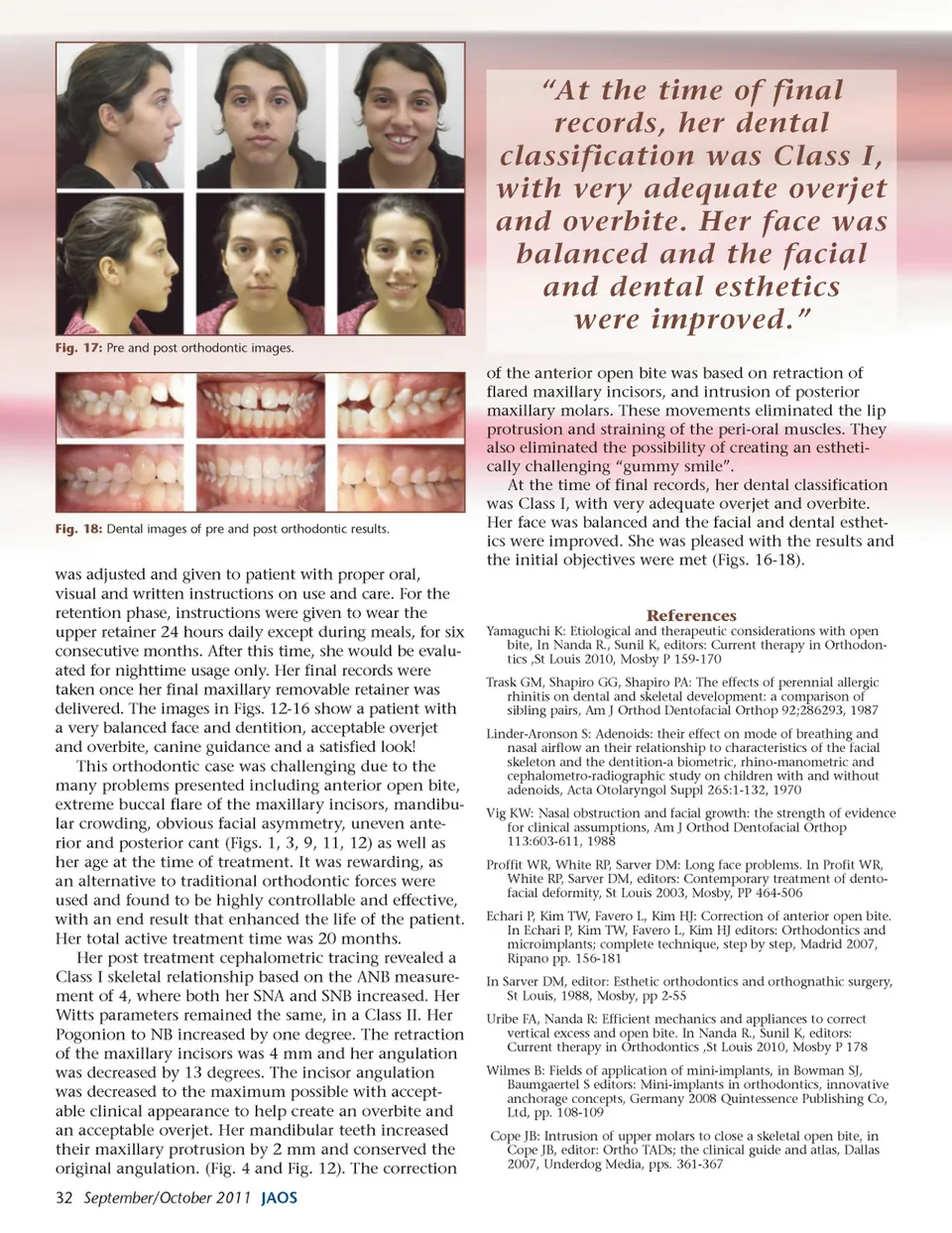
“At the time of final records, her dental classification was Class I, with very adequate overjet and overbite. Her face was balanced and the facial and dental esthetics were improved.” Fig. 17: Pre and post orthodontic images. Fig. 18: Dental images of pre and post orthodontic results. was adjusted and given to patient with proper oral, visual and written instructions on use and care. For the retention phase, instructions were given to wear the upper retainer 24 hours daily except during meals, for six consecutive months. After this time, she would be evalu-ated for nighttime usage only. Her final records were taken once her final maxillary removable retainer was delivered. The images in Figs. 12-16 show a patient with a very balanced face and dentition, acceptable overjet and overbite, canine guidance and a satisfied look! This orthodontic case was challenging due to the many problems presented including anterior open bite, extreme buccal flare of the maxillary incisors, mandibu-lar crowding, obvious facial asymmetry, uneven ante-rior and posterior cant (Figs. 1, 3, 9, 11, 12) as well as her age at the time of treatment. It was rewarding, as an alternative to traditional orthodontic forces were used and found to be highly controllable and effective, with an end result that enhanced the life of the patient. Her total active treatment time was 20 months. Her post treatment cephalometric tracing revealed a Class I skeletal relationship based on the ANB measure-ment of 4, where both her SNA and SNB increased. Her Witts parameters remained the same, in a Class II. Her Pogonion to NB increased by one degree. The retraction of the maxillary incisors was 4 mm and her angulation was decreased by 13 degrees. The incisor angulation was decreased to the maximum possible with accept-able clinical appearance to help create an overbite and an acceptable overjet. Her mandibular teeth increased their maxillary protrusion by 2 mm and conserved the original angulation. (Fig. 4 and Fig. 12). The correction 32 September/October 2011 JAOS of the anterior open bite was based on retraction of flared maxillary incisors, and intrusion of posterior maxillary molars. These movements eliminated the lip protrusion and straining of the peri-oral muscles. They also eliminated the possibility of creating an estheti-cally challenging “gummy smile”. At the time of final records, her dental classification was Class I, with very adequate overjet and overbite. Her face was balanced and the facial and dental esthet-ics were improved. She was pleased with the results and the initial objectives were met (Figs. 16-18). References Yamaguchi K: Etiological and therapeutic considerations with open bite, In Nanda R., Sunil K, editors: Current therapy in Orthodon-tics ,St Louis 2010, Mosby P 159-170 Trask GM, Shapiro GG, Shapiro PA: The effects of perennial allergic rhinitis on dental and skeletal development: a comparison of sibling pairs, Am J Orthod Dentofacial Orthop 92;286293, 1987 Linder-Aronson S: Adenoids: their effect on mode of breathing and nasal airflow an their relationship to characteristics of the facial skeleton and the dentition-a biometric, rhino-manometric and cephalometro-radiographic study on children with and without adenoids, Acta Otolaryngol Suppl 265:1-132, 1970 Vig KW: Nasal obstruction and facial growth: the strength of evidence for clinical assumptions, Am J Orthod Dentofacial Orthop 113:603-611, 1988 Proffit WR, White RP, Sarver DM: Long face problems. In Profit WR, White RP, Sarver DM, editors: Contemporary treatment of dento-facial deformity, St Louis 2003, Mosby, PP 464-506 Echari P, Kim TW, Favero L, Kim HJ: Correction of anterior open bite. In Echari P, Kim TW, Favero L, Kim HJ editors: Orthodontics and microimplants; complete technique, step by step, Madrid 2007, Ripano pp. 156-181 In Sarver DM, editor: Esthetic orthodontics and orthognathic surgery, St Louis, 1988, Mosby, pp 2-55 Uribe FA, Nanda R: Efficient mechanics and appliances to correct vertical excess and open bite. In Nanda R., Sunil K, editors: Current therapy in Orthodontics ,St Louis 2010, Mosby P 178 Wilmes B: Fields of application of mini-implants, in Bowman SJ, Baumgaertel S editors: Mini-implants in orthodontics, innovative anchorage concepts, Germany 2008 Quintessence Publishing Co, Ltd, pp. 108-109 Cope JB: Intrusion of upper molars to close a skeletal open bite, in Cope JB, editor: Ortho TADs; the clinical guide and atlas, Dallas 2007, Underdog Media, pps. 361-367
Journal of the American Orthodontic Society September-October 2011: Page 32