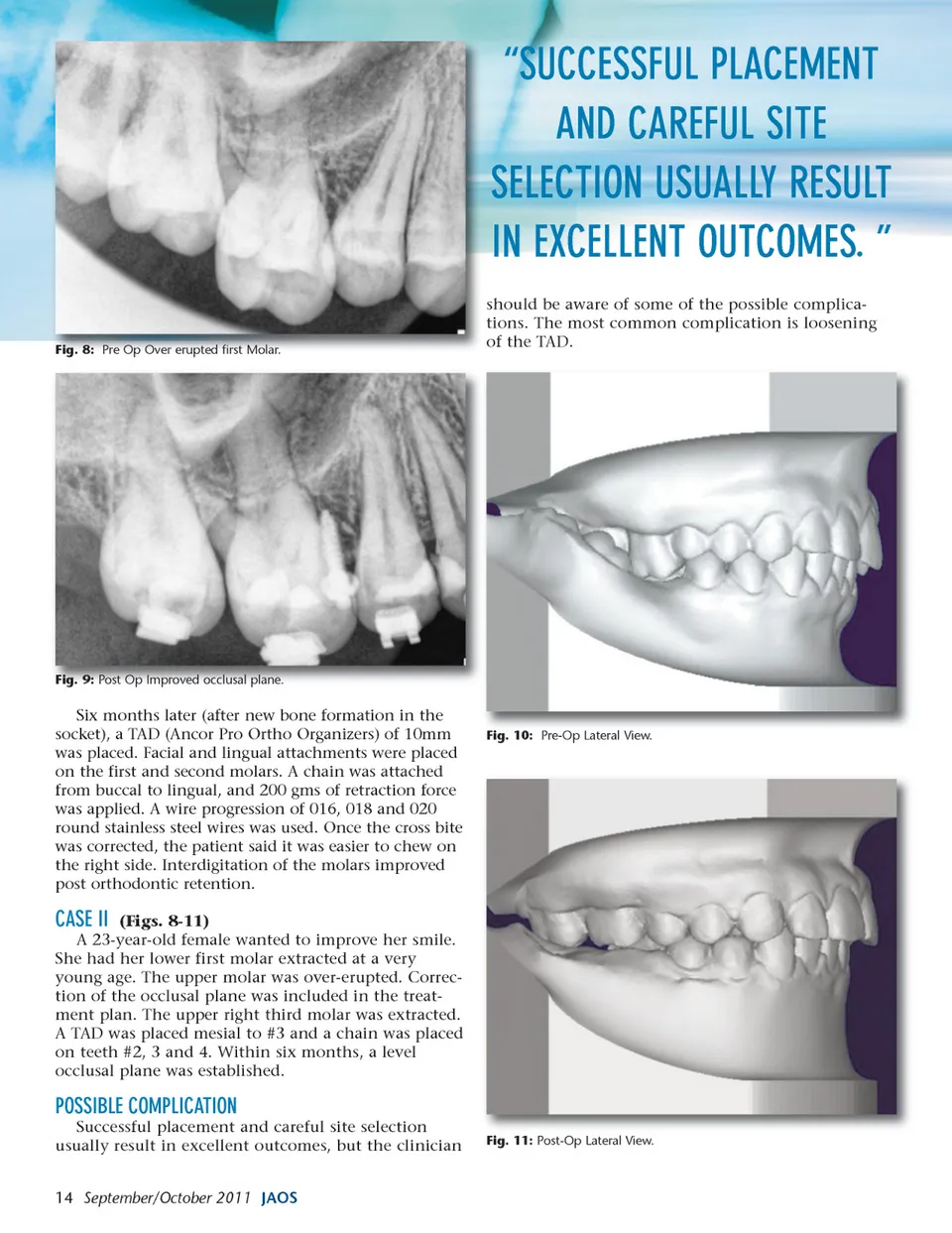
“SUCCESSFUL PLACEMENT AND CAREFUL SITE SELECTION USUALLY RESULT IN EXCELLENT OUTCOMES. ” Fig. 8: Pre Op Over erupted first Molar. should be aware of some of the possible complica-tions. The most common complication is loosening of the TAD. Fig. 9: Post Op Improved occlusal plane. Six months later (after new bone formation in the socket), a TAD (Ancor Pro Ortho Organizers) of 10mm was placed. Facial and lingual attachments were placed on the first and second molars. A chain was attached from buccal to lingual, and 200 gms of retraction force was applied. A wire progression of 016, 018 and 020 round stainless steel wires was used. Once the cross bite was corrected, the patient said it was easier to chew on the right side. Interdigitation of the molars improved post orthodontic retention. (Figs. 8-11) A 23-year-old female wanted to improve her smile. She had her lower first molar extracted at a very young age. The upper molar was over-erupted. Correc-tion of the occlusal plane was included in the treat-ment plan. The upper right third molar was extracted. A TAD was placed mesial to #3 and a chain was placed on teeth #2, 3 and 4. Within six months, a level occlusal plane was established. Fig. 10: Pre-Op Lateral View. CASE II POSSIBLE COMPLICATION Successful placement and careful site selection usually result in excellent outcomes, but the clinician 14 September/October 2011 JAOS Fig. 11: Post-Op Lateral View.
Journal of the American Orthodontic Society September-October 2011: Page 14