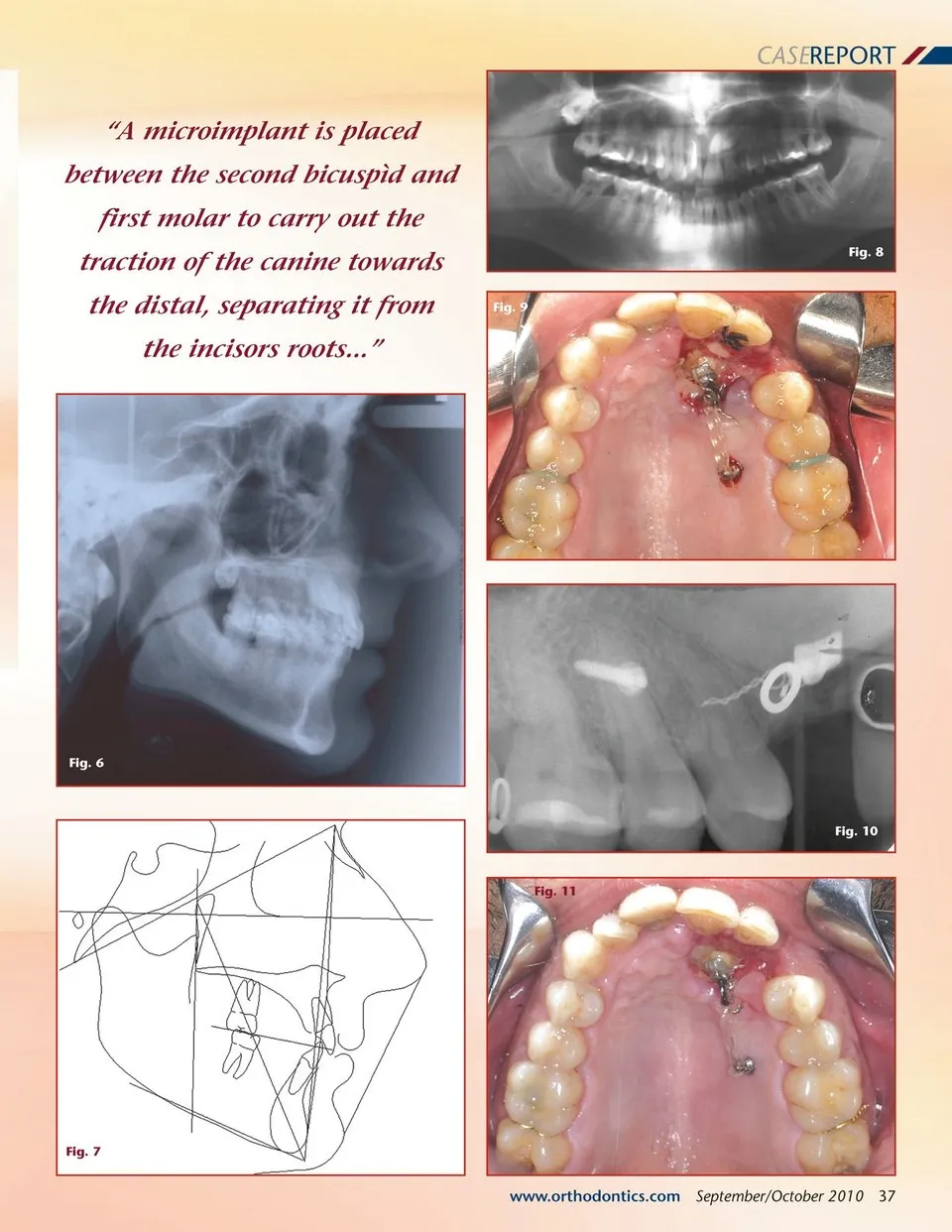
CASEREPORT Treatment of Impacted Canines Using By Pablo Echarri, DDS Microimplants Traction of impacted canines using the traditional orthodontic mechanics can provoke numerous side effects over teeth used as anchorage. To avoid this type of Figs. 1-5 undesired effect, the use of microimplants is indicated for retained canines traction. The author’s technique for microimplant usage, SARDAC (Skeletal Anchorage, Right direction, and Absolute Control) and the author’s CSW (Custom-made Straight Wire) technique are used to correct impacted canines. A 37 year old patient presented with a Class I molar malocclusion with crowding, mild rota-tions, an anterior deep bite and palatal impaction of the upper left canine. The cephalometric tracing shows a skeletal Class I malocclu-sion with mandibular retrognatia. The panoramic X-ray shows the canine in an unfavorable position due to its cusp touching the midline, and the canine’s axis angle is almost perpendicular to the incisors axis (Figs. 1 to 8). The diagnosis should be completed by a tomo-graphic study in order to determine the exact position of the canine and its relation to the roots of neighbor-ing teeth. 36 September/October 2010 JAOS Before bonding the teeth, a surgical exposure of the canine is carried out, the primary canine is extracted, and an eyelet is bonded to the impacted tooth. A microimplant is placed between the second bicuspìd and first molar to carry out the traction of the canine towards the distal, separating it from the incisors roots (Figs. 9-11). The traction is carried out using elastic chain. After having checked the effective movement of the canine, the maxillary teeth are bonded using ceramic .18” Roth prescription brackets, and a transpalatal bar with bands on the first molars and .016” NiTi archwire is also placed. The objective of this stage is to align, level and
Journal of the American Orthodontic Society September-October 2010: Page 36