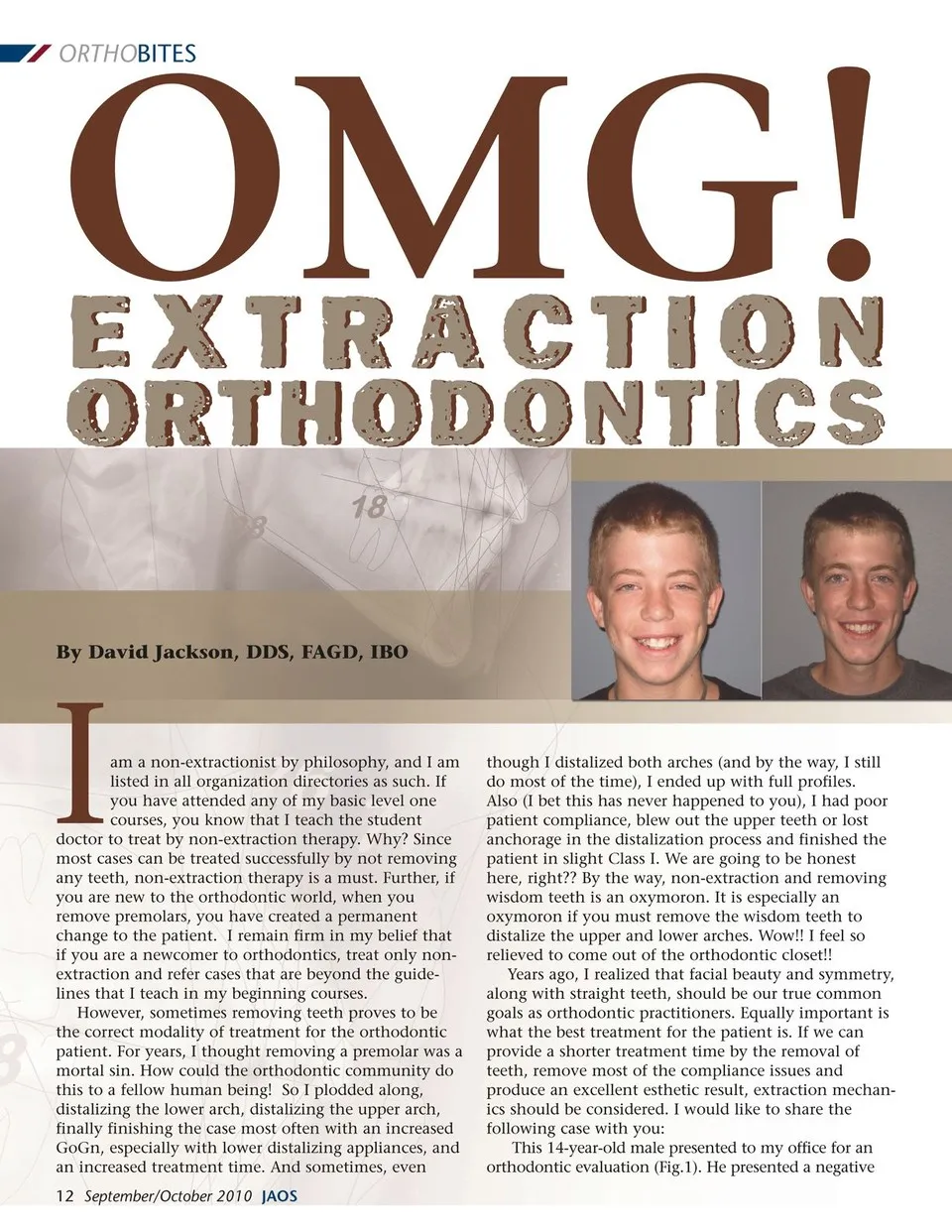
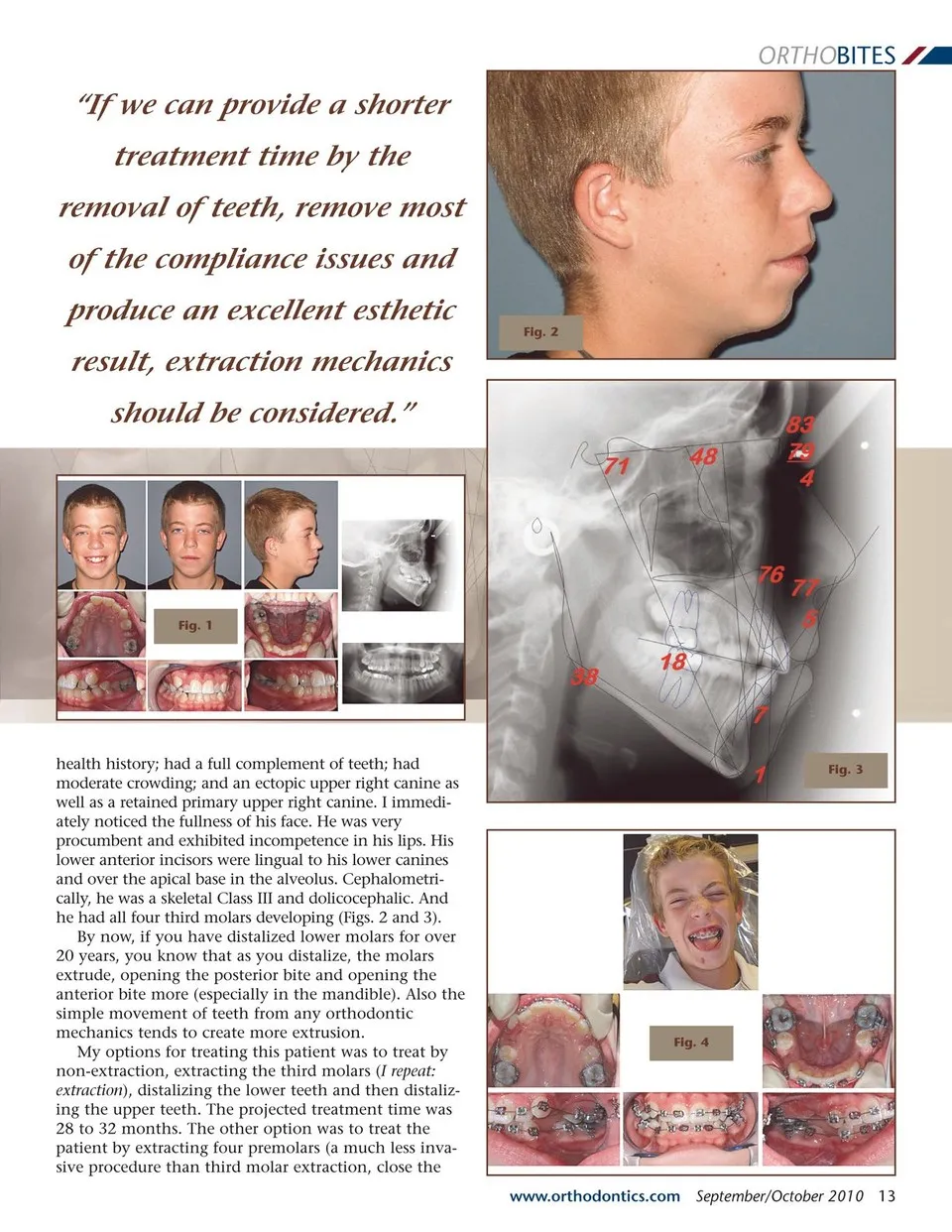
ORTHOBITES “If we can provide a shorter treatment time by the removal of teeth, remove most of the compliance issues and produce an excellent esthetic result, extraction mechanics should be considered.” Fig. 2 Fig. 1 health history; had a full complement of teeth; had moderate crowding; and an ectopic upper right canine as well as a retained primary upper right canine. I immedi-ately noticed the fullness of his face. He was very procumbent and exhibited incompetence in his lips. His lower anterior incisors were lingual to his lower canines and over the apical base in the alveolus. Cephalometri-cally, he was a skeletal Class III and dolicocephalic. And he had all four third molars developing (Figs. 2 and 3). By now, if you have distalized lower molars for over 20 years, you know that as you distalize, the molars extrude, opening the posterior bite and opening the anterior bite more (especially in the mandible). Also the simple movement of teeth from any orthodontic mechanics tends to create more extrusion. My options for treating this patient was to treat by non-extraction, extracting the third molars (I repeat: extraction), distalizing the lower teeth and then distaliz-ing the upper teeth. The projected treatment time was 28 to 32 months. The other option was to treat the patient by extracting four premolars (a much less inva-sive procedure than third molar extraction, close the Fig. 3 Fig. 4 www.orthodontics.com September/October 2010 13
Journal of the American Orthodontic Society September-October 2010: Page 13