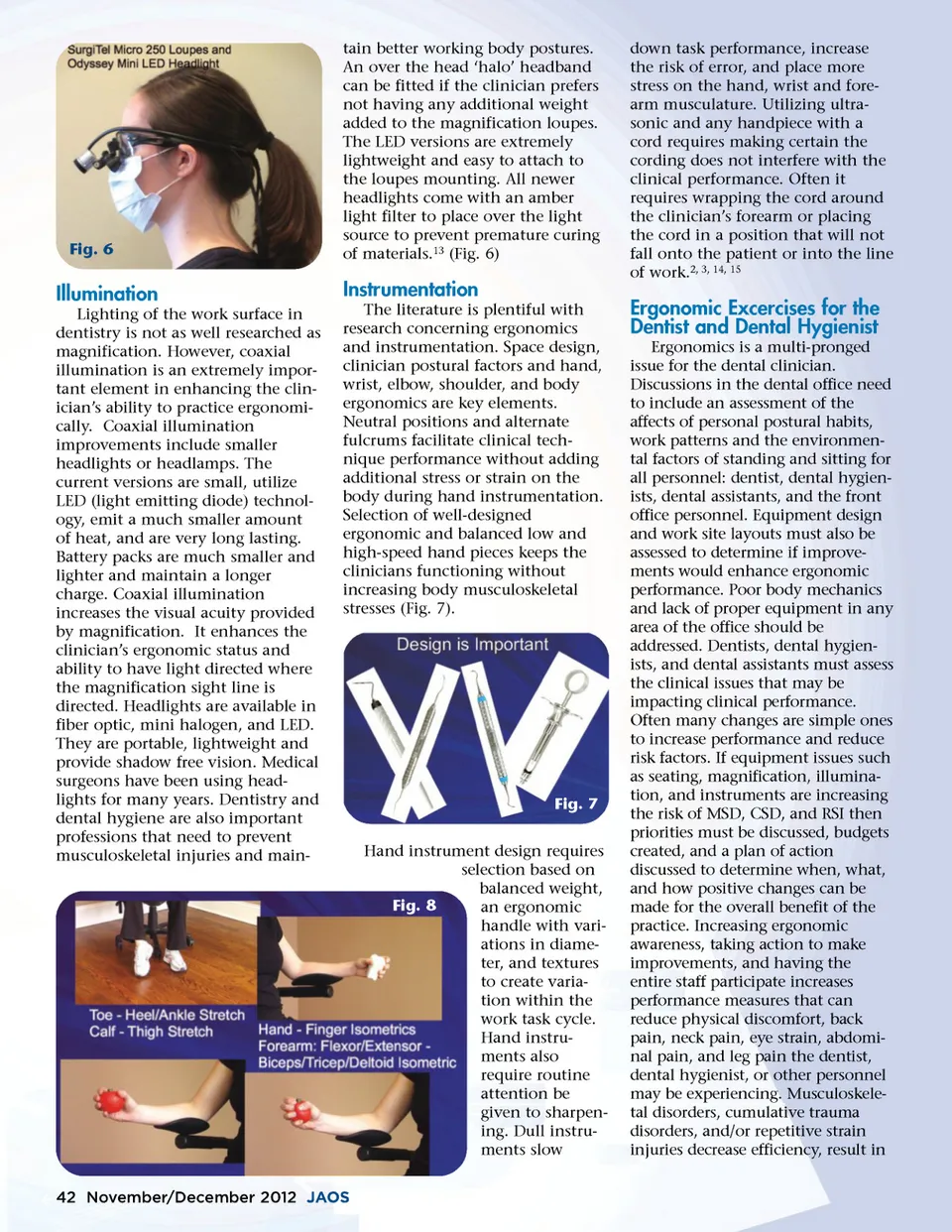
Fig. 6 tain better working body postures. An over the head ‘halo’ headband can be fitted if the clinician prefers not having any additional weight added to the magnification loupes. The LED versions are extremely lightweight and easy to attach to the loupes mounting. All newer headlights come with an amber light filter to place over the light source to prevent premature curing of materials. 13 (Fig. 6) Illumination Lighting of the work surface in dentistry is not as well researched as magnification. However, coaxial illumination is an extremely impor-tant element in enhancing the clin-ician’s ability to practice ergonomi-cally. Coaxial illumination improvements include smaller headlights or headlamps. The current versions are small, utilize LED (light emitting diode) technol-ogy, emit a much smaller amount of heat, and are very long lasting. Battery packs are much smaller and lighter and maintain a longer charge. Coaxial illumination increases the visual acuity provided by magnification. It enhances the clinician’s ergonomic status and ability to have light directed where the magnification sight line is directed. Headlights are available in fiber optic, mini halogen, and LED. They are portable, lightweight and provide shadow free vision. Medical surgeons have been using head-lights for many years. Dentistry and dental hygiene are also important professions that need to prevent musculoskeletal injuries and main-Instrumentation The literature is plentiful with research concerning ergonomics and instrumentation. Space design, clinician postural factors and hand, wrist, elbow, shoulder, and body ergonomics are key elements. Neutral positions and alternate fulcrums facilitate clinical tech-nique performance without adding additional stress or strain on the body during hand instrumentation. Selection of well-designed ergonomic and balanced low and high-speed hand pieces keeps the clinicians functioning without increasing body musculoskeletal stresses (Fig. 7). down task performance, increase the risk of error, and place more stress on the hand, wrist and fore-arm musculature. Utilizing ultra-sonic and any handpiece with a cord requires making certain the cording does not interfere with the clinical performance. Often it requires wrapping the cord around the clinician’s forearm or placing the cord in a position that will not fall onto the patient or into the line of work. 2, 3, 14, 15 Ergonomic Excercises for the Dentist and Dental Hygienist Ergonomics is a multi-pronged issue for the dental clinician. Discussions in the dental office need to include an assessment of the affects of personal postural habits, work patterns and the environmen-tal factors of standing and sitting for all personnel: dentist, dental hygien-ists, dental assistants, and the front office personnel. Equipment design and work site layouts must also be assessed to determine if improve-ments would enhance ergonomic performance. Poor body mechanics and lack of proper equipment in any area of the office should be addressed. Dentists, dental hygien-ists, and dental assistants must assess the clinical issues that may be impacting clinical performance. Often many changes are simple ones to increase performance and reduce risk factors. If equipment issues such as seating, magnification, illumina-tion, and instruments are increasing the risk of MSD, CSD, and RSI then priorities must be discussed, budgets created, and a plan of action discussed to determine when, what, and how positive changes can be made for the overall benefit of the practice. Increasing ergonomic awareness, taking action to make improvements, and having the entire staff participate increases performance measures that can reduce physical discomfort, back pain, neck pain, eye strain, abdomi-nal pain, and leg pain the dentist, dental hygienist, or other personnel may be experiencing. Musculoskele-tal disorders, cumulative trauma disorders, and/or repetitive strain injuries decrease efficiency, result in Fig. 7 Hand instrument design requires selection based on balanced weight, Fig. 8 an ergonomic handle with vari-ations in diame-ter, and textures to create varia-tion within the work task cycle. Hand instru-ments also require routine attention be given to sharpen-ing. Dull instru-ments slow 42 November/December 2012 JAOS
Journal of the American Orthodontic Society November-December 2012: Page 42