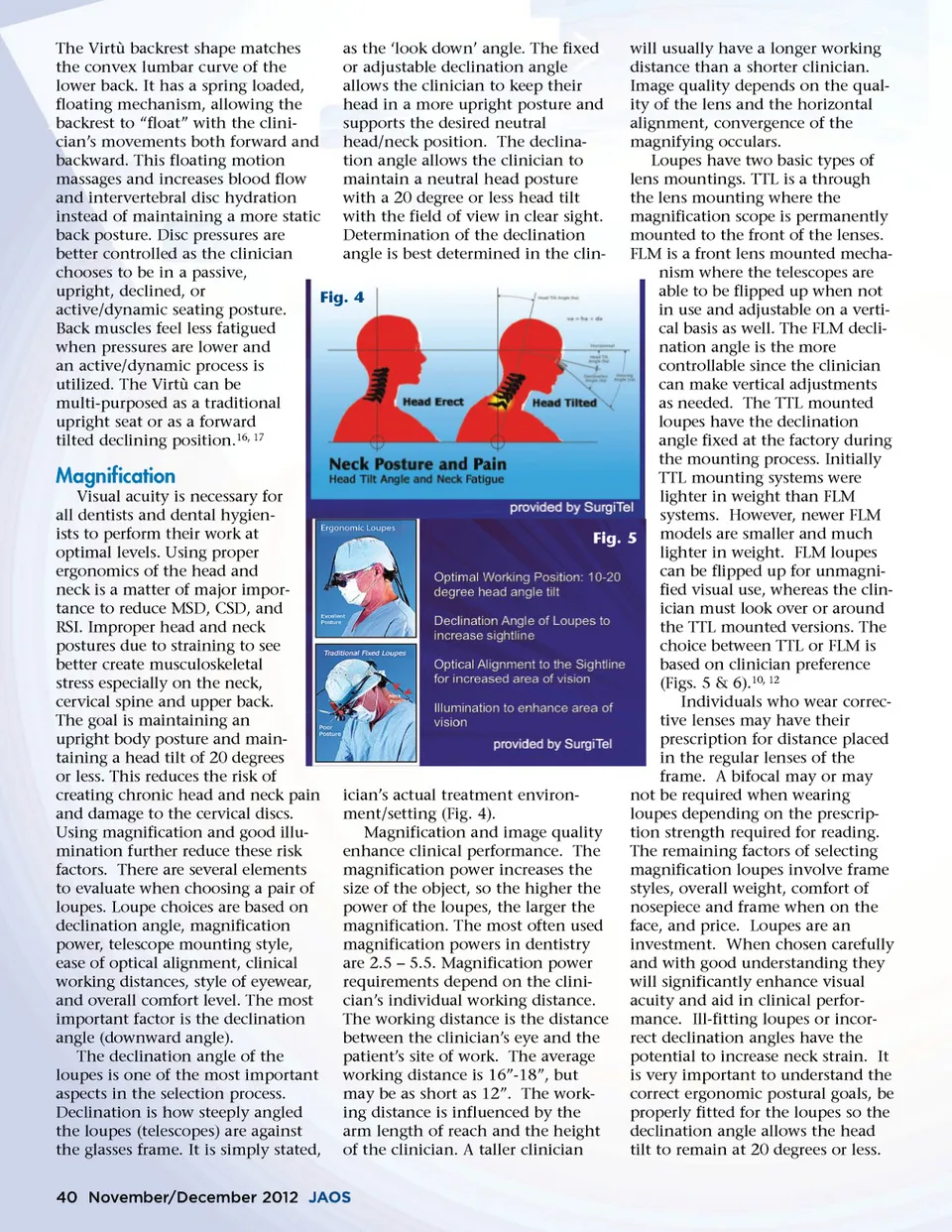
The Virtù backrest shape matches as the ‘look down’ angle. The fixed the convex lumbar curve of the or adjustable declination angle lower back. It has a spring loaded, allows the clinician to keep their floating mechanism, allowing the head in a more upright posture and backrest to “float” with the clini-supports the desired neutral cian’s movements both forward and head/neck position. The declina-backward. This floating motion tion angle allows the clinician to massages and increases blood flow maintain a neutral head posture and intervertebral disc hydration with a 20 degree or less head tilt instead of maintaining a more static with the field of view in clear sight. back posture. Disc pressures are Determination of the declination better controlled as the clinician angle is best determined in the clin-chooses to be in a passive, upright, declined, or Fig. 4 active/dynamic seating posture. Back muscles feel less fatigued when pressures are lower and an active/dynamic process is utilized. The Virtù can be multi-purposed as a traditional upright seat or as a forward tilted declining position. 16, 17 Magnification Visual acuity is necessary for all dentists and dental hygien-ists to perform their work at optimal levels. Using proper ergonomics of the head and neck is a matter of major impor-tance to reduce MSD, CSD, and RSI. Improper head and neck postures due to straining to see better create musculoskeletal stress especially on the neck, cervical spine and upper back. The goal is maintaining an upright body posture and main-taining a head tilt of 20 degrees or less. This reduces the risk of creating chronic head and neck pain and damage to the cervical discs. Using magnification and good illu-mination further reduce these risk factors. There are several elements to evaluate when choosing a pair of loupes. Loupe choices are based on declination angle, magnification power, telescope mounting style, ease of optical alignment, clinical working distances, style of eyewear, and overall comfort level. The most important factor is the declination angle (downward angle). The declination angle of the loupes is one of the most important aspects in the selection process. Declination is how steeply angled the loupes (telescopes) are against the glasses frame. It is simply stated, will usually have a longer working distance than a shorter clinician. Image quality depends on the qual-ity of the lens and the horizontal alignment, convergence of the magnifying occulars. Loupes have two basic types of lens mountings. TTL is a through the lens mounting where the magnification scope is permanently mounted to the front of the lenses. FLM is a front lens mounted mecha-nism where the telescopes are able to be flipped up when not in use and adjustable on a verti-cal basis as well. The FLM decli-nation angle is the more controllable since the clinician can make vertical adjustments as needed. The TTL mounted loupes have the declination angle fixed at the factory during the mounting process. Initially TTL mounting systems were lighter in weight than FLM systems. However, newer FLM Fig. 5 models are smaller and much lighter in weight. FLM loupes can be flipped up for unmagni-fied visual use, whereas the clin-ician must look over or around the TTL mounted versions. The choice between TTL or FLM is based on clinician preference (Figs. 5 & 6). 10, 12 Individuals who wear correc-tive lenses may have their prescription for distance placed in the regular lenses of the frame. A bifocal may or may not be required when wearing ician’s actual treatment environ-loupes depending on the prescrip-ment/setting (Fig. 4). tion strength required for reading. Magnification and image quality The remaining factors of selecting enhance clinical performance. The magnification loupes involve frame magnification power increases the styles, overall weight, comfort of size of the object, so the higher the nosepiece and frame when on the power of the loupes, the larger the magnification. The most often used face, and price. Loupes are an magnification powers in dentistry investment. When chosen carefully are 2.5 – 5.5. Magnification power and with good understanding they requirements depend on the clini-will significantly enhance visual cian’s individual working distance. acuity and aid in clinical perfor-The working distance is the distance mance. Ill-fitting loupes or incor-rect declination angles have the between the clinician’s eye and the potential to increase neck strain. It patient’s site of work. The average is very important to understand the working distance is 16”-18”, but correct ergonomic postural goals, be may be as short as 12”. The work-properly fitted for the loupes so the ing distance is influenced by the declination angle allows the head arm length of reach and the height tilt to remain at 20 degrees or less. of the clinician. A taller clinician 40 November/December 2012 JAOS
Journal of the American Orthodontic Society November-December 2012: Page 40