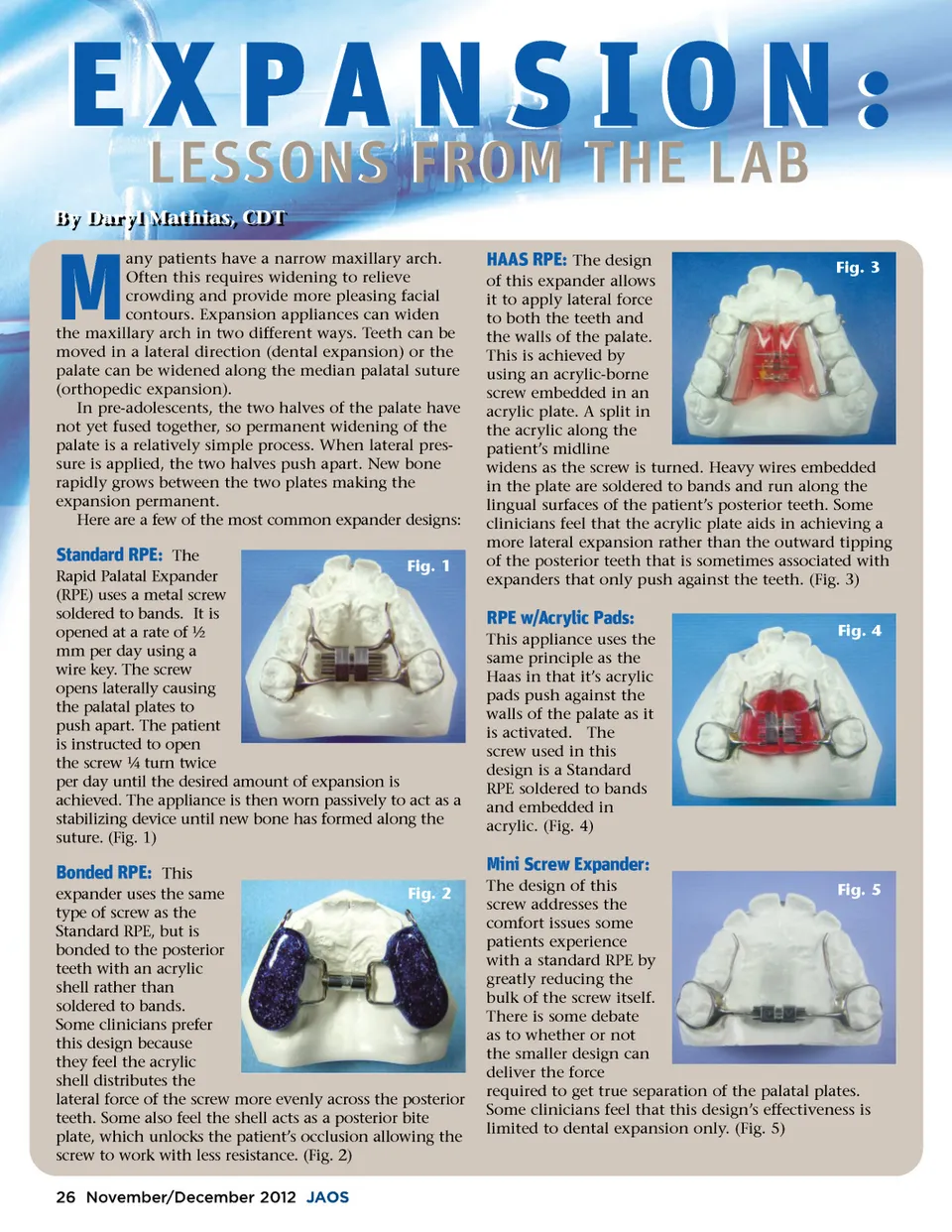
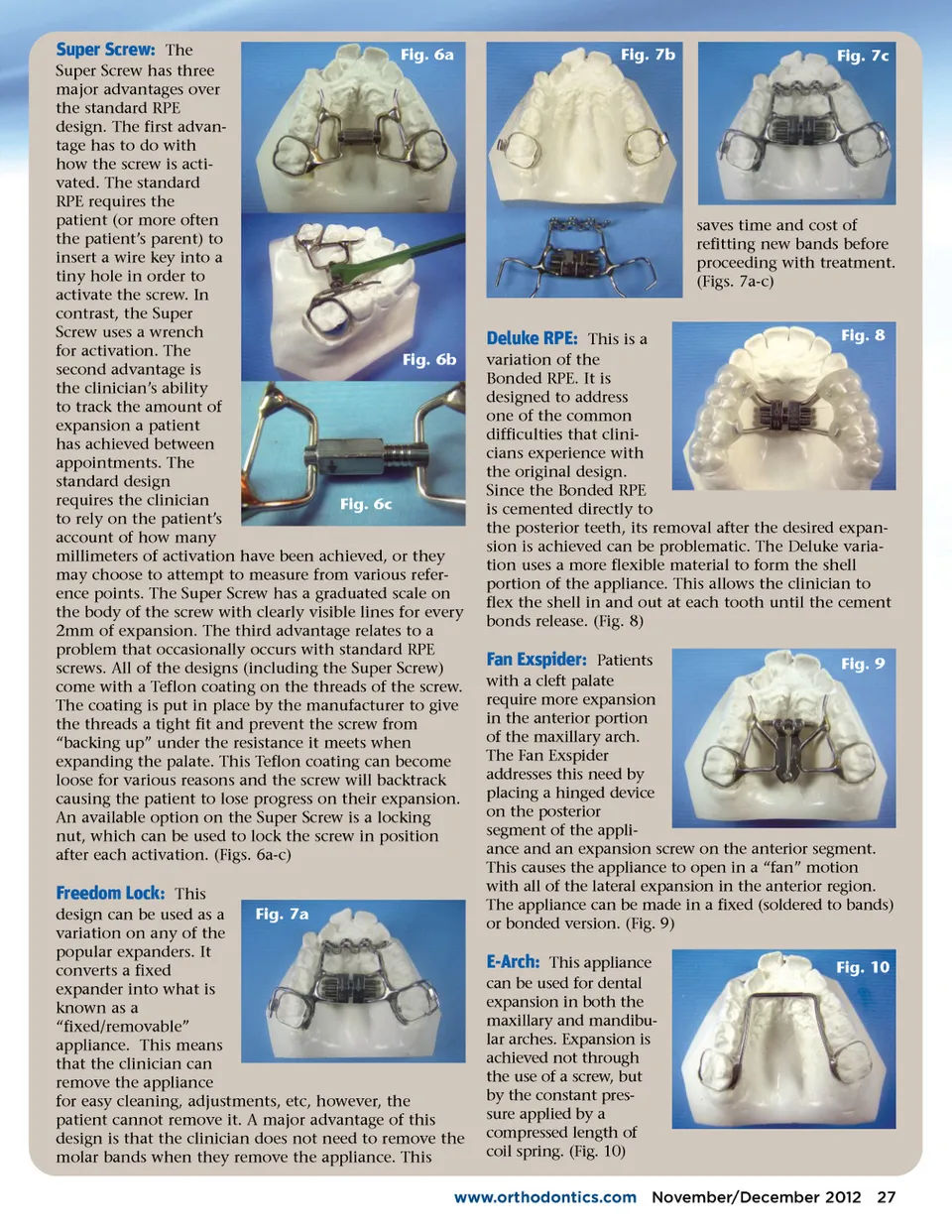
Fig. 6a Super Screw has three major advantages over the standard RPE design. The first advan-tage has to do with how the screw is acti-vated. The standard RPE requires the patient (or more often the patient’s parent) to insert a wire key into a tiny hole in order to activate the screw. In contrast, the Super Screw uses a wrench for activation. The Fig. 6b second advantage is the clinician’s ability to track the amount of expansion a patient has achieved between appointments. The standard design requires the clinician Fig. 6c to rely on the patient’s account of how many millimeters of activation have been achieved, or they may choose to attempt to measure from various refer-ence points. The Super Screw has a graduated scale on the body of the screw with clearly visible lines for every 2mm of expansion. The third advantage relates to a problem that occasionally occurs with standard RPE screws. All of the designs (including the Super Screw) come with a Teflon coating on the threads of the screw. The coating is put in place by the manufacturer to give the threads a tight fit and prevent the screw from “backing up” under the resistance it meets when expanding the palate. This Teflon coating can become loose for various reasons and the screw will backtrack causing the patient to lose progress on their expansion. An available option on the Super Screw is a locking nut, which can be used to lock the screw in position after each activation. (Figs. 6a-c) Super Screw: The Fig. 7b Fig. 7c saves time and cost of refitting new bands before proceeding with treatment. (Figs. 7a-c) Fig. 8 Deluke RPE: This is a variation of the Bonded RPE. It is designed to address one of the common difficulties that clini-cians experience with the original design. Since the Bonded RPE is cemented directly to the posterior teeth, its removal after the desired expan-sion is achieved can be problematic. The Deluke varia-tion uses a more flexible material to form the shell portion of the appliance. This allows the clinician to flex the shell in and out at each tooth until the cement bonds release. (Fig. 8) Fig. 9 with a cleft palate require more expansion in the anterior portion of the maxillary arch. The Fan Exspider addresses this need by placing a hinged device on the posterior segment of the appli-ance and an expansion screw on the anterior segment. This causes the appliance to open in a “fan” motion with all of the lateral expansion in the anterior region. The appliance can be made in a fixed (soldered to bands) or bonded version. (Fig. 9) Fan Exspider: Patients Freedom Lock: This Fig. 7a design can be used as a variation on any of the popular expanders. It converts a fixed expander into what is known as a “fixed/removable” appliance. This means that the clinician can remove the appliance for easy cleaning, adjustments, etc, however, the patient cannot remove it. A major advantage of this design is that the clinician does not need to remove the molar bands when they remove the appliance. This E-Arch: This appliance can be used for dental expansion in both the maxillary and mandibu-lar arches. Expansion is achieved not through the use of a screw, but by the constant pres-sure applied by a compressed length of coil spring. (Fig. 10) Fig. 10 www.orthodontics.com November/December 2012 27
Journal of the American Orthodontic Society November-December 2012: Page 27