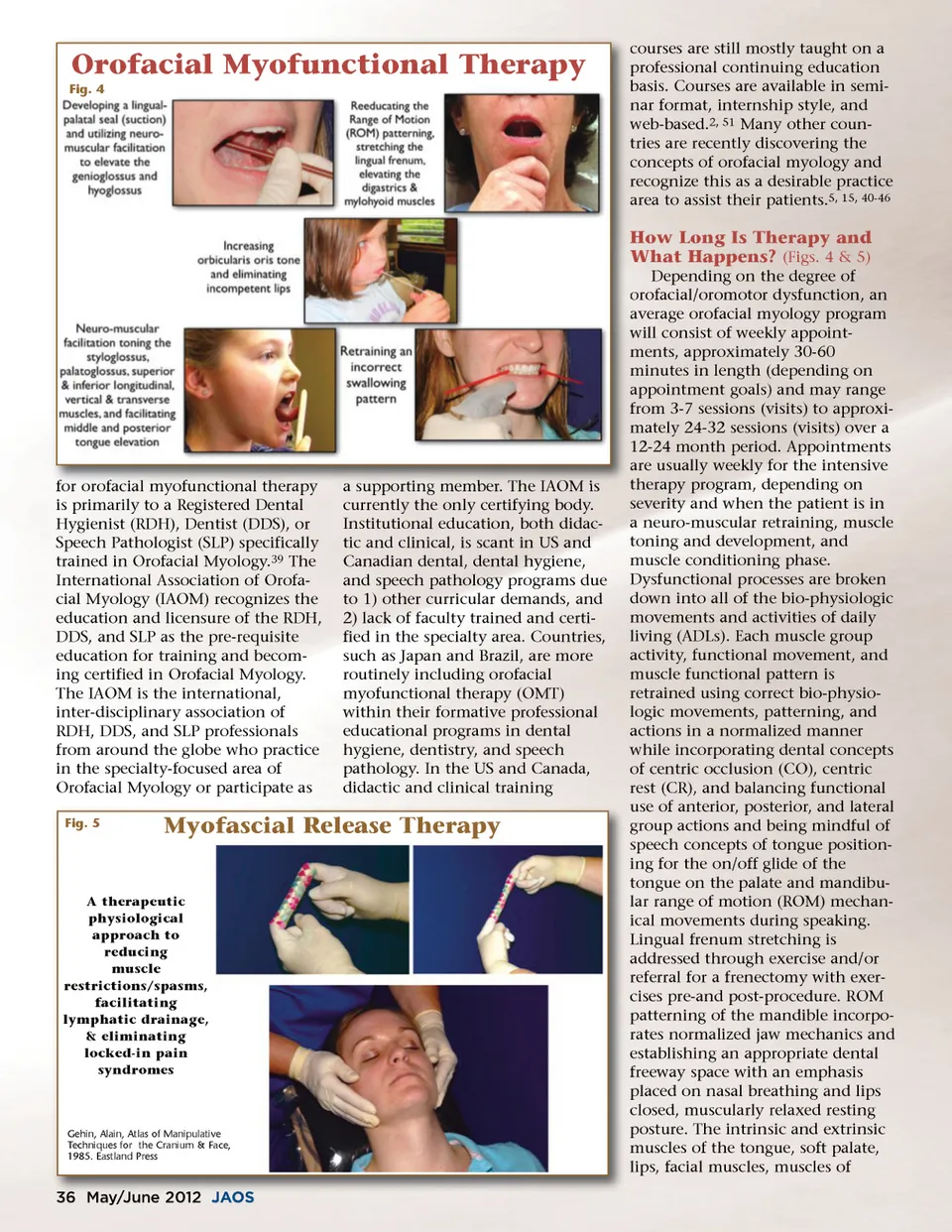
Orofacial Myofunctional Therapy Fig. 4 courses are still mostly taught on a c professional continuing education p basis. Courses are available in semi-b nar format, internship style, and n web-based. 2, 51 Many other coun-w tries are recently discovering the t concepts of orofacial myology and c recognize this as a desirable practice r area to assist their patients. 5, 15, 40-46 a H How Long Is Therapy and What Happens? (Figs. 4 & 5) W Depending on the degree of orofacial/oromotor dysfunction, an o a average orofacial myology program will w consist of weekly appoint-ments, approximately 30-60 m minutes in length (depending on m appointment goals) and may range a from 3-7 sessions (visits) to approxi-f mately 24-32 sessions (visits) over a m 12-24 month period. Appointments are a usually weekly for the intensive therapy program, depending on t severity and when the patient is in a neuro-muscular retraining, muscle toning and development, and muscle conditioning phase. Dysfunctional processes are broken down into all of the bio-physiologic movements and activities of daily living (ADLs). Each muscle group activity, functional movement, and muscle functional pattern is retrained using correct bio-physio-logic movements, patterning, and actions in a normalized manner while incorporating dental concepts of centric occlusion (CO), centric rest (CR), and balancing functional use of anterior, posterior, and lateral group actions and being mindful of speech concepts of tongue position-ing for the on/off glide of the tongue on the palate and mandibu-lar range of motion (ROM) mechan-ical movements during speaking. Lingual frenum stretching is addressed through exercise and/or referral for a frenectomy with exer-cises pre-and post-procedure. ROM patterning of the mandible incorpo-rates normalized jaw mechanics and establishing an appropriate dental freeway space with an emphasis placed on nasal breathing and lips closed, muscularly relaxed resting posture. The intrinsic and extrinsic muscles of the tongue, soft palate, lips, facial muscles, muscles of for orofacial myofunctional myofu f nctional therapy is primarily to a Registered Dental Hygienist (RDH), Dentist (DDS), or Speech Pathologist (SLP) specifically trained in Orofacial Myology. 39 The International Association of Orofa-cial Myology (IAOM) recognizes the education and licensure of the RDH, DDS, and SLP as the pre-requisite education for training and becom-ing certified in Orofacial Myology. The IAOM is the international, inter-disciplinary association of RDH, DDS, and SLP professionals from around the globe who practice in the specialty-focused area of Orofacial Myology or participate as Fig. 5 member. The IAOM is a supporting member currently the only certifying body. Institutional education, both didac-tic and clinical, is scant in US and Canadian dental, dental hygiene, and speech pathology programs due to 1) other curricular demands, and 2) lack of faculty trained and certi-fied in the specialty area. Countries, such as Japan and Brazil, are more routinely including orofacial myofunctional therapy (OMT) within their formative professional educational programs in dental hygiene, dentistry, and speech pathology. In the US and Canada, didactic and clinical training Myofascial Release Therapy A therapeutic physiological approach to reducing muscle restrictions/spasms, facilitating lymphatic drainage, & eliminating locked-in pain syndromes Gehin, Alain, Atlas of Manipulative Techniques for the Cranium & Face, 1985. Eastland Press 36 May/June May/ y / J une 2012 JAOS JAOS
Journal of the American Orthodontic Society May-June 2012: Page 36