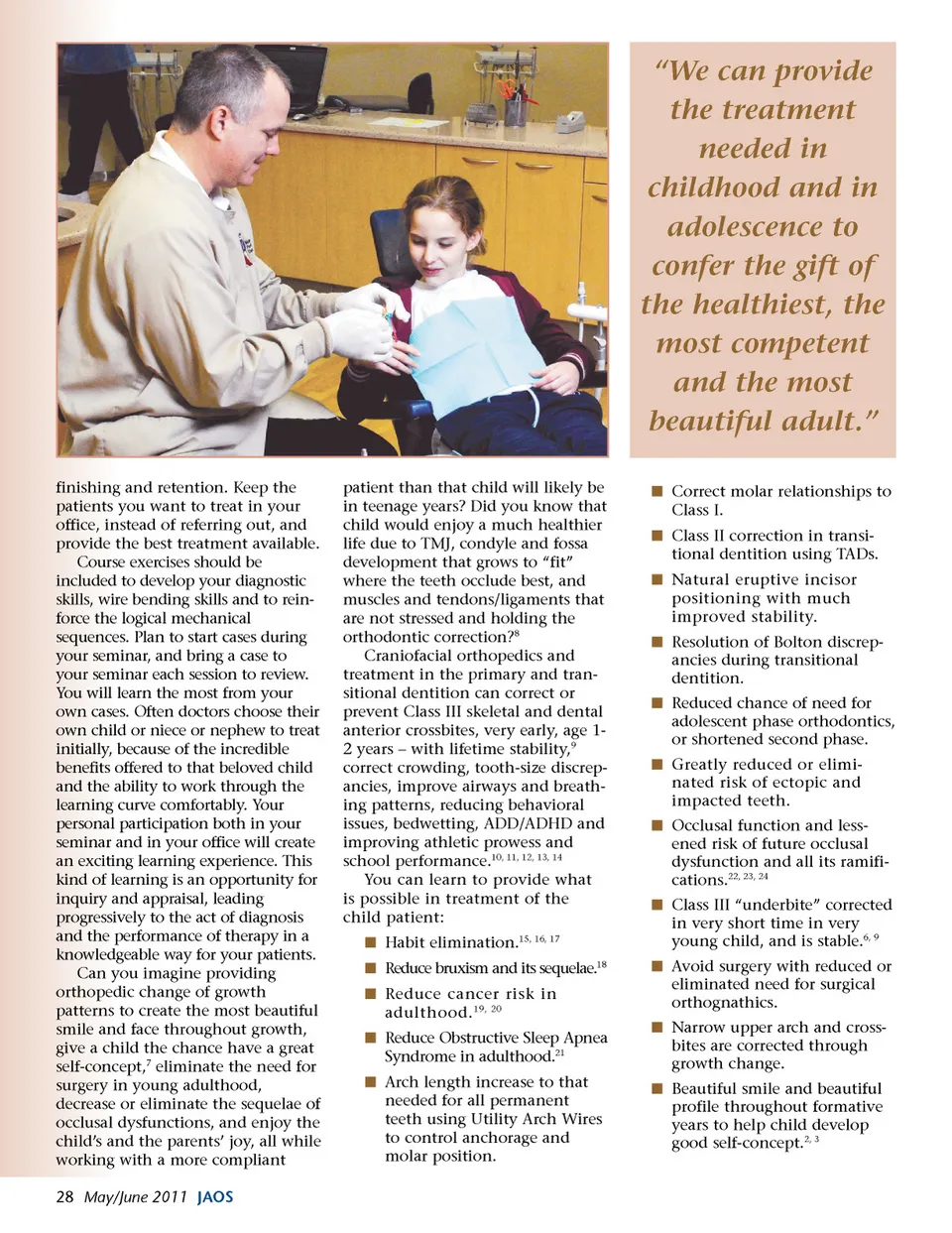
“We can provide the treatment needed in childhood and in adolescence to confer the gift of the healthiest, the most competent and the most beautiful adult.” finishing and retention. Keep the patients you want to treat in your office, instead of referring out, and provide the best treatment available. Course exercises should be included to develop your diagnostic skills, wire bending skills and to rein-force the logical mechanical sequences. Plan to start cases during your seminar, and bring a case to your seminar each session to review. You will learn the most from your own cases. Often doctors choose their own child or niece or nephew to treat initially, because of the incredible benefits offered to that beloved child and the ability to work through the learning curve comfortably. Your personal participation both in your seminar and in your office will create an exciting learning experience. This kind of learning is an opportunity for inquiry and appraisal, leading progressively to the act of diagnosis and the performance of therapy in a knowledgeable way for your patients. Can you imagine providing orthopedic change of growth patterns to create the most beautiful smile and face throughout growth, give a child the chance have a great self-concept, 7 eliminate the need for surgery in young adulthood, decrease or eliminate the sequelae of occlusal dysfunctions, and enjoy the child’s and the parents’ joy, all while working with a more compliant 28 May/June 2011 JAOS patient than that child will likely be in teenage years? Did you know that child would enjoy a much healthier life due to TMJ, condyle and fossa development that grows to “fit” where the teeth occlude best, and muscles and tendons/ligaments that are not stressed and holding the orthodontic correction? 8 Craniofacial orthopedics and treatment in the primary and tran-sitional dentition can correct or prevent Class III skeletal and dental anterior crossbites, very early, age 1-2 years – with lifetime stability, 9 correct crowding, tooth-size discrep-ancies, improve airways and breath-ing patterns, reducing behavioral issues, bedwetting, ADD/ADHD and improving athletic prowess and school performance. 10, 11, 12, 13, 14 You can learn to provide what is possible in treatment of the child patient: í Habit elimination. 15, 16, 17 í Reduce bruxism and its sequelae. 18 í Reduce cancer risk in adulthood. 19, 20 í Reduce Obstructive Sleep Apnea Syndrome in adulthood. 21 í Arch length increase to that needed for all permanent teeth using Utility Arch Wires to control anchorage and molar position. í Correct molar relationships to Class I. í Class II correction in transi-tional dentition using TADs. í Natural eruptive incisor positioning with much improved stability. í Resolution of Bolton discrep-ancies during transitional dentition. í Reduced chance of need for adolescent phase orthodontics, or shortened second phase. í Greatly reduced or elimi-nated risk of ectopic and impacted teeth. í Occlusal function and less-ened risk of future occlusal dysfunction and all its ramifi-cations. 22, 23, 24 í Class III “underbite” corrected in very short time in very young child, and is stable. 6, 9 í Avoid surgery with reduced or eliminated need for surgical orthognathics. í Narrow upper arch and cross-bites are corrected through growth change. í Beautiful smile and beautiful profile throughout formative years to help child develop good self-concept. 2, 3
Journal of the American Orthodontic Society May-June 2011: Page 28