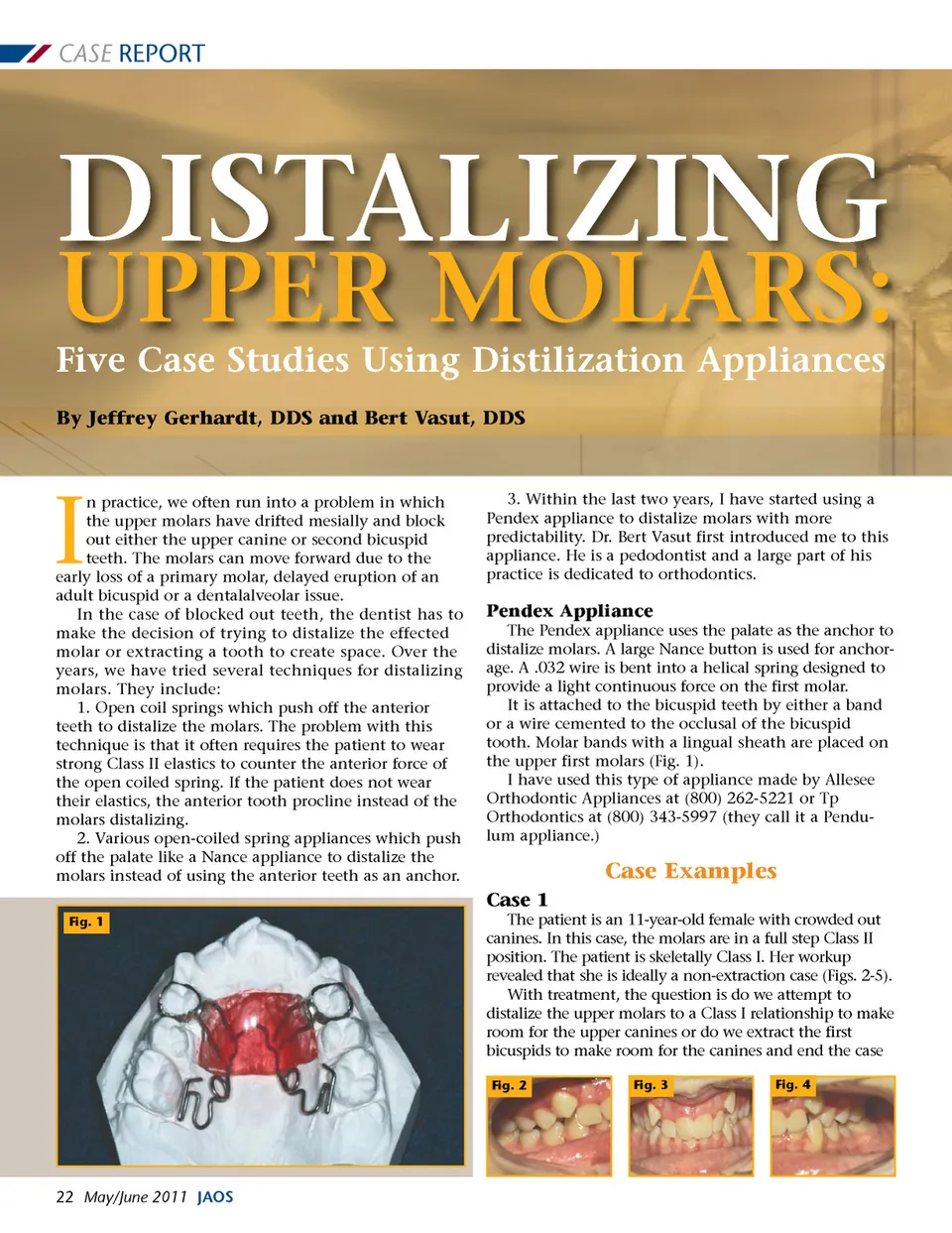
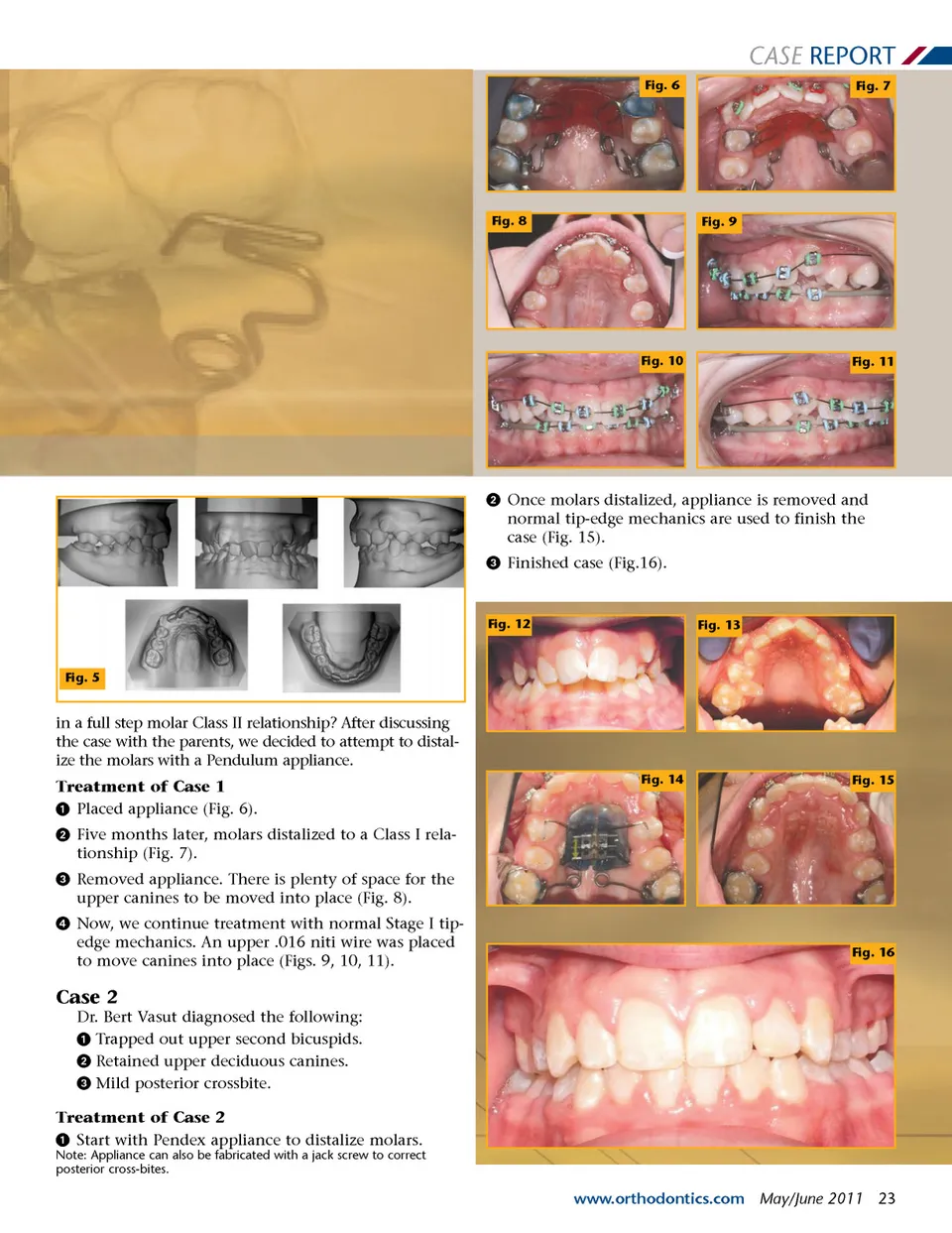
CASE REPORT DISTALIZING Five Case Studies Using Distilization Appliances By Jeffrey Gerhardt, DDS and Bert Vasut, DDS UPPER MOLARS: I n practice, we often run into a problem in which the upper molars have drifted mesially and block out either the upper canine or second bicuspid teeth. The molars can move forward due to the early loss of a primary molar, delayed eruption of an adult bicuspid or a dentalalveolar issue. In the case of blocked out teeth, the dentist has to make the decision of trying to distalize the effected molar or extracting a tooth to create space. Over the years, we have tried several techniques for distalizing molars. They include: 1. Open coil springs which push off the anterior teeth to distalize the molars. The problem with this technique is that it often requires the patient to wear strong Class II elastics to counter the anterior force of the open coiled spring. If the patient does not wear their elastics, the anterior tooth procline instead of the molars distalizing. 2. Various open-coiled spring appliances which push off the palate like a Nance appliance to distalize the molars instead of using the anterior teeth as an anchor. Fig. 1 3. Within the last two years, I have started using a Pendex appliance to distalize molars with more predictability. Dr. Bert Vasut first introduced me to this appliance. He is a pedodontist and a large part of his practice is dedicated to orthodontics. Pendex Appliance The Pendex appliance uses the palate as the anchor to distalize molars. A large Nance button is used for anchor-age. A .032 wire is bent into a helical spring designed to provide a light continuous force on the first molar. It is attached to the bicuspid teeth by either a band or a wire cemented to the occlusal of the bicuspid tooth. Molar bands with a lingual sheath are placed on the upper first molars (Fig. 1). I have used this type of appliance made by Allesee Orthodontic Appliances at (800) 262-5221 or Tp Orthodontics at (800) 343-5997 (they call it a Pendu-lum appliance.) Case Examples Case 1 The patient is an 11-year-old female with crowded out canines. In this case, the molars are in a full step Class II position. The patient is skeletally Class I. Her workup revealed that she is ideally a non-extraction case (Figs. 2-5). With treatment, the question is do we attempt to distalize the upper molars to a Class I relationship to make room for the upper canines or do we extract the first bicuspids to make room for the canines and end the case Fig. 2 Fig. 3 Fig. 4 22 May/June 2011 JAOS
Journal of the American Orthodontic Society May-June 2011: Page 22