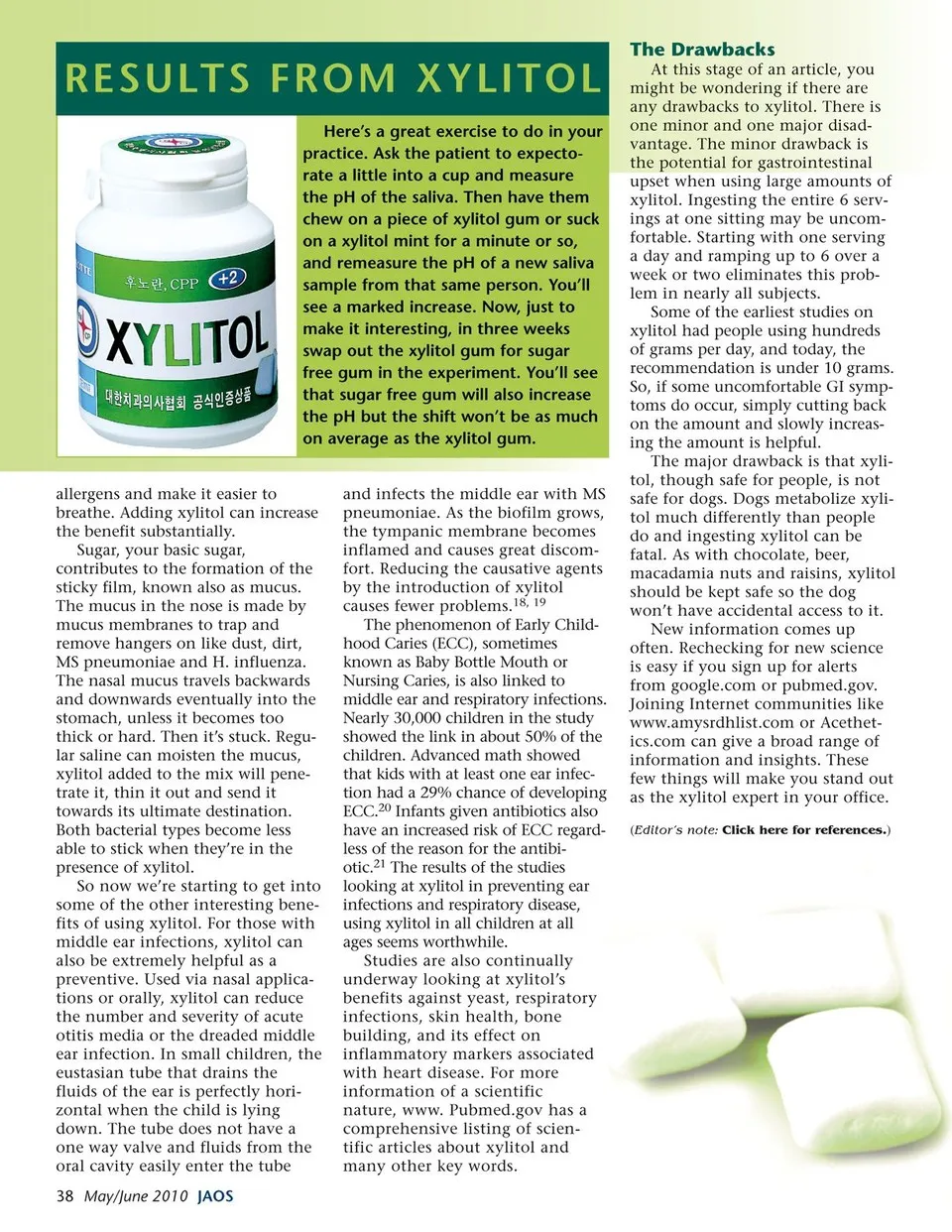
The Drawbacks RESULTS FROM XYLITOL Here’s a great exercise to do in your practice. Ask the patient to expecto- rate a little into a cup and measure the pH of the saliva. Then have them chew on a piece of xylitol gum or suck on a xylitol mint for a minute or so, and remeasure the pH of a new saliva sample from that same person. You’ll see a marked increase. Now, just to make it interesting, in three weeks swap out the xylitol gum for sugar free gum in the experiment. You’ll see that sugar free gum will also increase the pH but the shift won’t be as much on average as the xylitol gum. allergens and make it easier to breathe. Adding xylitol can increase the benefit substantially. Sugar, your basic sugar, contributes to the formation of the sticky film, known also as mucus. The mucus in the nose is made by mucus membranes to trap and remove hangers on like dust, dirt, MS pneumoniae and H. influenza. The nasal mucus travels backwards and downwards eventually into the stomach, unless it becomes too thick or hard. Then it’s stuck. Regu- lar saline can moisten the mucus, xylitol added to the mix will pene- trate it, thin it out and send it towards its ultimate destination. Both bacterial types become less able to stick when they’re in the presence of xylitol. So now we’re starting to get into some of the other interesting bene- fits of using xylitol. For those with middle ear infections, xylitol can also be extremely helpful as a preventive. Used via nasal applica- tions or orally, xylitol can reduce the number and severity of acute otitis media or the dreaded middle ear infection. In small children, the eustasian tube that drains the fluids of the ear is perfectly hori- zontal when the child is lying down. The tube does not have a one way valve and fluids from the oral cavity easily enter the tube 38 May/June 2010 JAOS and infects the middle ear with MS pneumoniae. As the biofilm grows, the tympanic membrane becomes inflamed and causes great discom- fort. Reducing the causative agents by the introduction of xylitol causes fewer problems.18, 19 The phenomenon of Early Child- hood Caries (ECC), sometimes known as Baby Bottle Mouth or Nursing Caries, is also linked to middle ear and respiratory infections. Nearly 30,000 children in the study showed the link in about 50% of the children. Advanced math showed that kids with at least one ear infec- tion had a 29% chance of developing ECC.20 Infants given antibiotics also have an increased risk of ECC regard- less of the reason for the antibi- otic.21 The results of the studies looking at xylitol in preventing ear infections and respiratory disease, using xylitol in all children at all ages seems worthwhile. Studies are also continually underway looking at xylitol’s benefits against yeast, respiratory infections, skin health, bone building, and its effect on inflammatory markers associated with heart disease. For more information of a scientific nature, www. Pubmed.gov has a comprehensive listing of scien- tific articles about xylitol and many other key words. At this stage of an article, you might be wondering if there are any drawbacks to xylitol. There is one minor and one major disad- vantage. The minor drawback is the potential for gastrointestinal upset when using large amounts of xylitol. Ingesting the entire 6 serv- ings at one sitting may be uncom- fortable. Starting with one serving a day and ramping up to 6 over a week or two eliminates this prob- lem in nearly all subjects. Some of the earliest studies on xylitol had people using hundreds of grams per day, and today, the recommendation is under 10 grams. So, if some uncomfortable GI symp- toms do occur, simply cutting back on the amount and slowly increas- ing the amount is helpful. The major drawback is that xyli- tol, though safe for people, is not safe for dogs. Dogs metabolize xyli- tol much differently than people do and ingesting xylitol can be fatal. As with chocolate, beer, macadamia nuts and raisins, xylitol should be kept safe so the dog won’t have accidental access to it. New information comes up often. Rechecking for new science is easy if you sign up for alerts from google.com or pubmed.gov. Joining Internet communities like www.amysrdhlist.com or Acethet- ics.com can give a broad range of information and insights. These few things will make you stand out as the xylitol expert in your office. (Editor’s note: Click here for references.)
Journal of the American Orthodontic Society May-June 2010: Page 38