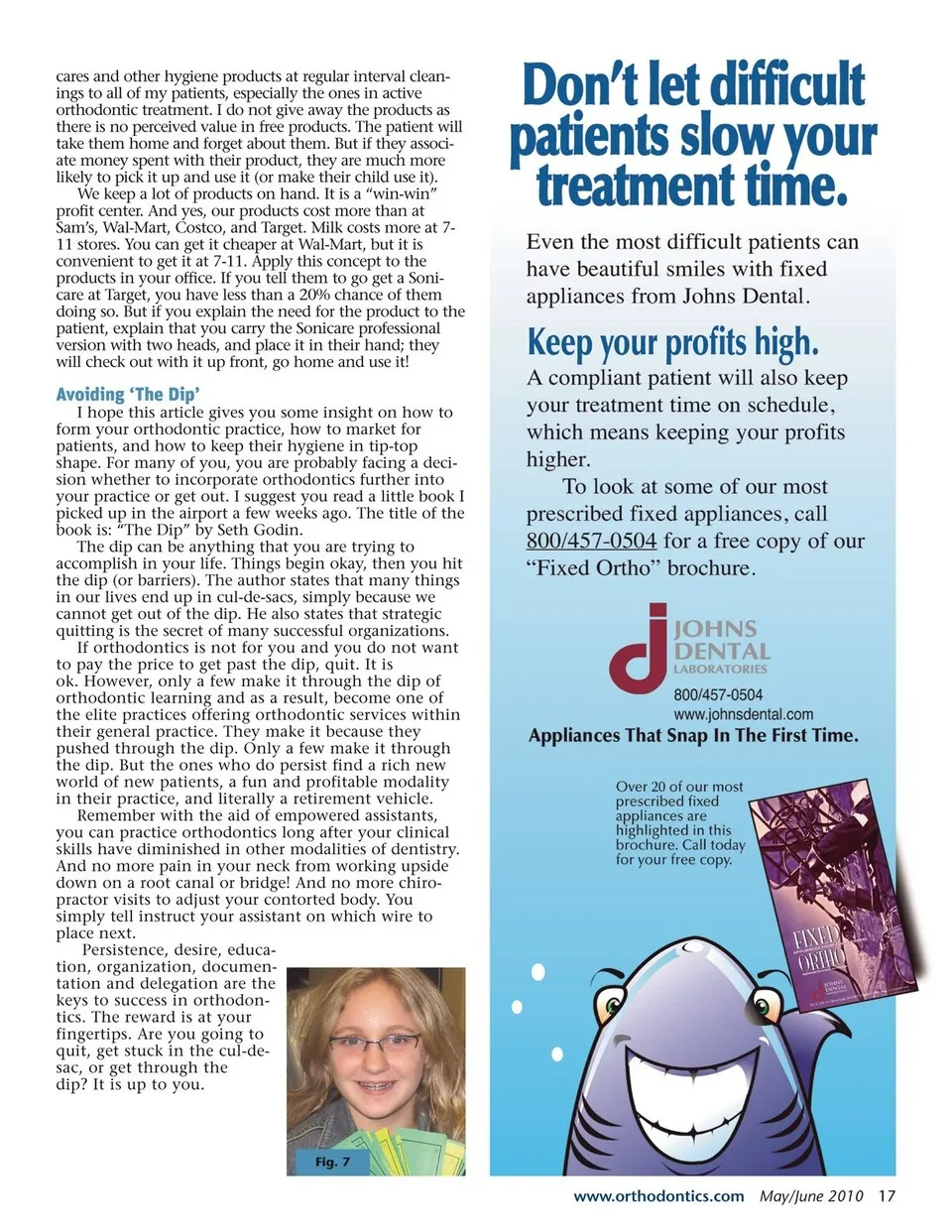
cares and other hygiene products at regular interval clean- ings to all of my patients, especially the ones in active orthodontic treatment. I do not give away the products as there is no perceived value in free products. The patient will take them home and forget about them. But if they associ- ate money spent with their product, they are much more likely to pick it up and use it (or make their child use it). We keep a lot of products on hand. It is a “win-win” profit center. And yes, our products cost more than at Sam’s, Wal-Mart, Costco, and Target. Milk costs more at 7- 11 stores. You can get it cheaper at Wal-Mart, but it is convenient to get it at 7-11. Apply this concept to the products in your office. If you tell them to go get a Soni- care at Target, you have less than a 20% chance of them doing so. But if you explain the need for the product to the patient, explain that you carry the Sonicare professional version with two heads, and place it in their hand; they will check out with it up front, go home and use it! Avoiding ‘The Dip’ I hope this article gives you some insight on how to form your orthodontic practice, how to market for patients, and how to keep their hygiene in tip-top shape. For many of you, you are probably facing a deci- sion whether to incorporate orthodontics further into your practice or get out. I suggest you read a little book I picked up in the airport a few weeks ago. The title of the book is: “The Dip” by Seth Godin. The dip can be anything that you are trying to accomplish in your life. Things begin okay, then you hit the dip (or barriers). The author states that many things in our lives end up in cul-de-sacs, simply because we cannot get out of the dip. He also states that strategic quitting is the secret of many successful organizations. If orthodontics is not for you and you do not want to pay the price to get past the dip, quit. It is ok. However, only a few make it through the dip of orthodontic learning and as a result, become one of the elite practices offering orthodontic services within their general practice. They make it because they pushed through the dip. Only a few make it through the dip. But the ones who do persist find a rich new world of new patients, a fun and profitable modality in their practice, and literally a retirement vehicle. Remember with the aid of empowered assistants, you can practice orthodontics long after your clinical skills have diminished in other modalities of dentistry. And no more pain in your neck from working upside down on a root canal or bridge! And no more chiro- practor visits to adjust your contorted body. You simply tell instruct your assistant on which wire to place next. Persistence, desire, educa- tion, organization, documen- tation and delegation are the keys to success in orthodon- tics. The reward is at your fingertips. Are you going to quit, get stuck in the cul-de- sac, or get through the dip? It is up to you. Fig. 7 www.orthodontics.com May/June 2010 17
Journal of the American Orthodontic Society May-June 2010: Page 17