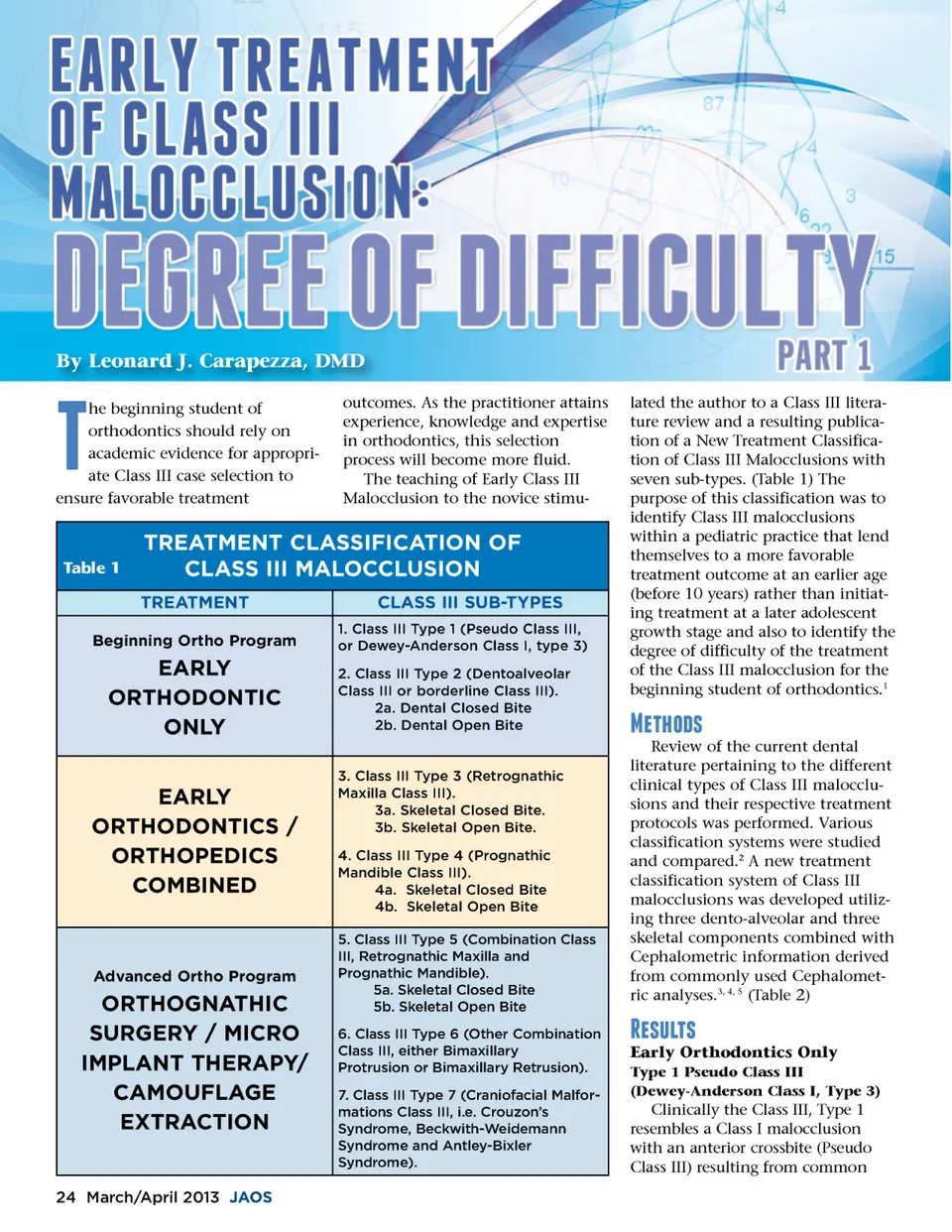
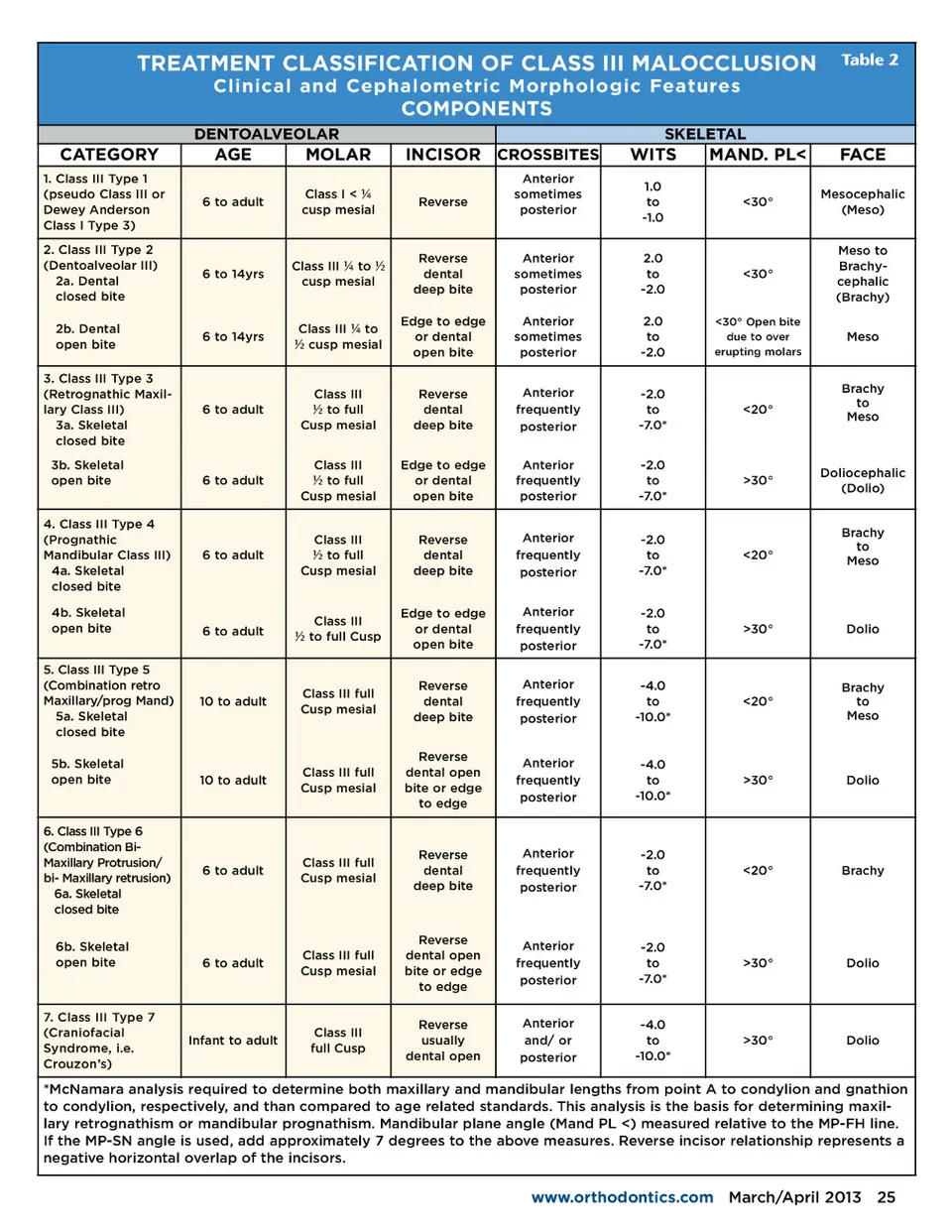
By Leonard J. Carapezza, DMD he beginning student of orthodontics should rely on academic evidence for appropri-ate Class III case selection to ensure favorable treatment ! outcomes As the practitioner attains outcomes. experience, knowledge and expertise in orthodontics, this selection process will become more fluid. The teaching of Early Class III Malocclusion to the novice stimu-Table 1 TREATMENT CLASSIFICATION OF CLASS III MALOCCLUSION TREATMENT CLASS III SUB-TYPES 1. Class III Type 1 (Pseudo Class III, or Dewey-Anderson Class I, type 3) 2. Class III Type 2 (Dentoalveolar Class III or borderline Class III). 2a. Dental Closed Bite 2b. Dental Open Bite Beginning Ortho Program EARLY ORTHODONTIC ONLY EARLY ORTHODONTICS / ORTHOPEDICS COMBINED lated the author to a Class III litera-ture review and a resulting publica-tion of a New Treatment Classifica-tion of Class III Malocclusions with seven sub-types. (Table 1) The purpose of this classification was to identify Class III malocclusions within a pediatric practice that lend themselves to a more favorable treatment outcome at an earlier age (before 10 years) rather than initiat-ing treatment at a later adolescent growth stage and also to identify the degree of difficulty of the treatment of the Class III malocclusion for the beginning student of orthodontics. 1 1.$,(* Review of the current dental literature pertaining to the different clinical types of Class III malocclu-sions and their respective treatment protocols was performed. Various classification systems were studied and compared. 2 A new treatment classification system of Class III malocclusions was developed utiliz-ing three dento-alveolar and three skeletal components combined with Cephalometric information derived from commonly used Cephalomet-ric analyses. 3, 4, 5 (Table 2) 3. Class III Type 3 (Retrognathic Maxilla Class III). 3a. Skeletal Closed Bite. 3b. Skeletal Open Bite. 4. Class III Type 4 (Prognathic Mandible Class III). 4a. Skeletal Closed Bite 4b. Skeletal Open Bite 5. Class III Type 5 (Combination Class III, Retrognathic Maxilla and Prognathic Mandible). 5a. Skeletal Closed Bite 5b. Skeletal Open Bite 6. Class III Type 6 (Other Combination Class III, either Bimaxillary Protrusion or Bimaxillary Retrusion). 7. Class III Type 7 (Craniofacial Malfor-mations Class III, i.e. Crouzon’s Syndrome, Beckwith-Weidemann Syndrome and Antley-Bixler Syndrome). Advanced Ortho Program ORTHOGNATHIC SURGERY / MICRO IMPLANT THERAPY/ CAMOUFLAGE EXTRACTION 1* +.* Early Orthodontics Only Type 1 Pseudo Class III (Dewey-Anderson Class I, Type 3) Clinically the Class III, Type 1 resembles a Class I malocclusion with an anterior crossbite (Pseudo Class III) resulting from common 24 March/April 2013 JAOS
Journal of the American Orthodontic Society March-April 2013: Page 24