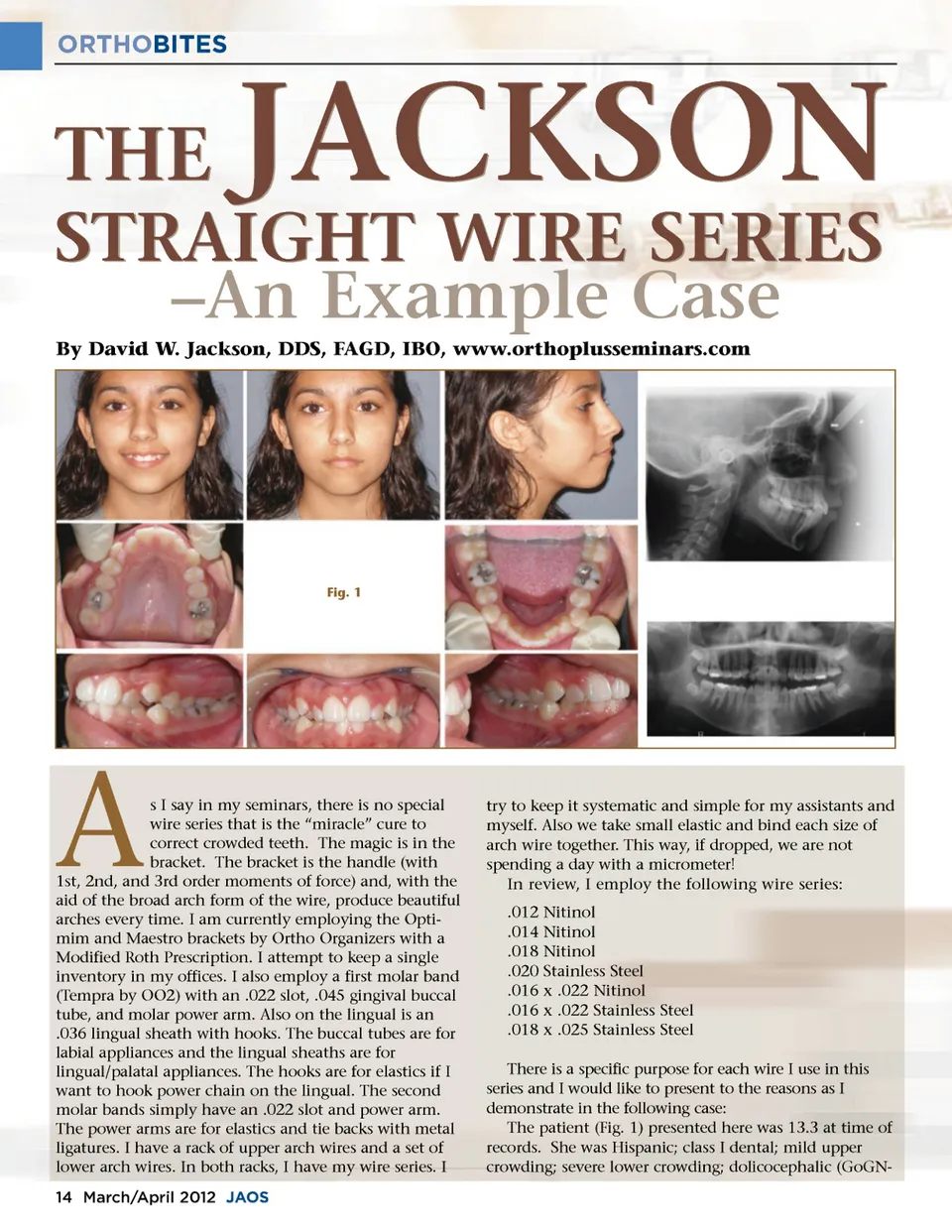
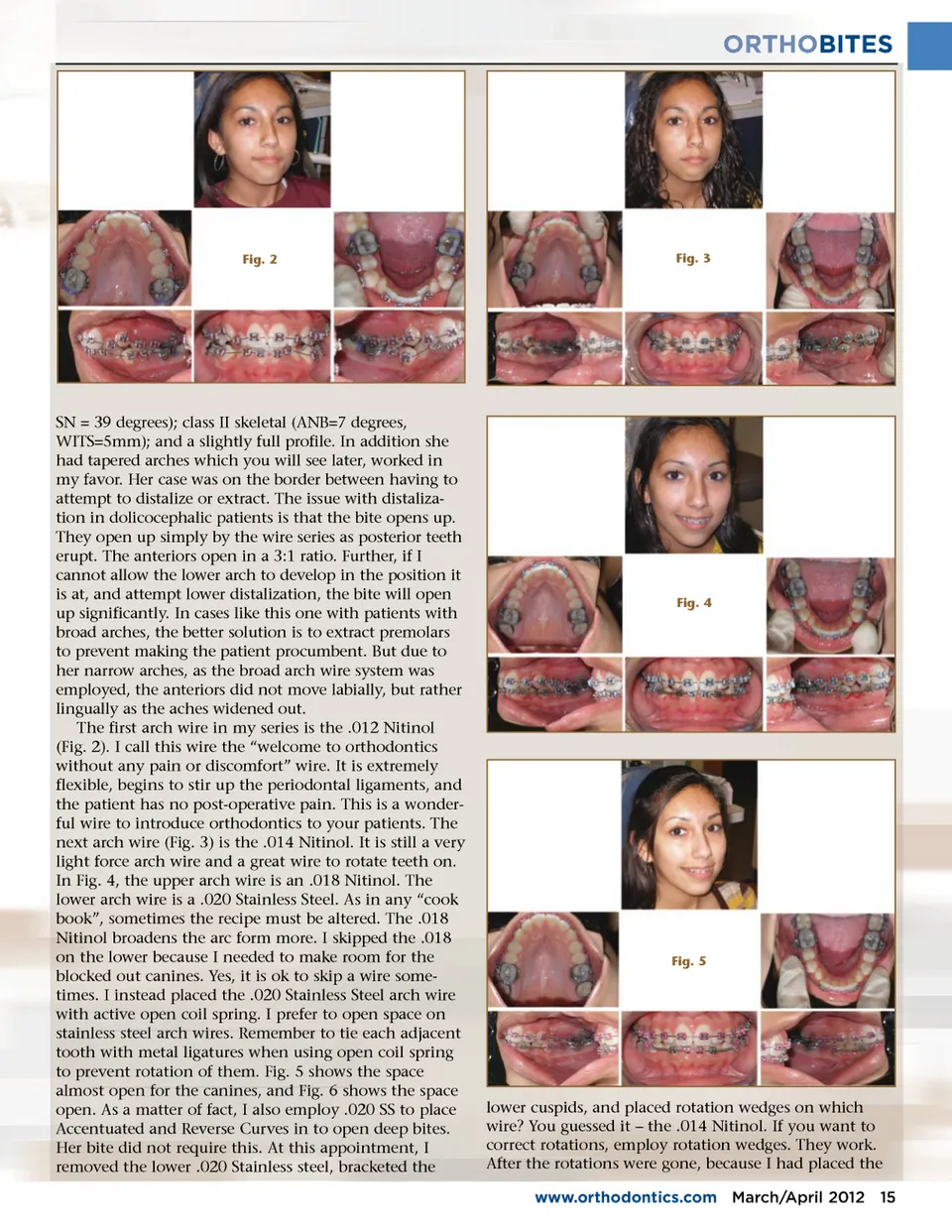
ORTHOBITES Fig. 2 Fig. 3 SN = 39 degrees); class II skeletal (ANB=7 degrees, WITS=5mm); and a slightly full profile. In addition she had tapered arches which you will see later, worked in my favor. Her case was on the border between having to attempt to distalize or extract. The issue with distaliza-tion in dolicocephalic patients is that the bite opens up. They open up simply by the wire series as posterior teeth erupt. The anteriors open in a 3:1 ratio. Further, if I cannot allow the lower arch to develop in the position it is at, and attempt lower distalization, the bite will open up significantly. In cases like this one with patients with broad arches, the better solution is to extract premolars to prevent making the patient procumbent. But due to her narrow arches, as the broad arch wire system was employed, the anteriors did not move labially, but rather lingually as the aches widened out. The first arch wire in my series is the .012 Nitinol (Fig. 2). I call this wire the “welcome to orthodontics without any pain or discomfort” wire. It is extremely flexible, begins to stir up the periodontal ligaments, and the patient has no post-operative pain. This is a wonder-ful wire to introduce orthodontics to your patients. The next arch wire (Fig. 3) is the .014 Nitinol. It is still a very light force arch wire and a great wire to rotate teeth on. In Fig. 4, the upper arch wire is an .018 Nitinol. The lower arch wire is a .020 Stainless Steel. As in any “cook book”, sometimes the recipe must be altered. The .018 Nitinol broadens the arc form more. I skipped the .018 on the lower because I needed to make room for the blocked out canines. Yes, it is ok to skip a wire some-times. I instead placed the .020 Stainless Steel arch wire with active open coil spring. I prefer to open space on stainless steel arch wires. Remember to tie each adjacent tooth with metal ligatures when using open coil spring to prevent rotation of them. Fig. 5 shows the space almost open for the canines, and Fig. 6 shows the space open. As a matter of fact, I also employ .020 SS to place Accentuated and Reverse Curves in to open deep bites. Her bite did not require this. At this appointment, I removed the lower .020 Stainless steel, bracketed the Fig. 4 Fig. 5 lower cuspids, and placed rotation wedges on which wire? You guessed it – the .014 Nitinol. If you want to correct rotations, employ rotation wedges. They work. After the rotations were gone, because I had placed the www.orthodontics.com March/April 2012 15
Journal of the American Orthodontic Society March-April 2012: Page 15