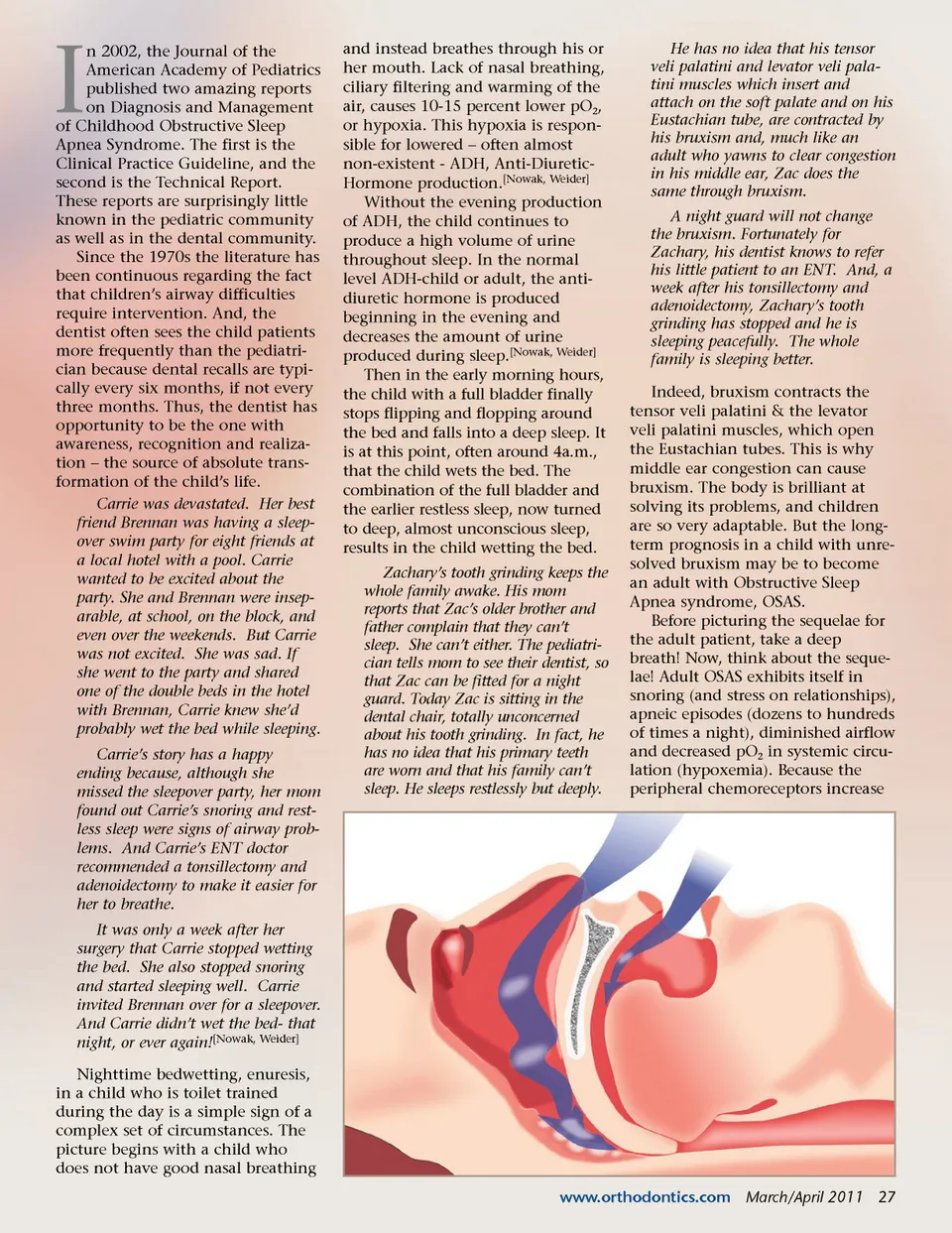
I n 2002, the Journal of the American Academy of Pediatrics published two amazing reports on Diagnosis and Management of Childhood Obstructive Sleep Apnea Syndrome. The first is the Clinical Practice Guideline, and the second is the Technical Report. These reports are surprisingly little known in the pediatric community as well as in the dental community. Since the 1970s the literature has been continuous regarding the fact that children’s airway difficulties require intervention. And, the dentist often sees the child patients more frequently than the pediatri-cian because dental recalls are typi-cally every six months, if not every three months. Thus, the dentist has opportunity to be the one with awareness, recognition and realiza-tion – the source of absolute trans-formation of the child’s life. Carrie was devastated. Her best friend Brennan was having a sleep-over swim party for eight friends at a local hotel with a pool. Carrie wanted to be excited about the party. She and Brennan were insep-arable, at school, on the block, and even over the weekends. But Carrie was not excited. She was sad. If she went to the party and shared one of the double beds in the hotel with Brennan, Carrie knew she’d probably wet the bed while sleeping. Carrie’s story has a happy ending because, although she missed the sleepover party, her mom found out Carrie’s snoring and rest-less sleep were signs of airway prob-lems. And Carrie’s ENT doctor recommended a tonsillectomy and adenoidectomy to make it easier for her to breathe. It was only a week after her surgery that Carrie stopped wetting the bed. She also stopped snoring and started sleeping well. Carrie invited Brennan over for a sleepover. And Carrie didn’t wet the bed-that night, or ever again! [Nowak, Weider] Nighttime bedwetting, enuresis, in a child who is toilet trained during the day is a simple sign of a complex set of circumstances. The picture begins with a child who does not have good nasal breathing and instead breathes through his or her mouth. Lack of nasal breathing, ciliary filtering and warming of the air, causes 10-15 percent lower pO 2 , or hypoxia. This hypoxia is respon-sible for lowered – often almost non-existent -ADH, Anti-Diuretic-Hormone production. [Nowak, Weider] Without the evening production of ADH, the child continues to produce a high volume of urine throughout sleep. In the normal level ADH-child or adult, the anti-diuretic hormone is produced beginning in the evening and decreases the amount of urine produced during sleep. [Nowak, Weider] Then in the early morning hours, the child with a full bladder finally stops flipping and flopping around the bed and falls into a deep sleep. It is at this point, often around 4a.m., that the child wets the bed. The combination of the full bladder and the earlier restless sleep, now turned to deep, almost unconscious sleep, results in the child wetting the bed. Zachary’s tooth grinding keeps the whole family awake. His mom reports that Zac’s older brother and father complain that they can’t sleep. She can’t either. The pediatri-cian tells mom to see their dentist, so that Zac can be fitted for a night guard. Today Zac is sitting in the dental chair, totally unconcerned about his tooth grinding. In fact, he has no idea that his primary teeth are worn and that his family can’t sleep. He sleeps restlessly but deeply. He has no idea that his tensor veli palatini and levator veli pala-tini muscles which insert and attach on the soft palate and on his Eustachian tube, are contracted by his bruxism and, much like an adult who yawns to clear congestion in his middle ear, Zac does the same through bruxism. A night guard will not change the bruxism. Fortunately for Zachary, his dentist knows to refer his little patient to an ENT. And, a week after his tonsillectomy and adenoidectomy, Zachary’s tooth grinding has stopped and he is sleeping peacefully. The whole family is sleeping better. Indeed, bruxism contracts the tensor veli palatini & the levator veli palatini muscles, which open the Eustachian tubes. This is why middle ear congestion can cause bruxism. The body is brilliant at solving its problems, and children are so very adaptable. But the long-term prognosis in a child with unre-solved bruxism may be to become an adult with Obstructive Sleep Apnea syndrome, OSAS. Before picturing the sequelae for the adult patient, take a deep breath! Now, think about the seque-lae! Adult OSAS exhibits itself in snoring (and stress on relationships), apneic episodes (dozens to hundreds of times a night), diminished airflow and decreased pO 2 in systemic circu-lation (hypoxemia). Because the peripheral chemoreceptors increase www.orthodontics.com March/April 2011 27
Journal of the American Orthodontic Society March-April 2011: Page 27