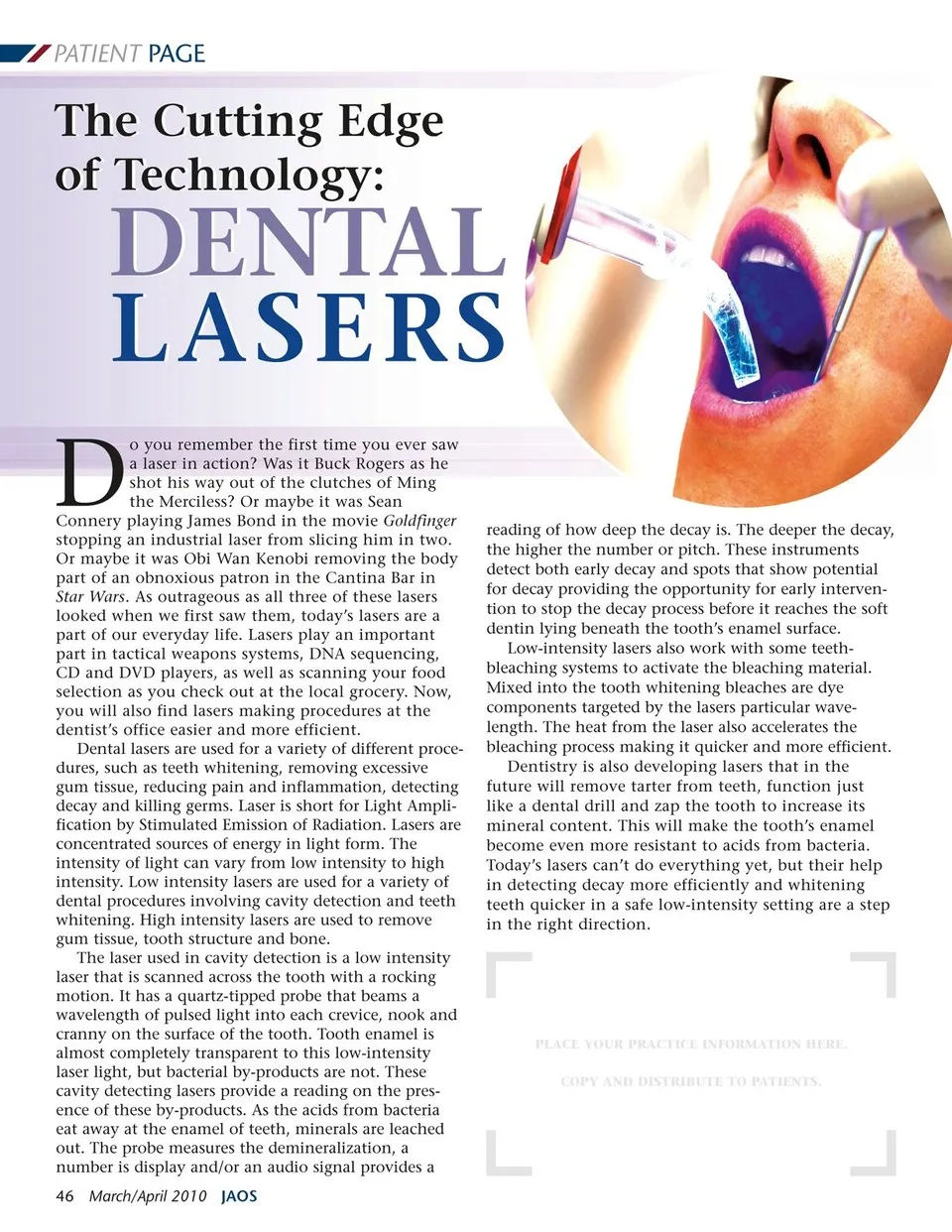
PATIENT PAGE The Cutting Edge of Technology: DENTAL LASERS D o you remember the first time you ever saw a laser in action? Was it Buck Rogers as he shot his way out of the clutches of Ming the Merciless? Or maybe it was Sean Connery playing James Bond in the movie Goldfinger stopping an industrial laser from slicing him in two. Or maybe it was Obi Wan Kenobi removing the body part of an obnoxious patron in the Cantina Bar in Star Wars. As outrageous as all three of these lasers looked when we first saw them, today’s lasers are a part of our everyday life. Lasers play an important part in tactical weapons systems, DNA sequencing, CD and DVD players, as well as scanning your food selection as you check out at the local grocery. Now, you will also find lasers making procedures at the dentist’s office easier and more efficient. Dental lasers are used for a variety of different proce- dures, such as teeth whitening, removing excessive gum tissue, reducing pain and inflammation, detecting decay and killing germs. Laser is short for Light Ampli- fication by Stimulated Emission of Radiation. Lasers are concentrated sources of energy in light form. The intensity of light can vary from low intensity to high intensity. Low intensity lasers are used for a variety of dental procedures involving cavity detection and teeth whitening. High intensity lasers are used to remove gum tissue, tooth structure and bone. The laser used in cavity detection is a low intensity laser that is scanned across the tooth with a rocking motion. It has a quartz-tipped probe that beams a wavelength of pulsed light into each crevice, nook and cranny on the surface of the tooth. Tooth enamel is almost completely transparent to this low-intensity laser light, but bacterial by-products are not. These cavity detecting lasers provide a reading on the pres- ence of these by-products. As the acids from bacteria eat away at the enamel of teeth, minerals are leached out. The probe measures the demineralization, a number is display and/or an audio signal provides a 46 March/April 2010 JAOS reading of how deep the decay is. The deeper the decay, the higher the number or pitch. These instruments detect both early decay and spots that show potential for decay providing the opportunity for early interven- tion to stop the decay process before it reaches the soft dentin lying beneath the tooth’s enamel surface. Low-intensity lasers also work with some teeth- bleaching systems to activate the bleaching material. Mixed into the tooth whitening bleaches are dye components targeted by the lasers particular wave- length. The heat from the laser also accelerates the bleaching process making it quicker and more efficient. Dentistry is also developing lasers that in the future will remove tarter from teeth, function just like a dental drill and zap the tooth to increase its mineral content. This will make the tooth’s enamel become even more resistant to acids from bacteria. Today’s lasers can’t do everything yet, but their help in detecting decay more efficiently and whitening teeth quicker in a safe low-intensity setting are a step in the right direction. PLACE YOUR PRACTICE INFORMATION HERE. COPY AND DISTRIBUTE TO PATIENTS.
Journal of the American Orthodontic Society March - April 2010: Page 46