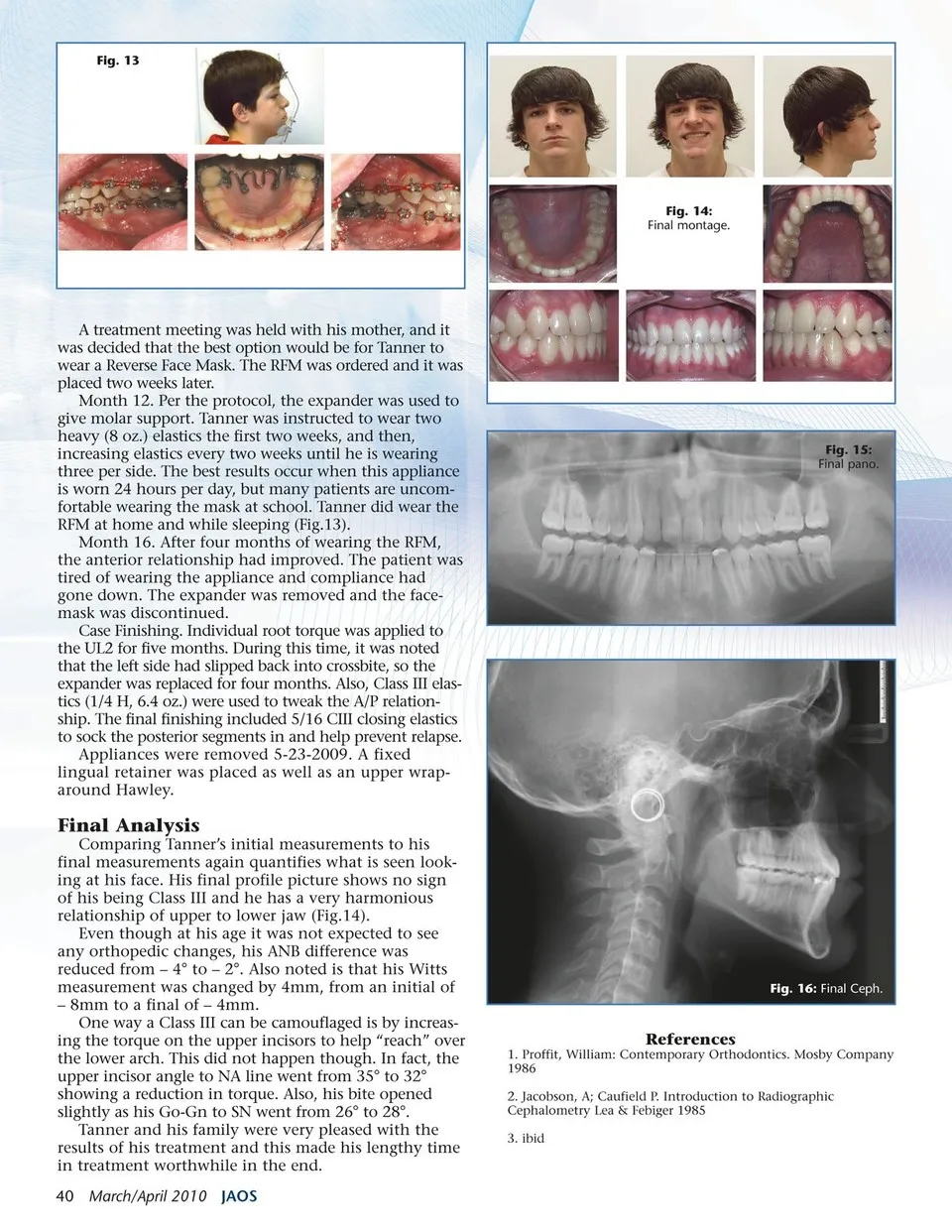
Fig. 13 Fig. 14: Final montage. A treatment meeting was held with his mother, and it was decided that the best option would be for Tanner to wear a Reverse Face Mask. The RFM was ordered and it was placed two weeks later. Month 12. Per the protocol, the expander was used to give molar support. Tanner was instructed to wear two heavy (8 oz.) elastics the first two weeks, and then, increasing elastics every two weeks until he is wearing three per side. The best results occur when this appliance is worn 24 hours per day, but many patients are uncom- fortable wearing the mask at school. Tanner did wear the RFM at home and while sleeping (Fig.13). Month 16. After four months of wearing the RFM, the anterior relationship had improved. The patient was tired of wearing the appliance and compliance had gone down. The expander was removed and the face- mask was discontinued. Case Finishing. Individual root torque was applied to the UL2 for five months. During this time, it was noted that the left side had slipped back into crossbite, so the expander was replaced for four months. Also, Class III elas- tics (1/4 H, 6.4 oz.) were used to tweak the A/P relation- ship. The final finishing included 5/16 CIII closing elastics to sock the posterior segments in and help prevent relapse. Appliances were removed 5-23-2009. A fixed lingual retainer was placed as well as an upper wrap- around Hawley. Final Analysis Comparing Tanner’s initial measurements to his final measurements again quantifies what is seen look- ing at his face. His final profile picture shows no sign of his being Class III and he has a very harmonious relationship of upper to lower jaw (Fig.14). Even though at his age it was not expected to see any orthopedic changes, his ANB difference was reduced from – 4° to – 2°. Also noted is that his Witts measurement was changed by 4mm, from an initial of – 8mm to a final of – 4mm. One way a Class III can be camouflaged is by increas- ing the torque on the upper incisors to help “reach” over the lower arch. This did not happen though. In fact, the upper incisor angle to NA line went from 35° to 32° showing a reduction in torque. Also, his bite opened slightly as his Go-Gn to SN went from 26° to 28°. Tanner and his family were very pleased with the results of his treatment and this made his lengthy time in treatment worthwhile in the end. 40 March/April 2010 JAOS References 1. Proffit, William: Contemporary Orthodontics. Mosby Company 1986 2. Jacobson, A; Caufield P. Introduction to Radiographic Cephalometry Lea & Febiger 1985 3. ibid Fig. 15: Final pano. Fig. 16: Final Ceph.
Journal of the American Orthodontic Society March - April 2010: Page 40