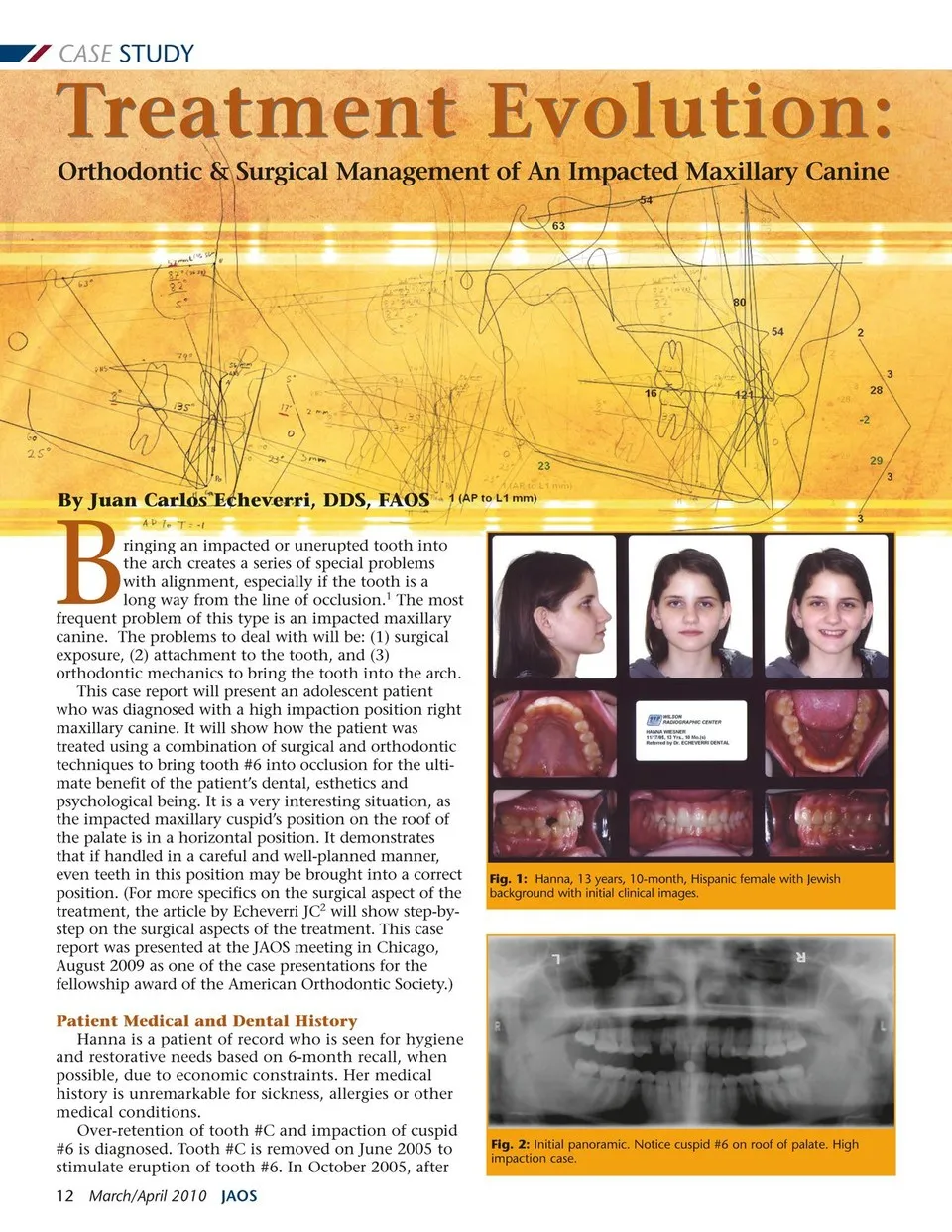
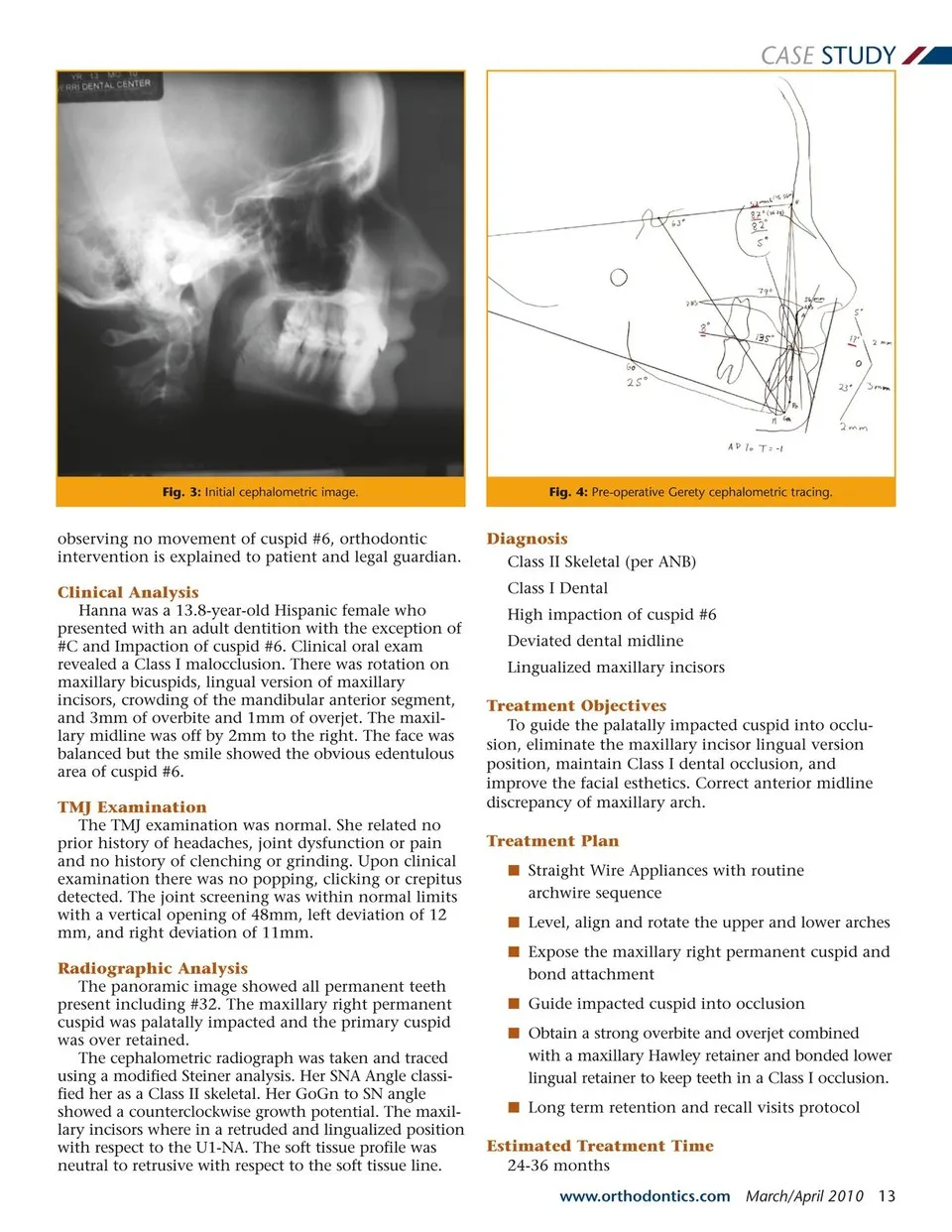
CASE STUDY Fig. 3: Initial cephalometric image. observing no movement of cuspid #6, orthodontic intervention is explained to patient and legal guardian. Clinical Analysis Hanna was a 13.8-year-old Hispanic female who presented with an adult dentition with the exception of #C and Impaction of cuspid #6. Clinical oral exam revealed a Class I malocclusion. There was rotation on maxillary bicuspids, lingual version of maxillary incisors, crowding of the mandibular anterior segment, and 3mm of overbite and 1mm of overjet. The maxil- lary midline was off by 2mm to the right. The face was balanced but the smile showed the obvious edentulous area of cuspid #6. TMJ Examination The TMJ examination was normal. She related no prior history of headaches, joint dysfunction or pain and no history of clenching or grinding. Upon clinical examination there was no popping, clicking or crepitus detected. The joint screening was within normal limits with a vertical opening of 48mm, left deviation of 12 mm, and right deviation of 11mm. Radiographic Analysis The panoramic image showed all permanent teeth present including #32. The maxillary right permanent cuspid was palatally impacted and the primary cuspid was over retained. The cephalometric radiograph was taken and traced using a modified Steiner analysis. Her SNA Angle classi- fied her as a Class II skeletal. Her GoGn to SN angle showed a counterclockwise growth potential. The maxil- lary incisors where in a retruded and lingualized position with respect to the U1-NA. The soft tissue profile was neutral to retrusive with respect to the soft tissue line. Fig. 4: Pre-operative Gerety cephalometric tracing. Diagnosis Class II Skeletal (per ANB) Class I Dental High impaction of cuspid #6 Deviated dental midline Lingualized maxillary incisors Treatment Objectives To guide the palatally impacted cuspid into occlu- sion, eliminate the maxillary incisor lingual version position, maintain Class I dental occlusion, and improve the facial esthetics. Correct anterior midline discrepancy of maxillary arch. Treatment Plan Straight Wire Appliances with routine archwire sequence Level, align and rotate the upper and lower arches Expose the maxillary right permanent cuspid and bond attachment Guide impacted cuspid into occlusion Obtain a strong overbite and overjet combined with a maxillary Hawley retainer and bonded lower lingual retainer to keep teeth in a Class I occlusion. Long term retention and recall visits protocol Estimated Treatment Time 24-36 months www.orthodontics.com March/April 2010 13
Journal of the American Orthodontic Society March - April 2010: Page 13