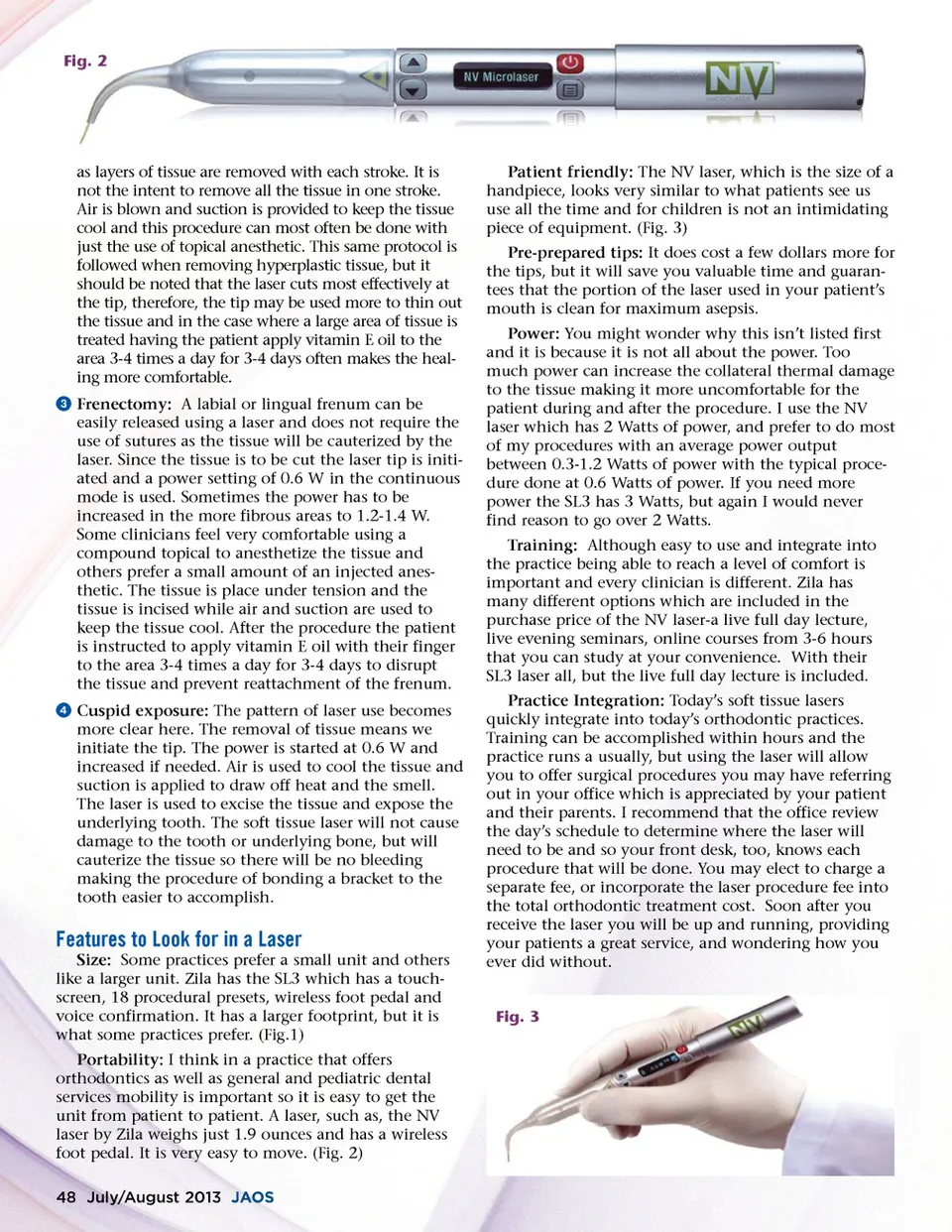
Fig. 2 as layers of tissue are removed with each stroke. It is not the intent to remove all the tissue in one stroke. Air is blown and suction is provided to keep the tissue cool and this procedure can most often be done with just the use of topical anesthetic. This same protocol is followed when removing hyperplastic tissue, but it should be noted that the laser cuts most effectively at the tip, therefore, the tip may be used more to thin out the tissue and in the case where a large area of tissue is treated having the patient apply vitamin E oil to the area 3-4 times a day for 3-4 days often makes the heal-ing more comfortable. ᕣ Frenectomy: A labial or lingual frenum can be easily released using a laser and does not require the use of sutures as the tissue will be cauterized by the laser. Since the tissue is to be cut the laser tip is initi-ated and a power setting of 0.6 W in the continuous mode is used. Sometimes the power has to be increased in the more fibrous areas to 1.2-1.4 W. Some clinicians feel very comfortable using a compound topical to anesthetize the tissue and others prefer a small amount of an injected anes-thetic. The tissue is place under tension and the tissue is incised while air and suction are used to keep the tissue cool. After the procedure the patient is instructed to apply vitamin E oil with their finger to the area 3-4 times a day for 3-4 days to disrupt the tissue and prevent reattachment of the frenum. ᕤ Cuspid exposure: The pattern of laser use becomes more clear here. The removal of tissue means we initiate the tip. The power is started at 0.6 W and increased if needed. Air is used to cool the tissue and suction is applied to draw off heat and the smell. The laser is used to excise the tissue and expose the underlying tooth. The soft tissue laser will not cause damage to the tooth or underlying bone, but will cauterize the tissue so there will be no bleeding making the procedure of bonding a bracket to the tooth easier to accomplish. Patient friendly: The NV laser, which is the size of a handpiece, looks very similar to what patients see us use all the time and for children is not an intimidating piece of equipment. (Fig. 3) Pre-prepared tips: It does cost a few dollars more for the tips, but it will save you valuable time and guaran-tees that the portion of the laser used in your patient’s mouth is clean for maximum asepsis. Power: You might wonder why this isn’t listed first and it is because it is not all about the power. Too much power can increase the collateral thermal damage to the tissue making it more uncomfortable for the patient during and after the procedure. I use the NV laser which has 2 Watts of power, and prefer to do most of my procedures with an average power output between 0.3-1.2 Watts of power with the typical proce-dure done at 0.6 Watts of power. If you need more power the SL3 has 3 Watts, but again I would never find reason to go over 2 Watts. Training: Although easy to use and integrate into the practice being able to reach a level of comfort is important and every clinician is different. Zila has many different options which are included in the purchase price of the NV laser-a live full day lecture, live evening seminars, online courses from 3-6 hours that you can study at your convenience. With their SL3 laser all, but the live full day lecture is included. Practice Integration: Today’s soft tissue lasers quickly integrate into today’s orthodontic practices. Training can be accomplished within hours and the practice runs a usually, but using the laser will allow you to offer surgical procedures you may have referring out in your office which is appreciated by your patient and their parents. I recommend that the office review the day’s schedule to determine where the laser will need to be and so your front desk, too, knows each procedure that will be done. You may elect to charge a separate fee, or incorporate the laser procedure fee into the total orthodontic treatment cost. Soon after you receive the laser you will be up and running, providing your patients a great service, and wondering how you ever did without. Features to Look for in a Laser Size: Some practices prefer a small unit and others like a larger unit. Zila has the SL3 which has a touch-screen, 18 procedural presets, wireless foot pedal and voice confirmation. It has a larger footprint, but it is what some practices prefer. (Fig.1) Portability: I think in a practice that offers orthodontics as well as general and pediatric dental services mobility is important so it is easy to get the unit from patient to patient. A laser, such as, the NV laser by Zila weighs just 1.9 ounces and has a wireless foot pedal. It is very easy to move. (Fig. 2) 48 July/August 2013 JAOS Fig. 3
Journal of the American Orthodontic Society July-August 2013 Buyer's Guide: Page 48