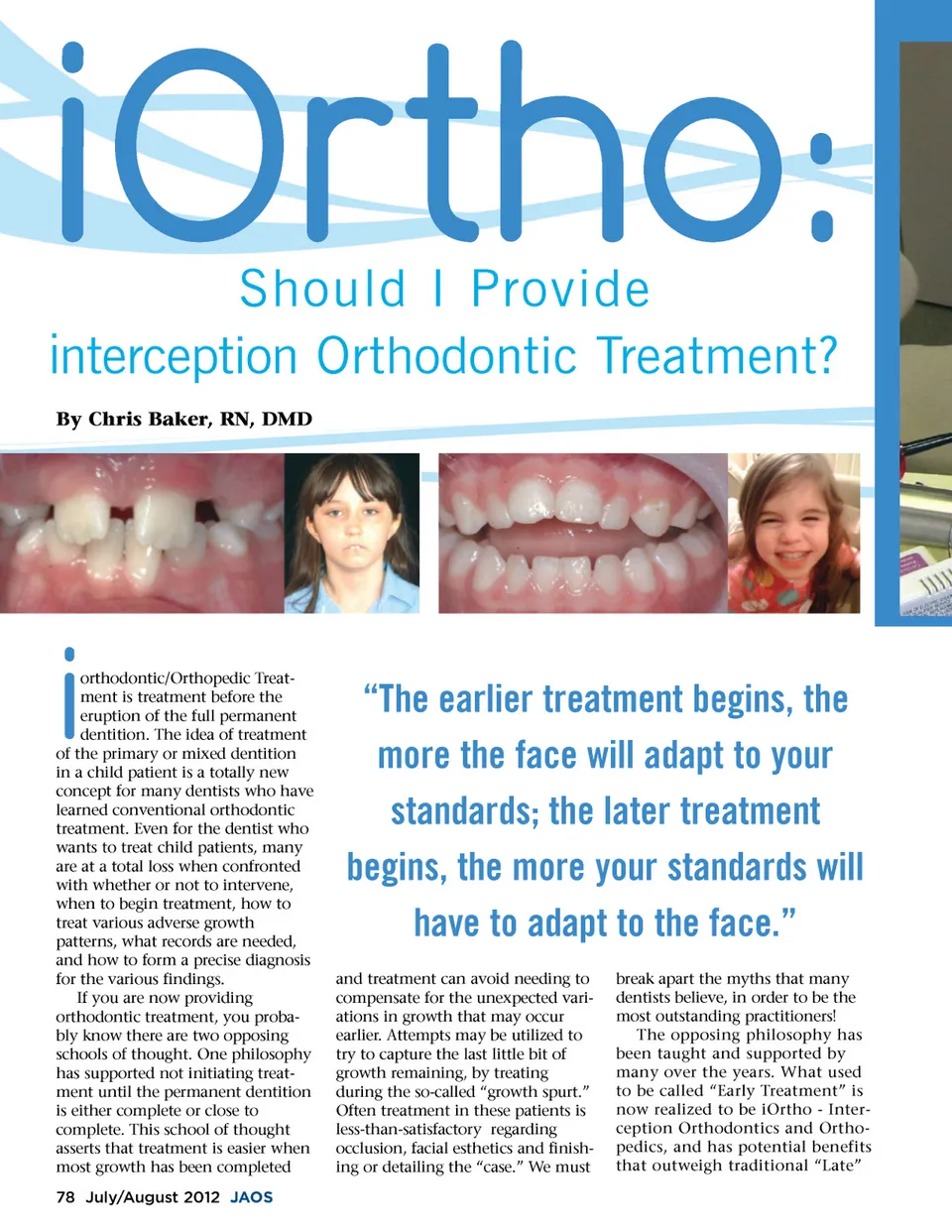
iOrtho: Should I Provide i nterception Orthodontic Treatment? By Chris Baker, RN, DMD orthodontic/Orthopedic Treat-ment is treatment before the eruption of the full permanent dentition. The idea of treatment of the primary or mixed dentition in a child patient is a totally new concept for many dentists who have learned conventional orthodontic treatment. Even for the dentist who wants to treat child patients, many are at a total loss when confronted with whether or not to intervene, when to begin treatment, how to treat various adverse growth patterns, what records are needed, and how to form a precise diagnosis for the various findings. If you are now providing orthodontic treatment, you proba-bly know there are two opposing schools of thought. One philosophy has supported not initiating treat-ment until the permanent dentition is either complete or close to complete. This school of thought asserts that treatment is easier when most growth has been completed 78 July/August 2012 JAOS i “The earlier treatment begins, the more the face will adapt to your standards; the later treatment begins, the more your standards will have to adapt to the face.” and treatment can avoid needing to compensate for the unexpected vari-ations in growth that may occur earlier. Attempts may be utilized to try to capture the last little bit of growth remaining, by treating during the so-called “growth spurt.” Often treatment in these patients is less-than-satisfactory regarding occlusion, facial esthetics and finish-ing or detailing the “case.” We must break apart the myths that many dentists believe, in order to be the most outstanding practitioners! The opposing philosophy has been taught and supported by many over the years. What used to be called “Early Treatment” is now realized to be iOrtho -Inter-ception Orthodontics and Ortho-pedics, and has potential benefits that outweigh traditional “Late”
Journal of the American Orthodontic Society July-August 2012 Buyer's Guide: Page 78