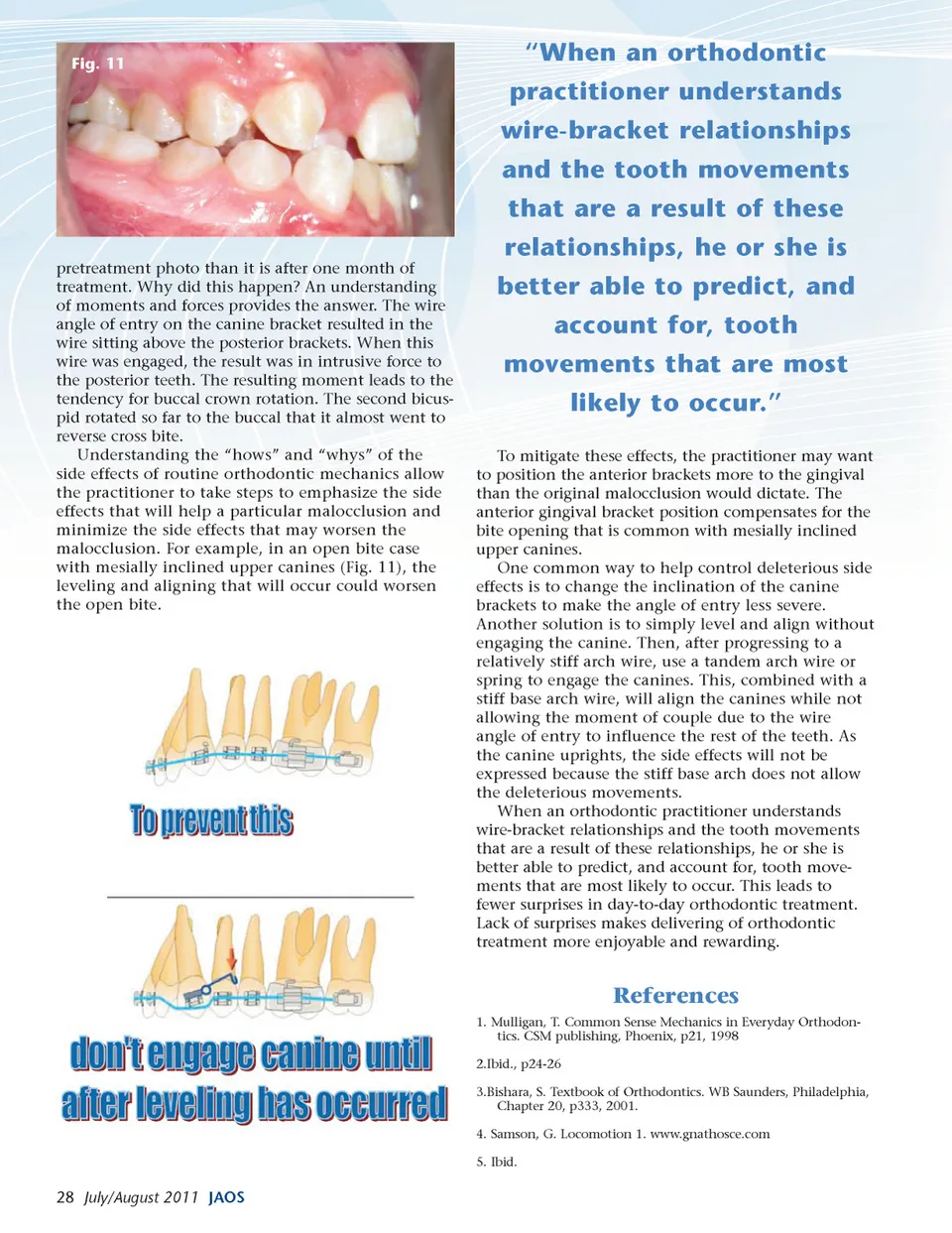
Fig. 11 “When an orthodontic practitioner understands wire-bracket relationships and the tooth movements that are a result of these relationships, he or she is pretreatment photo than it is after one month of treatment. Why did this happen? An understanding of moments and forces provides the answer. The wire angle of entry on the canine bracket resulted in the wire sitting above the posterior brackets. When this wire was engaged, the result was in intrusive force to the posterior teeth. The resulting moment leads to the tendency for buccal crown rotation. The second bicus-pid rotated so far to the buccal that it almost went to reverse cross bite. Understanding the “hows” and “whys” of the side effects of routine orthodontic mechanics allow the practitioner to take steps to emphasize the side effects that will help a particular malocclusion and minimize the side effects that may worsen the malocclusion. For example, in an open bite case with mesially inclined upper canines (Fig. 11), the leveling and aligning that will occur could worsen the open bite. better able to predict, and account for, tooth movements that are most likely to occur.” To mitigate these effects, the practitioner may want to position the anterior brackets more to the gingival than the original malocclusion would dictate. The anterior gingival bracket position compensates for the bite opening that is common with mesially inclined upper canines. One common way to help control deleterious side effects is to change the inclination of the canine brackets to make the angle of entry less severe. Another solution is to simply level and align without engaging the canine. Then, after progressing to a relatively stiff arch wire, use a tandem arch wire or spring to engage the canines. This, combined with a stiff base arch wire, will align the canines while not allowing the moment of couple due to the wire angle of entry to influence the rest of the teeth. As the canine uprights, the side effects will not be expressed because the stiff base arch does not allow the deleterious movements. When an orthodontic practitioner understands wire-bracket relationships and the tooth movements that are a result of these relationships, he or she is better able to predict, and account for, tooth move-ments that are most likely to occur. This leads to fewer surprises in day-to-day orthodontic treatment. Lack of surprises makes delivering of orthodontic treatment more enjoyable and rewarding. References 1. Mulligan, T. Common Sense Mechanics in Everyday Orthodon-tics. CSM publishing, Phoenix, p21, 1998 2.Ibid., p24-26 3.Bishara, S. Textbook of Orthodontics. WB Saunders, Philadelphia, Chapter 20, p333, 2001. 4. Samson, G. Locomotion 1. www.gnathosce.com 5. Ibid. 28 July/August 2011 JAOS
Journal of the American Orthodontic Society July-August 2011-Buyer's Guide: Page 28