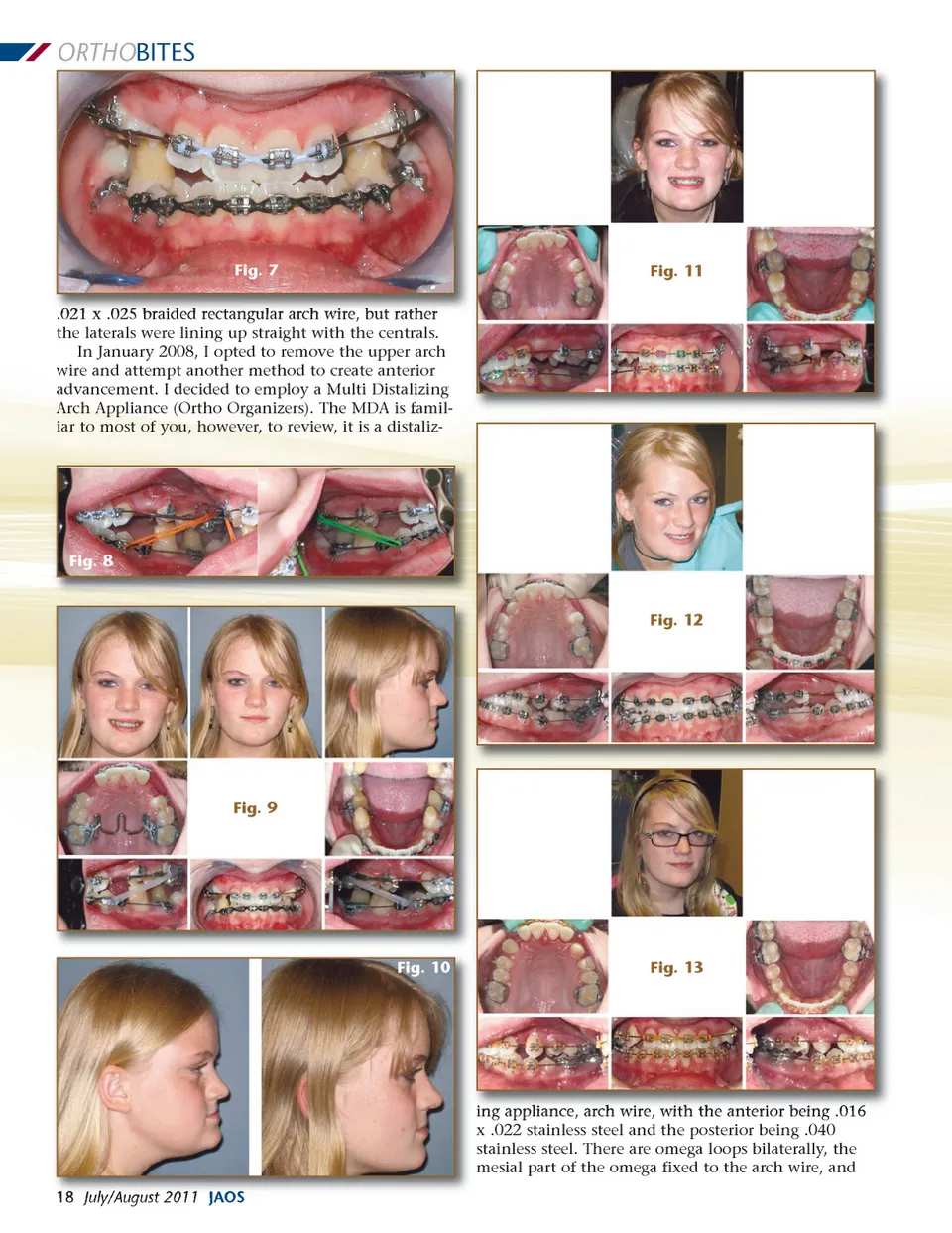
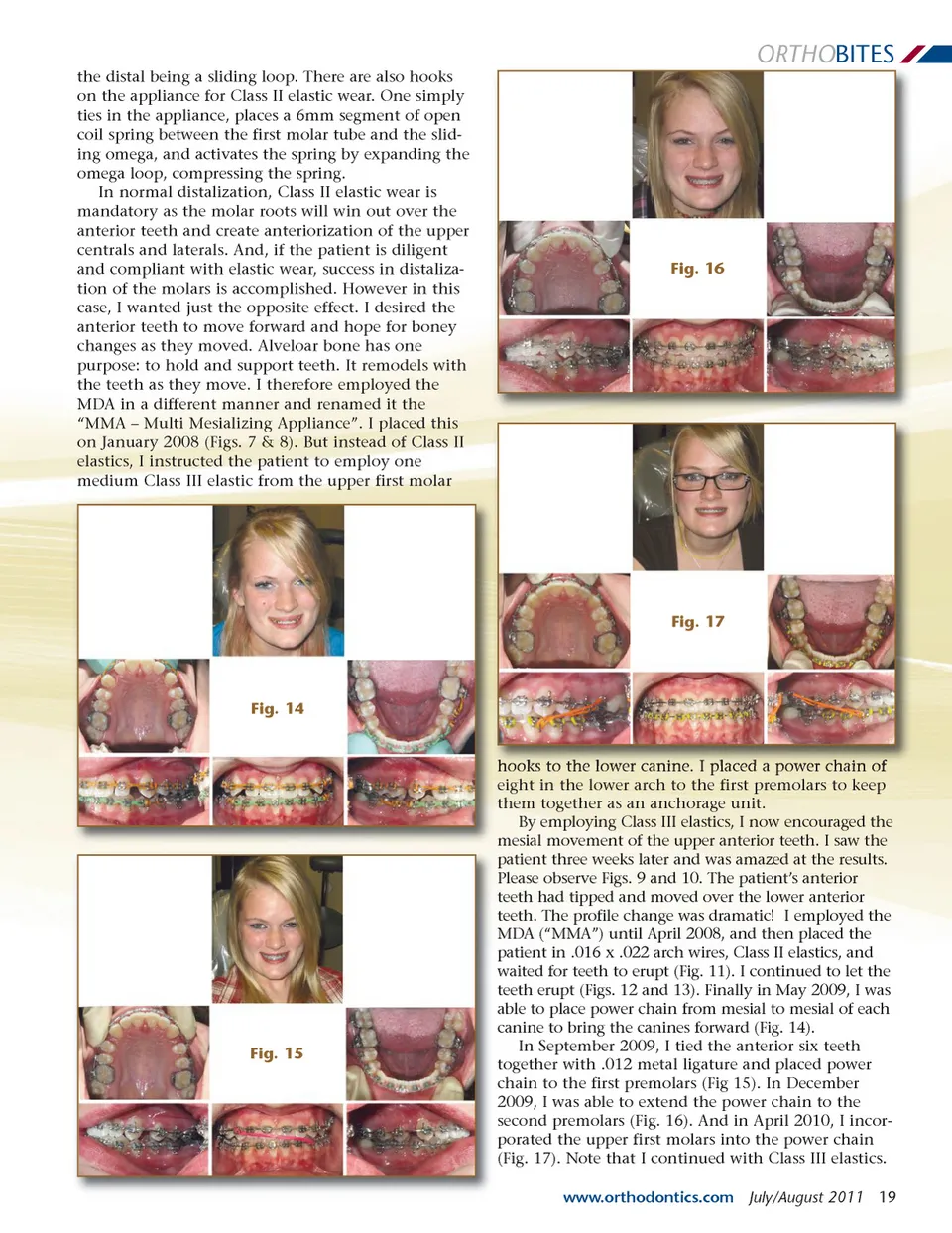
ORTHO BITES the distal being a sliding loop. There are also hooks on the appliance for Class II elastic wear. One simply ties in the appliance, places a 6mm segment of open coil spring between the first molar tube and the slid-ing omega, and activates the spring by expanding the omega loop, compressing the spring. In normal distalization, Class II elastic wear is mandatory as the molar roots will win out over the anterior teeth and create anteriorization of the upper centrals and laterals. And, if the patient is diligent and compliant with elastic wear, success in distaliza-tion of the molars is accomplished. However in this case, I wanted just the opposite effect. I desired the anterior teeth to move forward and hope for boney changes as they moved. Alveloar bone has one purpose: to hold and support teeth. It remodels with the teeth as they move. I therefore employed the MDA in a different manner and renamed it the “MMA – Multi Mesializing Appliance”. I placed this on January 2008 (Figs. 7 & 8). But instead of Class II elastics, I instructed the patient to employ one medium Class III elastic from the upper first molar Fig. 16 Fig. 17 Fig. 14 Fig. 15 hooks to the lower canine. I placed a power chain of eight in the lower arch to the first premolars to keep them together as an anchorage unit. By employing Class III elastics, I now encouraged the mesial movement of the upper anterior teeth. I saw the patient three weeks later and was amazed at the results. Please observe Figs. 9 and 10. The patient’s anterior teeth had tipped and moved over the lower anterior teeth. The profile change was dramatic! I employed the MDA (“MMA”) until April 2008, and then placed the patient in .016 x .022 arch wires, Class II elastics, and waited for teeth to erupt (Fig. 11). I continued to let the teeth erupt (Figs. 12 and 13). Finally in May 2009, I was able to place power chain from mesial to mesial of each canine to bring the canines forward (Fig. 14). In September 2009, I tied the anterior six teeth together with .012 metal ligature and placed power chain to the first premolars (Fig 15). In December 2009, I was able to extend the power chain to the second premolars (Fig. 16). And in April 2010, I incor-porated the upper first molars into the power chain (Fig. 17). Note that I continued with Class III elastics. www.orthodontics.com July/August 2011 19
Journal of the American Orthodontic Society July-August 2011-Buyer's Guide: Page 19