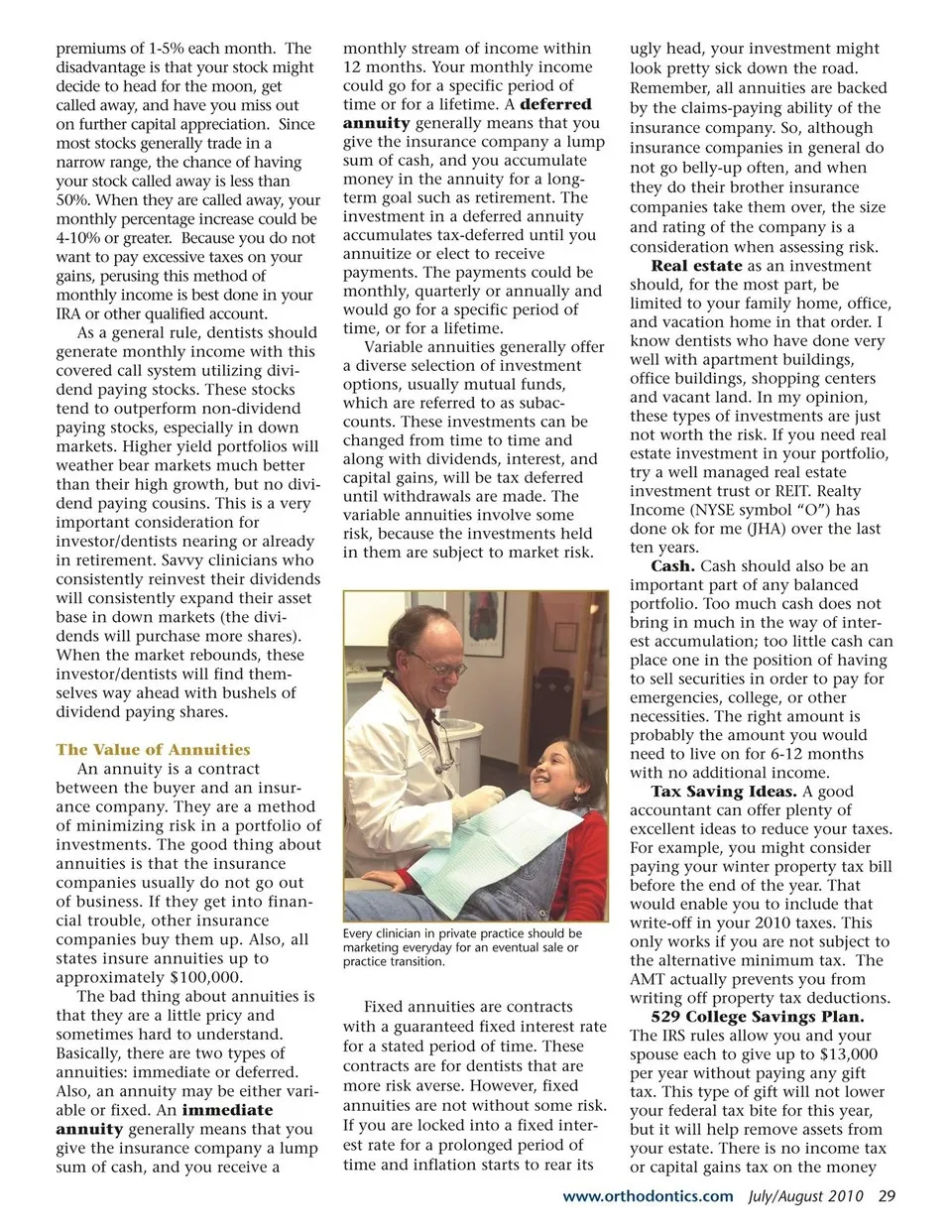
premiums of 1-5% each month. The disadvantage is that your stock might decide to head for the moon, get called away, and have you miss out on further capital appreciation. Since most stocks generally trade in a narrow range, the chance of having your stock called away is less than 50%. When they are called away, your monthly percentage increase could be 4-10% or greater. Because you do not want to pay excessive taxes on your gains, perusing this method of monthly income is best done in your IRA or other qualified account. As a general rule, dentists should generate monthly income with this covered call system utilizing divi-dend paying stocks. These stocks tend to outperform non-dividend paying stocks, especially in down markets. Higher yield portfolios will weather bear markets much better than their high growth, but no divi-dend paying cousins. This is a very important consideration for investor/dentists nearing or already in retirement. Savvy clinicians who consistently reinvest their dividends will consistently expand their asset base in down markets (the divi-dends will purchase more shares). When the market rebounds, these investor/dentists will find them-selves way ahead with bushels of dividend paying shares. The Value of Annuities An annuity is a contract between the buyer and an insur-ance company. They are a method of minimizing risk in a portfolio of investments. The good thing about annuities is that the insurance companies usually do not go out of business. If they get into finan-cial trouble, other insurance companies buy them up. Also, all states insure annuities up to approximately $100,000. The bad thing about annuities is that they are a little pricy and sometimes hard to understand. Basically, there are two types of annuities: immediate or deferred. Also, an annuity may be either vari-able or fixed. An immediate annuity generally means that you give the insurance company a lump sum of cash, and you receive a monthly stream of income within 12 months. Your monthly income could go for a specific period of time or for a lifetime. A deferred annuity generally means that you give the insurance company a lump sum of cash, and you accumulate money in the annuity for a long-term goal such as retirement. The investment in a deferred annuity accumulates tax-deferred until you annuitize or elect to receive payments. The payments could be monthly, quarterly or annually and would go for a specific period of time, or for a lifetime. Variable annuities generally offer a diverse selection of investment options, usually mutual funds, which are referred to as subac-counts. These investments can be changed from time to time and along with dividends, interest, and capital gains, will be tax deferred until withdrawals are made. The variable annuities involve some risk, because the investments held in them are subject to market risk. Every clinician in private practice should be marketing everyday for an eventual sale or practice transition. Fixed annuities are contracts with a guaranteed fixed interest rate for a stated period of time. These contracts are for dentists that are more risk averse. However, fixed annuities are not without some risk. If you are locked into a fixed inter-est rate for a prolonged period of time and inflation starts to rear its ugly head, your investment might look pretty sick down the road. Remember, all annuities are backed by the claims-paying ability of the insurance company. So, although insurance companies in general do not go belly-up often, and when they do their brother insurance companies take them over, the size and rating of the company is a consideration when assessing risk. Real estate as an investment should, for the most part, be limited to your family home, office, and vacation home in that order. I know dentists who have done very well with apartment buildings, office buildings, shopping centers and vacant land. In my opinion, these types of investments are just not worth the risk. If you need real estate investment in your portfolio, try a well managed real estate investment trust or REIT. Realty Income (NYSE symbol “O”) has done ok for me (JHA) over the last ten years. Cash. Cash should also be an important part of any balanced portfolio. Too much cash does not bring in much in the way of inter-est accumulation; too little cash can place one in the position of having to sell securities in order to pay for emergencies, college, or other necessities. The right amount is probably the amount you would need to live on for 6-12 months with no additional income. Tax Saving Ideas. A good accountant can offer plenty of excellent ideas to reduce your taxes. For example, you might consider paying your winter property tax bill before the end of the year. That would enable you to include that write-off in your 2010 taxes. This only works if you are not subject to the alternative minimum tax. The AMT actually prevents you from writing off property tax deductions. 529 College Savings Plan. The IRS rules allow you and your spouse each to give up to $13,000 per year without paying any gift tax. This type of gift will not lower your federal tax bite for this year, but it will help remove assets from your estate. There is no income tax or capital gains tax on the money www.orthodontics.com July/August 2010 29
Journal of the American Orthodontic Society July-August 2010/Buyer's Guide: Page 29