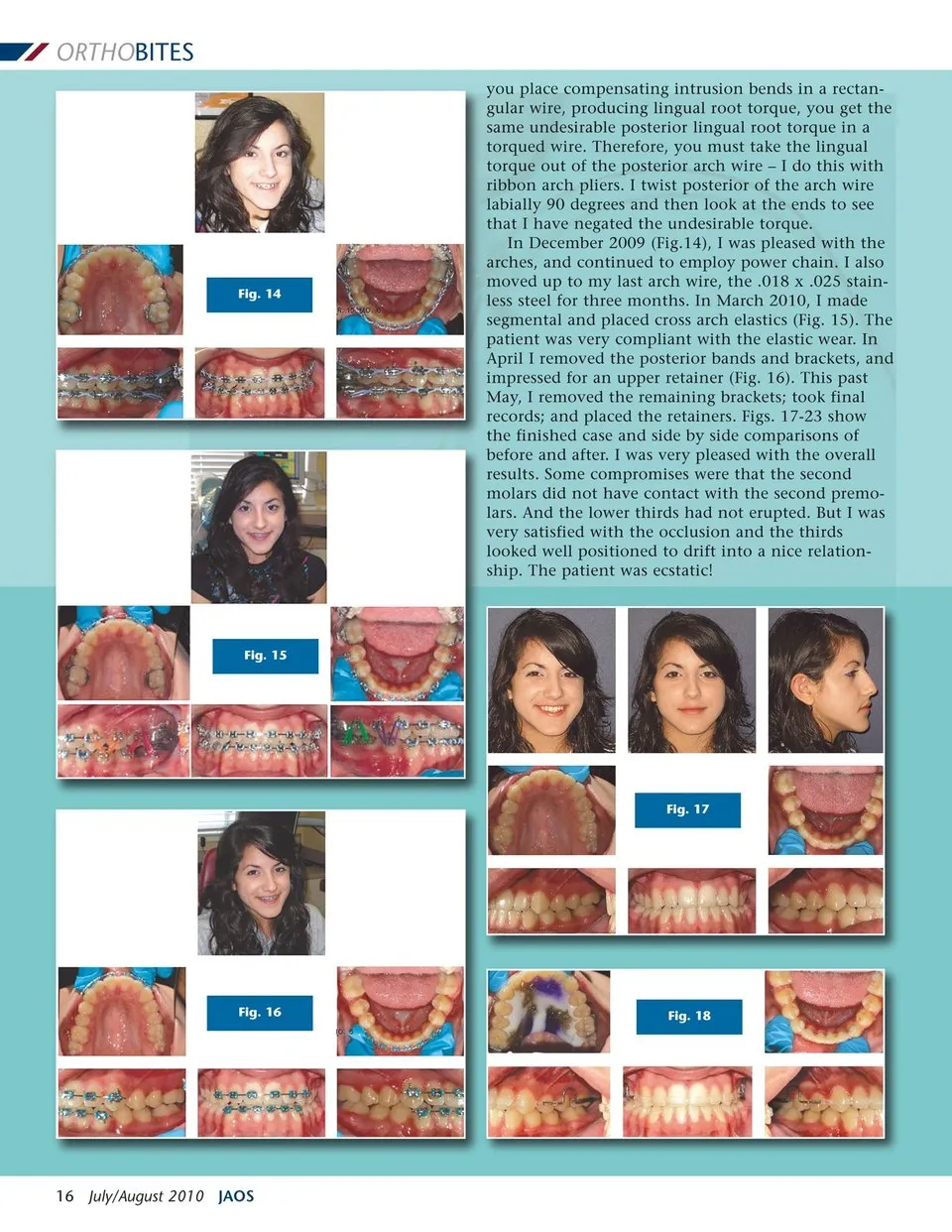
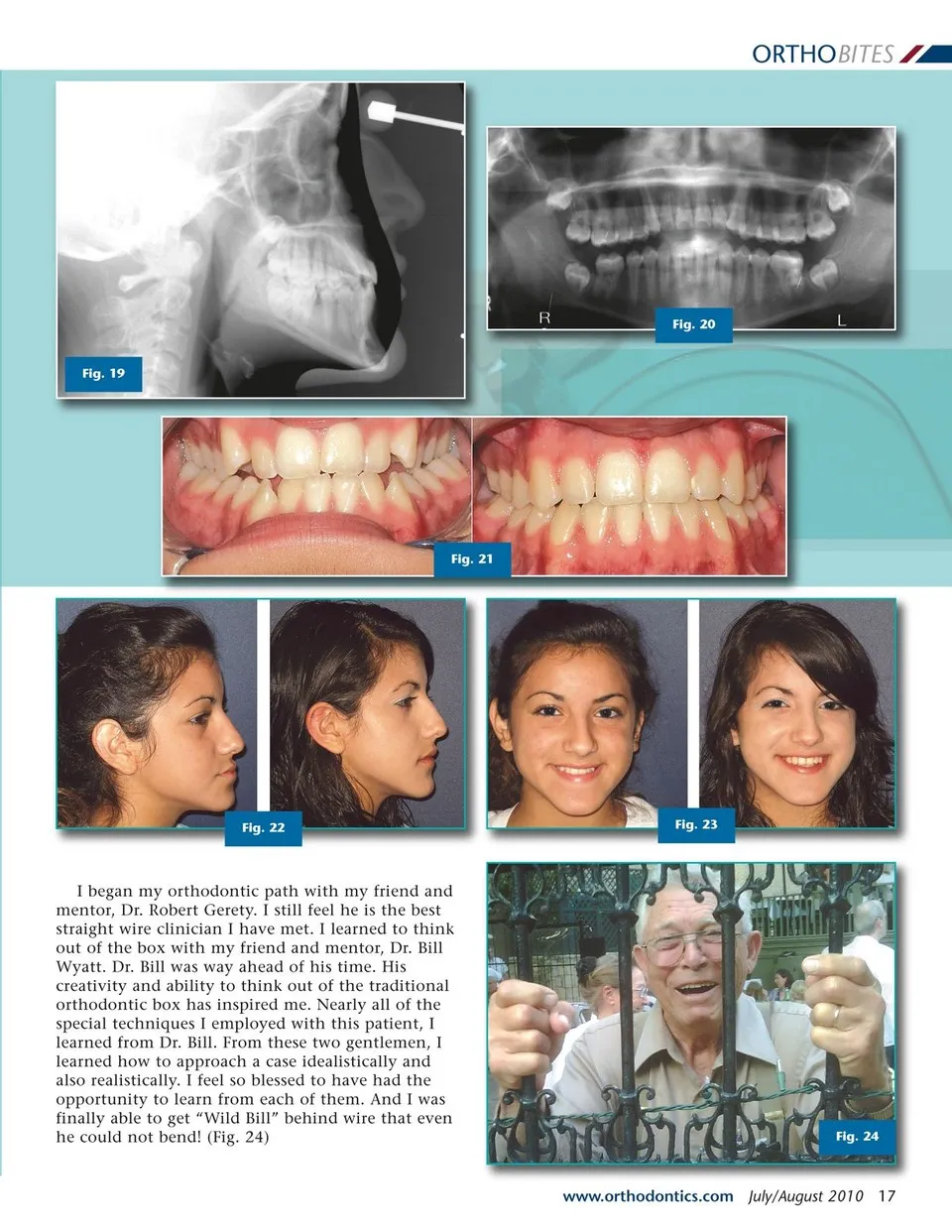
ORTHOBITES you place compensating intrusion bends in a rectan-gular wire, producing lingual root torque, you get the same undesirable posterior lingual root torque in a torqued wire. Therefore, you must take the lingual torque out of the posterior arch wire – I do this with ribbon arch pliers. I twist posterior of the arch wire labially 90 degrees and then look at the ends to see that I have negated the undesirable torque. In December 2009 (Fig.14), I was pleased with the Fig. 14 arches, and continued to employ power chain. I also moved up to my last arch wire, the .018 x .025 stain-less steel for three months. In March 2010, I made segmental and placed cross arch elastics (Fig. 15). The patient was very compliant with the elastic wear. In April I removed the posterior bands and brackets, and impressed for an upper retainer (Fig. 16). This past May, I removed the remaining brackets; took final records; and placed the retainers. Figs. 17-23 show the finished case and side by side comparisons of before and after. I was very pleased with the overall results. Some compromises were that the second molars did not have contact with the second premo-lars. And the lower thirds had not erupted. But I was very satisfied with the occlusion and the thirds looked well positioned to drift into a nice relation-ship. The patient was ecstatic! Fig. 15 Fig. 17 Fig. 16 Fig. 18 16 July/August 2010 JAOS
Journal of the American Orthodontic Society July-August 2010/Buyer's Guide: Page 16