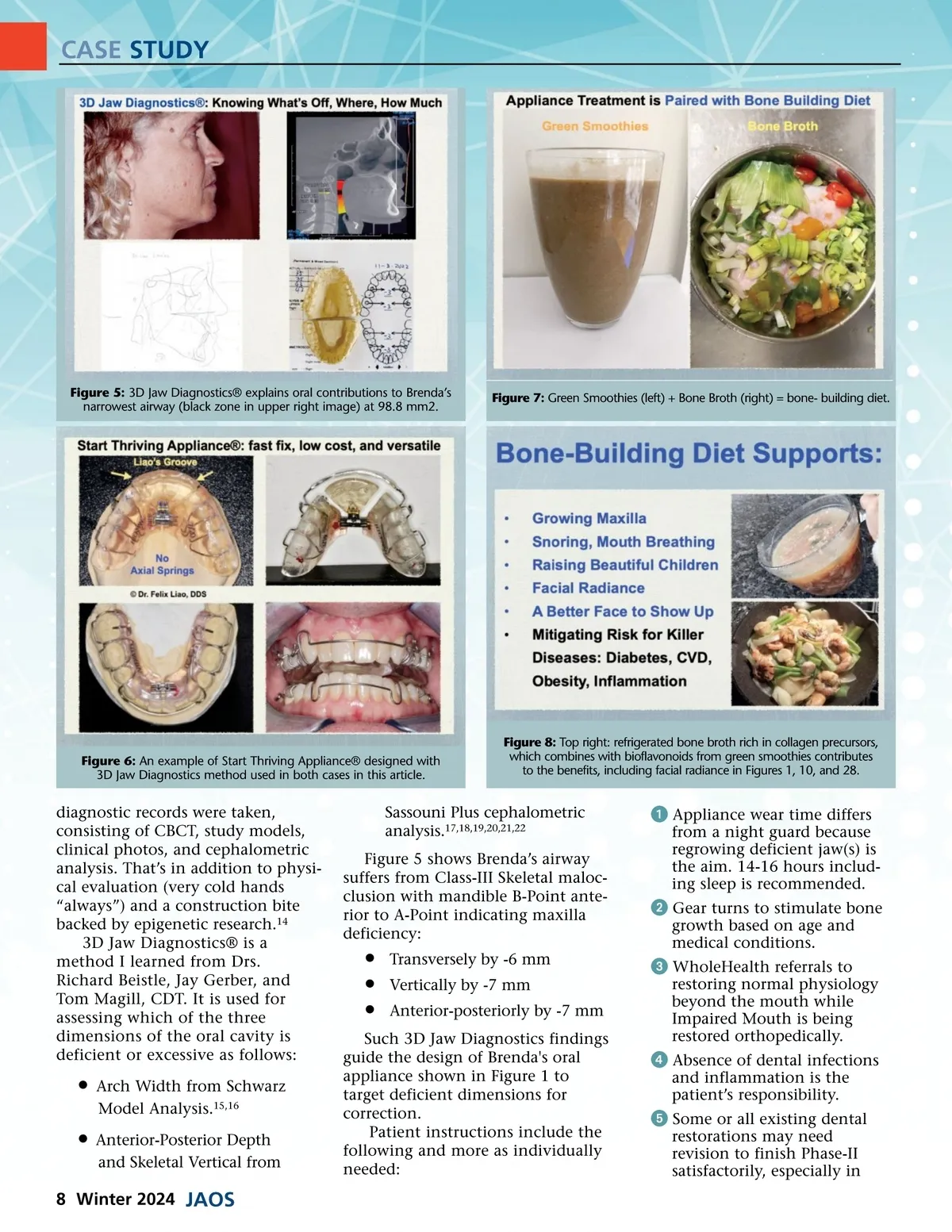
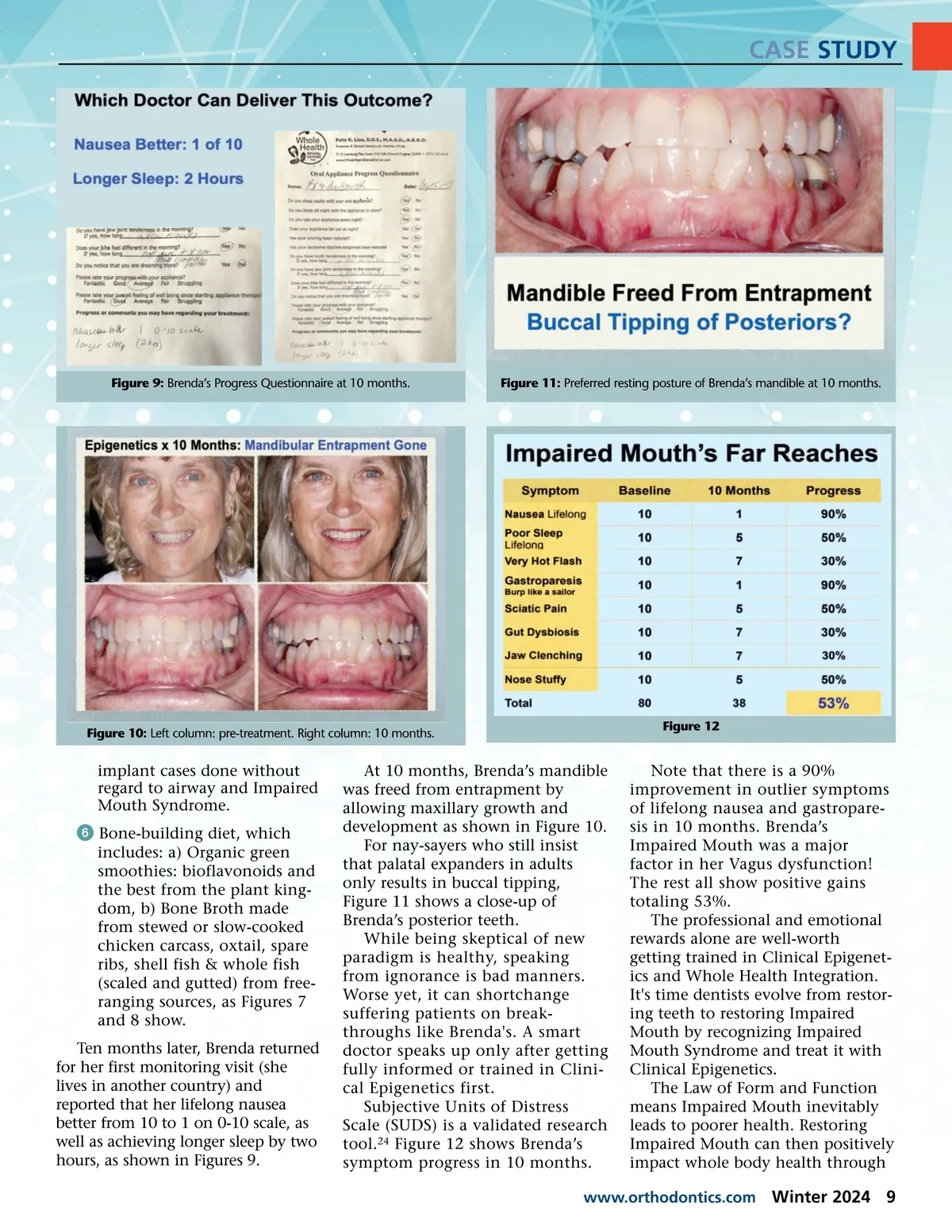
CASE STUDY Figure 5: 3D Jaw Diagnostics® explains oral contributions to Brenda’s narrowest airway (black zone in upper right image) at 98.8 mm2. Figure 7: Green Smoothies (left) + Bone Broth (right) = bone-building diet. Figure 6: An example of Start Thriving Appliance® designed with 3D Jaw Diagnostics method used in both cases in this article. Figure 8: Top right: refrigerated bone broth rich in collagen precursors, which combines with bioflavonoids from green smoothies contributes to the benefits, including facial radiance in Figures 1, 10, and 28. diagnostic records were taken, consisting of CBCT, study models, clinical photos, and cephalometric analysis. That’s in addition to physi-cal evaluation (very cold hands “always”) and a construction bite backed by epigenetic research. 14 3D Jaw Diagnostics® is a method I learned from Drs. Richard Beistle, Jay Gerber, and Tom Magill, CDT. It is used for assessing which of the three dimensions of the oral cavity is deficient or excessive as follows: Sassouni Plus cephalometric analysis. 17,18,19,20,21,22 Figure 5 shows Brenda’s airway suffers from Class-III Skeletal maloc-clusion with mandible B-Point ante-rior to A-Point indicating maxilla deficiency: ᕡ Appliance wear time differs from a night guard because regrowing deficient jaw(s) is the aim. 14-16 hours includ-ing sleep is recommended. ᕢ Gear turns to stimulate bone growth based on age and medical conditions. • • • Transversely by -6 mm Vertically by -7 mm Anterior-posteriorly by -7 mm ᕣ WholeHealth referrals to restoring normal physiology beyond the mouth while Impaired Mouth is being restored orthopedically. • Arch Width from Schwarz Model Analysis. 15,16 and Skeletal Vertical from • Anterior-Posterior Depth 8 Winter 2024 JAOS Such 3D Jaw Diagnostics findings guide the design of Brenda's oral appliance shown in Figure 1 to target deficient dimensions for correction. Patient instructions include the following and more as individually needed: ᕤ Absence of dental infections and inflammation is the patient’s responsibility. ᕥ Some or all existing dental restorations may need revision to finish Phase-II satisfactorily, especially in
Journal of the American Orthodontic Society JAOS Winter 2024: Page 8