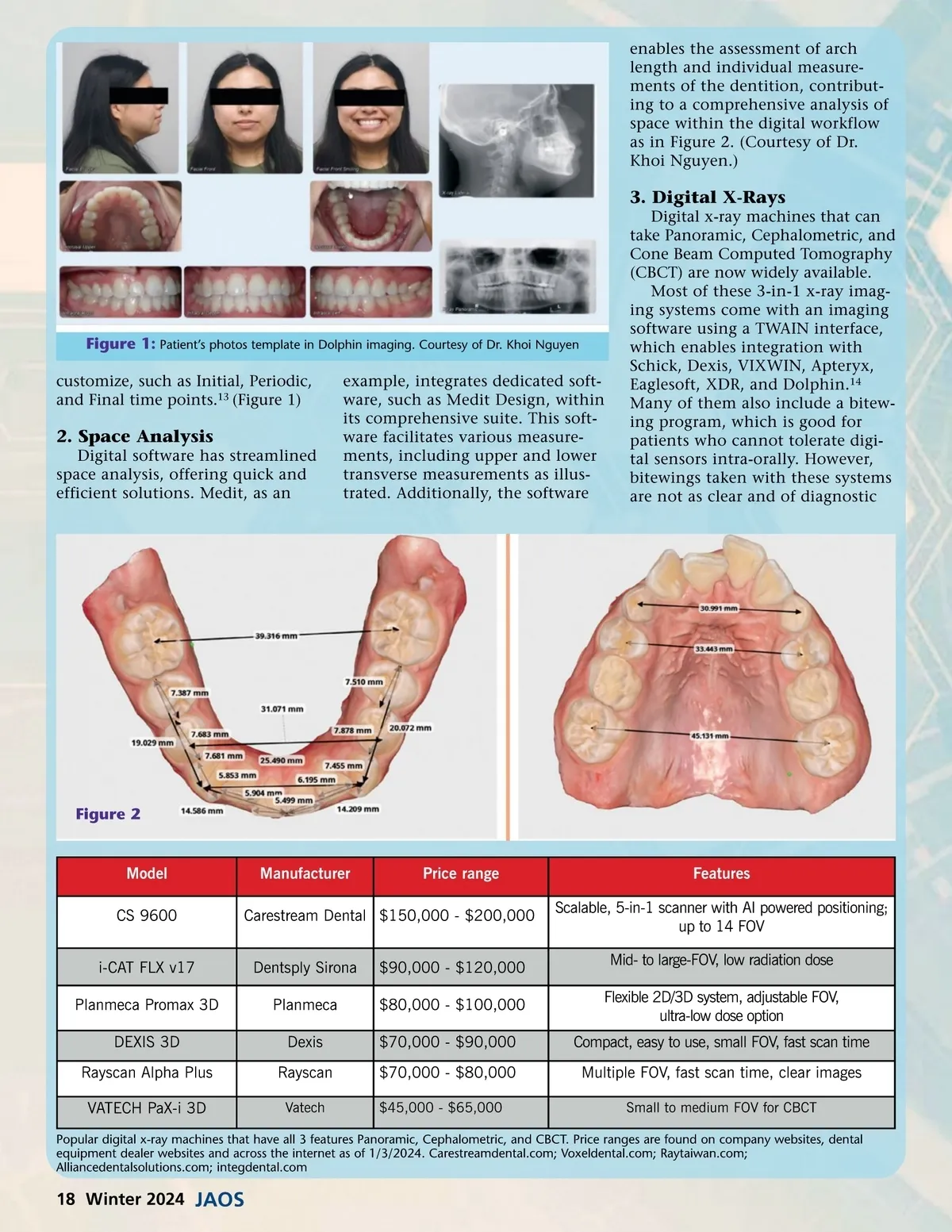
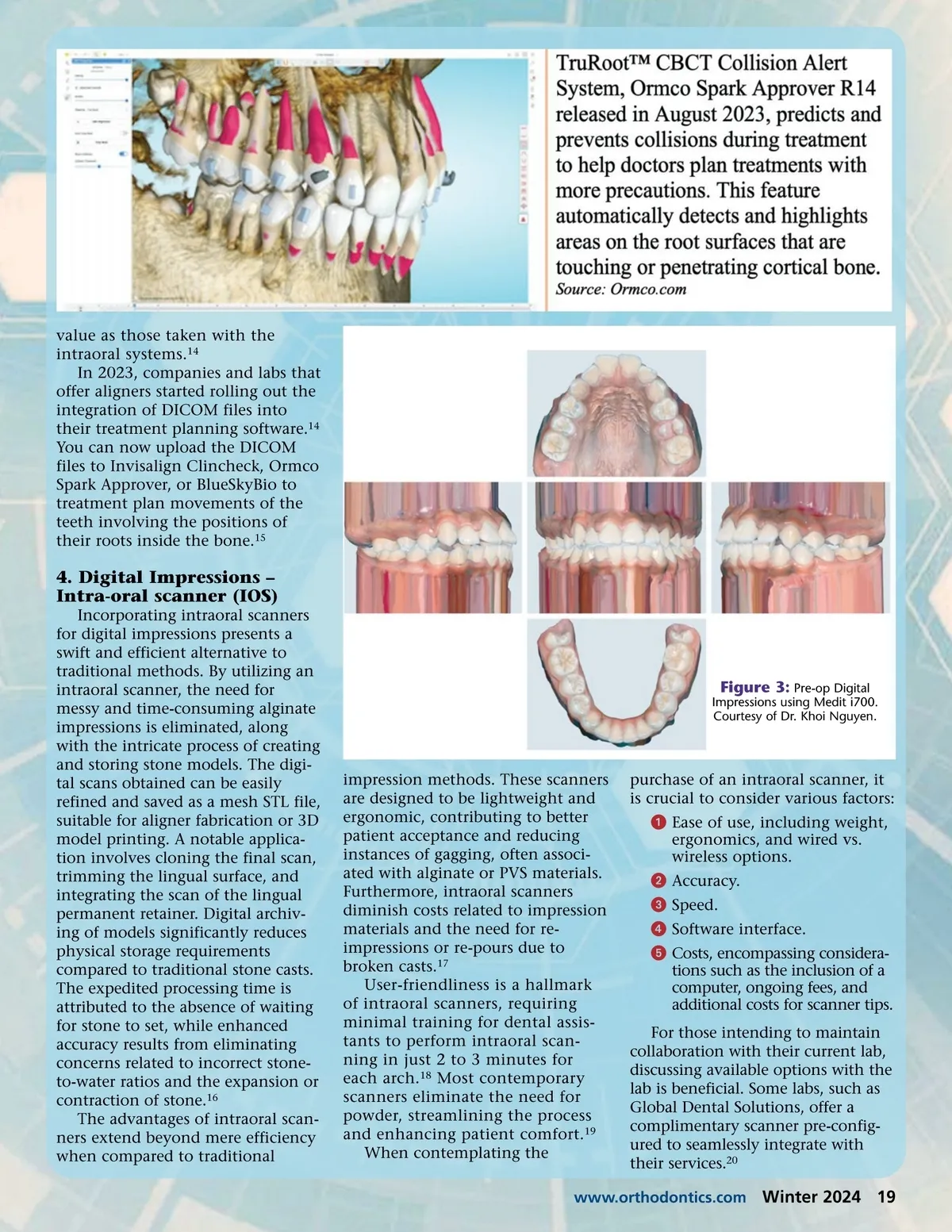
value as those taken with the intraoral systems. 14 In 2023, companies and labs that offer aligners started rolling out the integration of DICOM files into their treatment planning software. 14 You can now upload the DICOM files to Invisalign Clincheck, Ormco Spark Approver, or BlueSkyBio to treatment plan movements of the teeth involving the positions of their roots inside the bone. 15 4. Digital Impressions – Intra-oral scanner (IOS) Incorporating intraoral scanners for digital impressions presents a swift and efficient alternative to traditional methods. By utilizing an intraoral scanner, the need for messy and time-consuming alginate impressions is eliminated, along with the intricate process of creating and storing stone models. The digi-tal scans obtained can be easily refined and saved as a mesh STL file, suitable for aligner fabrication or 3D model printing. A notable applica-tion involves cloning the final scan, trimming the lingual surface, and integrating the scan of the lingual permanent retainer. Digital archiv-ing of models significantly reduces physical storage requirements compared to traditional stone casts. The expedited processing time is attributed to the absence of waiting for stone to set, while enhanced accuracy results from eliminating concerns related to incorrect stone-to-water ratios and the expansion or contraction of stone. 16 The advantages of intraoral scan-ners extend beyond mere efficiency when compared to traditional Figure 3: Pre-op Digital Impressions using Medit i700. Courtesy of Dr. Khoi Nguyen. impression methods. These scanners are designed to be lightweight and ergonomic, contributing to better patient acceptance and reducing instances of gagging, often associ-ated with alginate or PVS materials. Furthermore, intraoral scanners diminish costs related to impression materials and the need for re-impressions or re-pours due to broken casts. 17 User-friendliness is a hallmark of intraoral scanners, requiring minimal training for dental assis-tants to perform intraoral scan-ning in just 2 to 3 minutes for each arch. 18 Most contemporary scanners eliminate the need for powder, streamlining the process and enhancing patient comfort. 19 When contemplating the purchase of an intraoral scanner, it is crucial to consider various factors: ᕡ Ease of use, including weight, ergonomics, and wired vs. wireless options. ᕢ Accuracy. ᕣ Speed. ᕤ Software interface. ᕥ Costs, encompassing considera-tions such as the inclusion of a computer, ongoing fees, and additional costs for scanner tips. For those intending to maintain collaboration with their current lab, discussing available options with the lab is beneficial. Some labs, such as Global Dental Solutions, offer a complimentary scanner pre-config-ured to seamlessly integrate with their services. 20 www.orthodontics.com Winter 2024 19
Journal of the American Orthodontic Society JAOS Winter 2024: Page 19