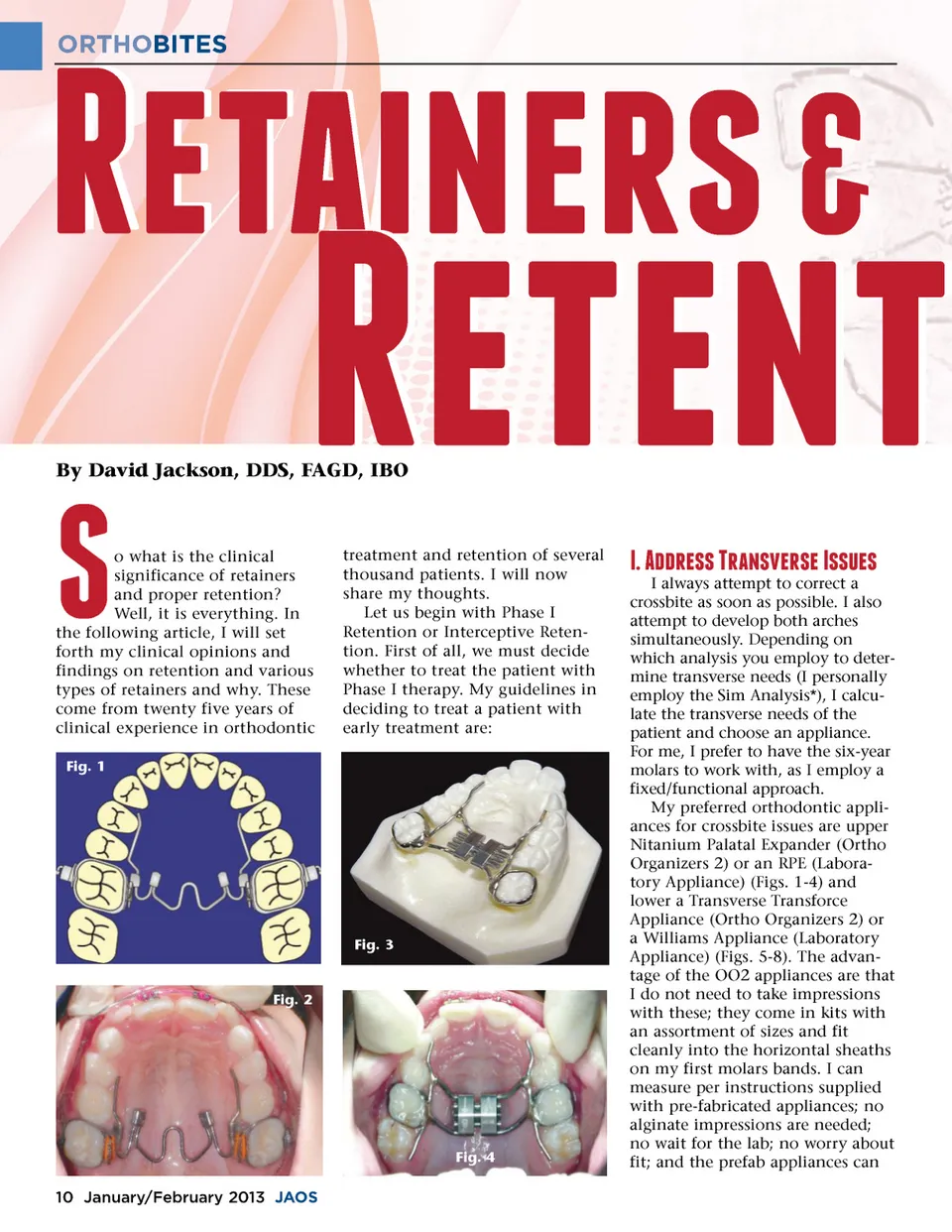
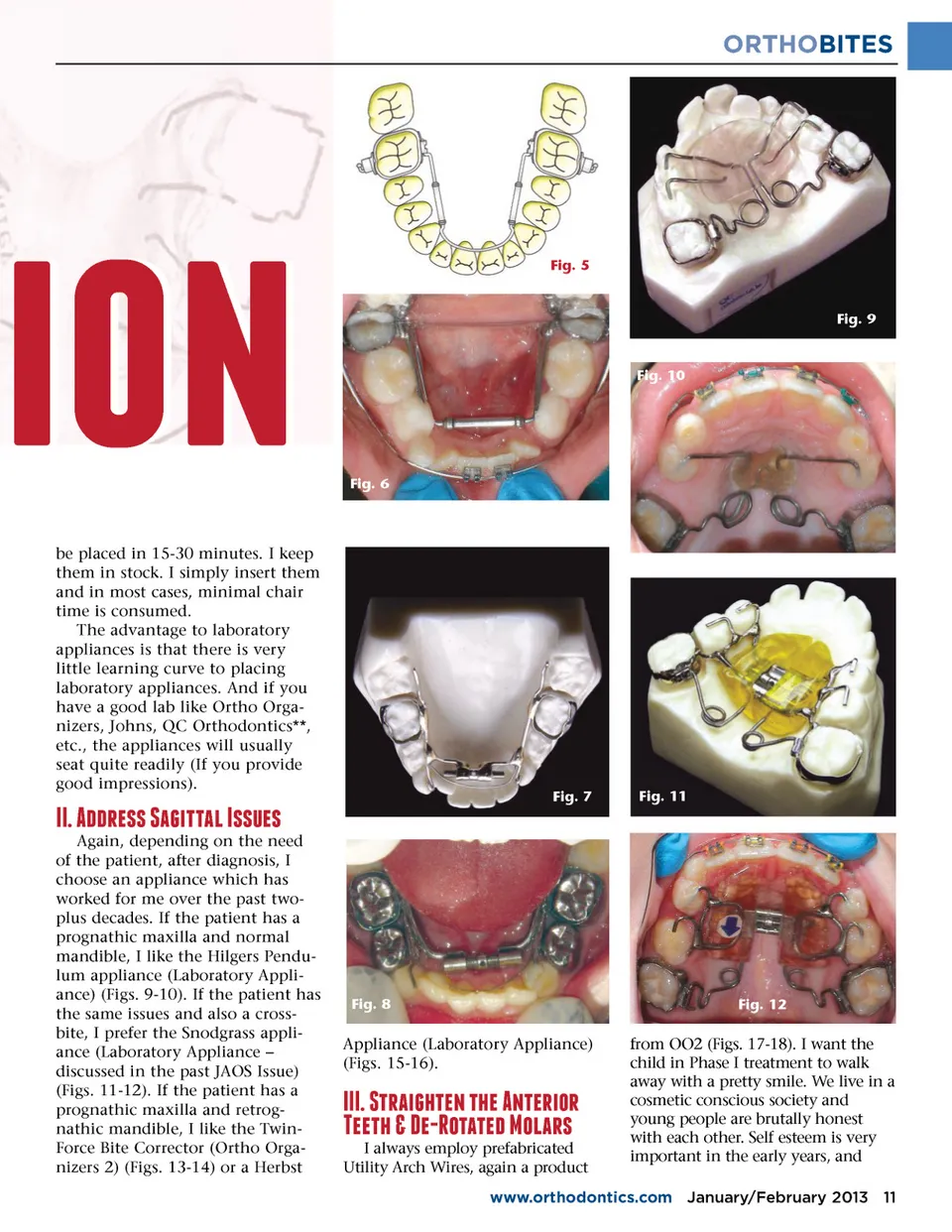
ORTHOBITES tion be placed in 15-30 minutes. I keep them in stock. I simply insert them and in most cases, minimal chair time is consumed. The advantage to laboratory appliances is that there is very little learning curve to placing laboratory appliances. And if you have a good lab like Ortho Orga-nizers, Johns, QC Orthodontics**, etc., the appliances will usually seat quite readily (If you provide good impressions). Fig. 5 Fig. 9 Fig. 10 Fig. 6 Fig. 7 Fig. 11 II. Address Sagittal Issues Again, depending on the need of the patient, after diagnosis, I choose an appliance which has worked for me over the past two-plus decades. If the patient has a prognathic maxilla and normal mandible, I like the Hilgers Pendu-lum appliance (Laboratory Appli-ance) (Figs. 9-10). If the patient has the same issues and also a cross-bite, I prefer the Snodgrass appli-ance (Laboratory Appliance – discussed in the past JAOS Issue) (Figs. 11-12). If the patient has a prognathic maxilla and retrog-nathic mandible, I like the Twin-Force Bite Corrector (Ortho Orga-nizers 2) (Figs. 13-14) or a Herbst Fig. 8 Fig. 12 Appliance (Laboratory Appliance) (Figs. 15-16). III. Straighten the Anterior Teeth & De-Rotated Molars I always employ prefabricated Utility Arch Wires, again a product from OO2 (Figs. 17-18). I want the child in Phase I treatment to walk away with a pretty smile. We live in a cosmetic conscious society and young people are brutally honest with each other. Self esteem is very important in the early years, and www.orthodontics.com January/February 2013 11
Journal of the American Orthodontic Society January-February 2013: Page 11