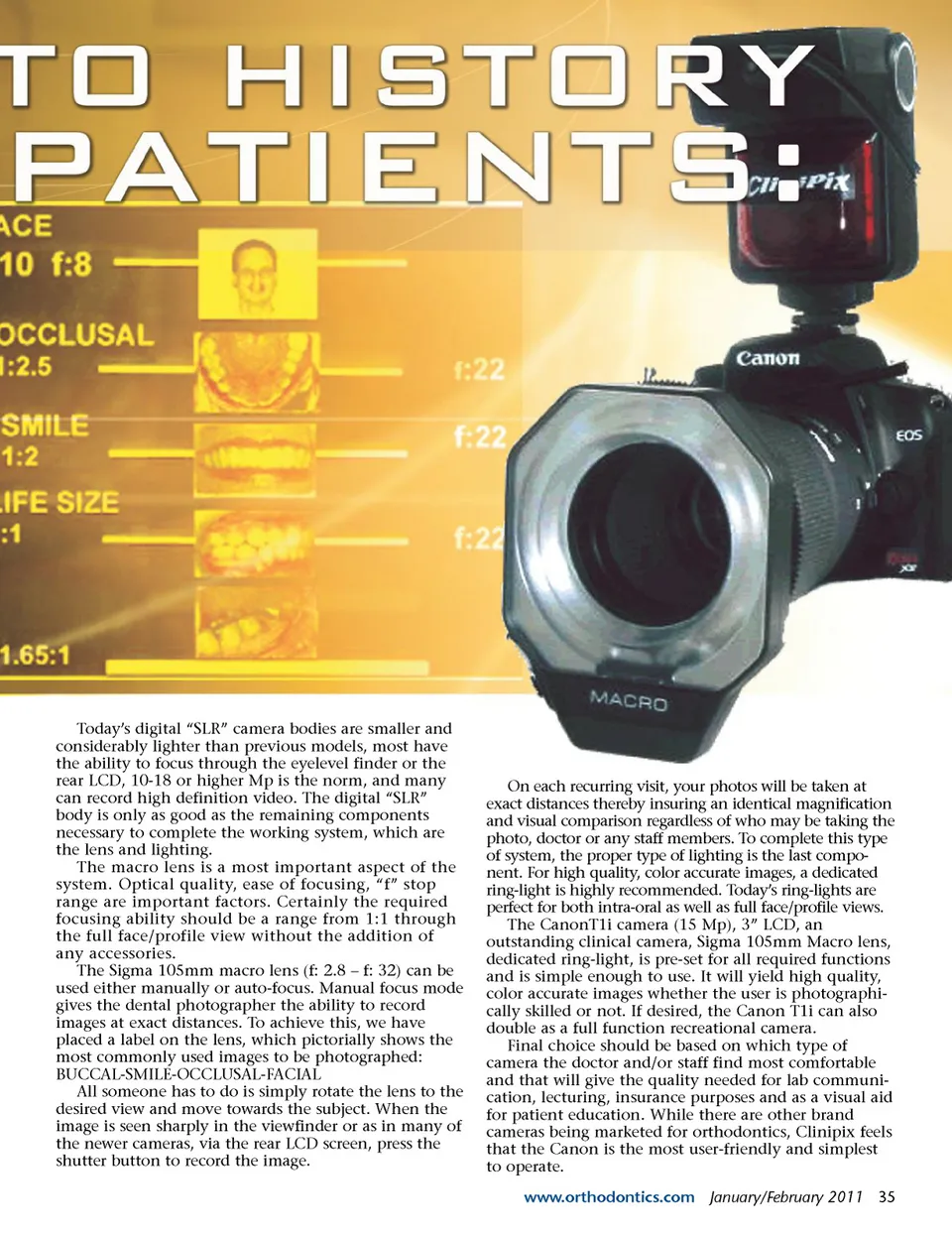
Today’s digital “SLR” camera bodies are smaller and considerably lighter than previous models, most have the ability to focus through the eyelevel finder or the rear LCD, 10-18 or higher Mp is the norm, and many can record high definition video. The digital “SLR” body is only as good as the remaining components necessary to complete the working system, which are the lens and lighting. The macro lens is a most important aspect of the system. Optical quality, ease of focusing, “f” stop range are important factors. Certainly the required focusing ability should be a range from 1:1 through the full face/profile view without the addition of any accessories. The Sigma 105mm macro lens (f: 2.8 – f: 32) can be used either manually or auto-focus. Manual focus mode gives the dental photographer the ability to record images at exact distances. To achieve this, we have placed a label on the lens, which pictorially shows the most commonly used images to be photographed: BUCCAL-SMILE-OCCLUSAL-FACIAL All someone has to do is simply rotate the lens to the desired view and move towards the subject. When the image is seen sharply in the viewfinder or as in many of the newer cameras, via the rear LCD screen, press the shutter button to record the image. On each recurring visit, your photos will be taken at exact distances thereby insuring an identical magnification and visual comparison regardless of who may be taking the photo, doctor or any staff members. To complete this type of system, the proper type of lighting is the last compo-nent. For high quality, color accurate images, a dedicated ring-light is highly recommended. Today’s ring-lights are perfect for both intra-oral as well as full face/profile views. The CanonT1i camera (15 Mp), 3” LCD, an outstanding clinical camera, Sigma 105mm Macro lens, dedicated ring-light, is pre-set for all required functions and is simple enough to use. It will yield high quality, color accurate images whether the user is photographi-cally skilled or not. If desired, the Canon T1i can also double as a full function recreational camera. Final choice should be based on which type of camera the doctor and/or staff find most comfortable and that will give the quality needed for lab communi-cation, lecturing, insurance purposes and as a visual aid for patient education. While there are other brand cameras being marketed for orthodontics, Clinipix feels that the Canon is the most user-friendly and simplest to operate. www.orthodontics.com January/February 2011 35
Journal of the American Orthodontic Society January - February 2011: Page 35