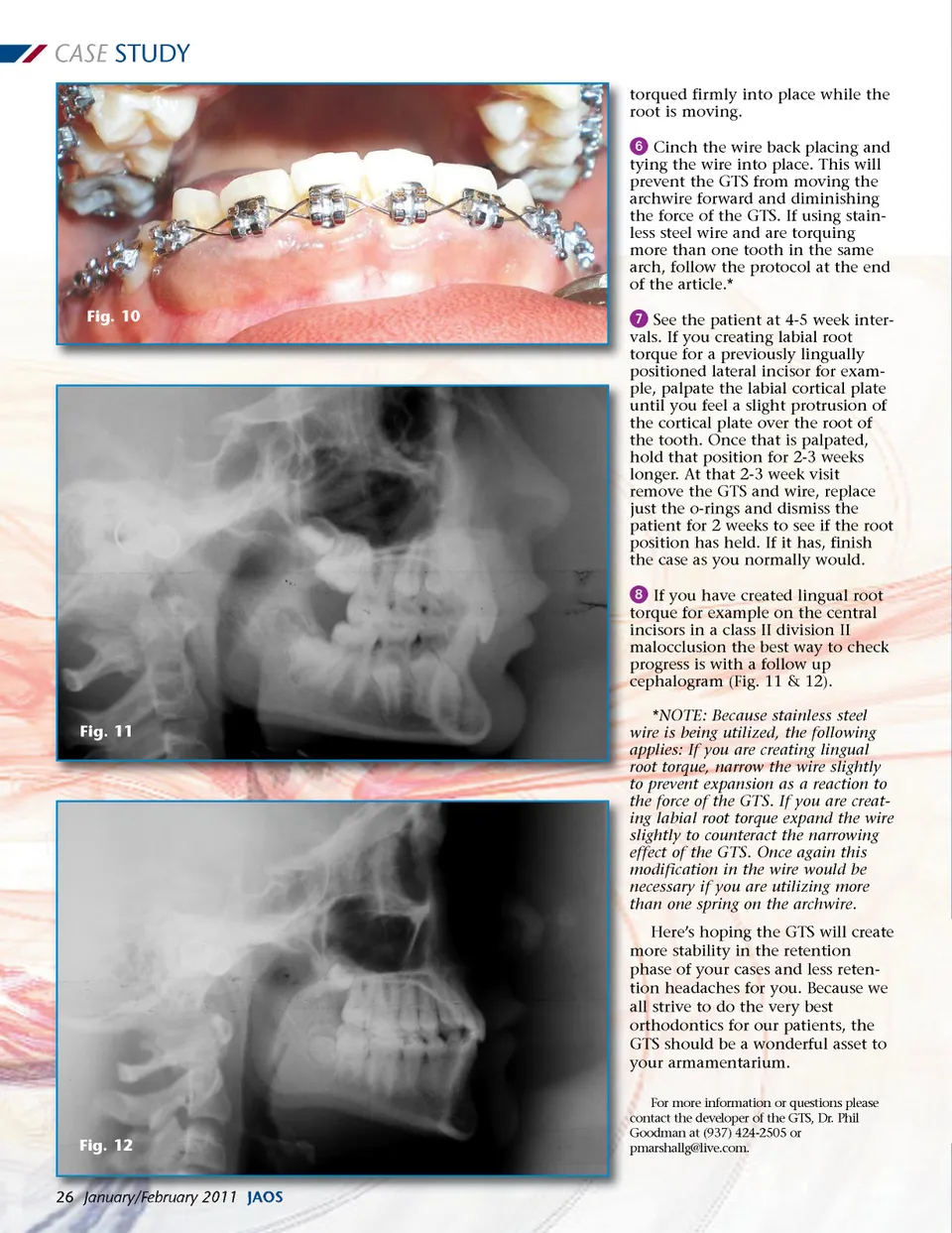
CASE STUDY torqued firmly into place while the root is moving. ᕦ Cinch the wire back placing and tying the wire into place. This will prevent the GTS from moving the archwire forward and diminishing the force of the GTS. If using stain-less steel wire and are torquing more than one tooth in the same arch, follow the protocol at the end of the article.* Fig. 10 ᕧ See the patient at 4-5 week inter-vals. If you creating labial root torque for a previously lingually positioned lateral incisor for exam-ple, palpate the labial cortical plate until you feel a slight protrusion of the cortical plate over the root of the tooth. Once that is palpated, hold that position for 2-3 weeks longer. At that 2-3 week visit remove the GTS and wire, replace just the o-rings and dismiss the patient for 2 weeks to see if the root position has held. If it has, finish the case as you normally would. ᕨ If you have created lingual root torque for example on the central incisors in a class II division II malocclusion the best way to check progress is with a follow up cephalogram (Fig. 11 & 12). Fig. 11 *NOTE: Because stainless steel wire is being utilized, the following applies: If you are creating lingual root torque, narrow the wire slightly to prevent expansion as a reaction to the force of the GTS. If you are creat-ing labial root torque expand the wire slightly to counteract the narrowing effect of the GTS. Once again this modification in the wire would be necessary if you are utilizing more than one spring on the archwire. Here’s hoping the GTS will create more stability in the retention phase of your cases and less reten-tion headaches for you. Because we all strive to do the very best orthodontics for our patients, the GTS should be a wonderful asset to your armamentarium. For more information or questions please contact the developer of the GTS, Dr. Phil Goodman at (937) 424-2505 or pmarshallg@live.com. Fig. 12 26 January/February 2011 JAOS
Journal of the American Orthodontic Society January - February 2011: Page 26