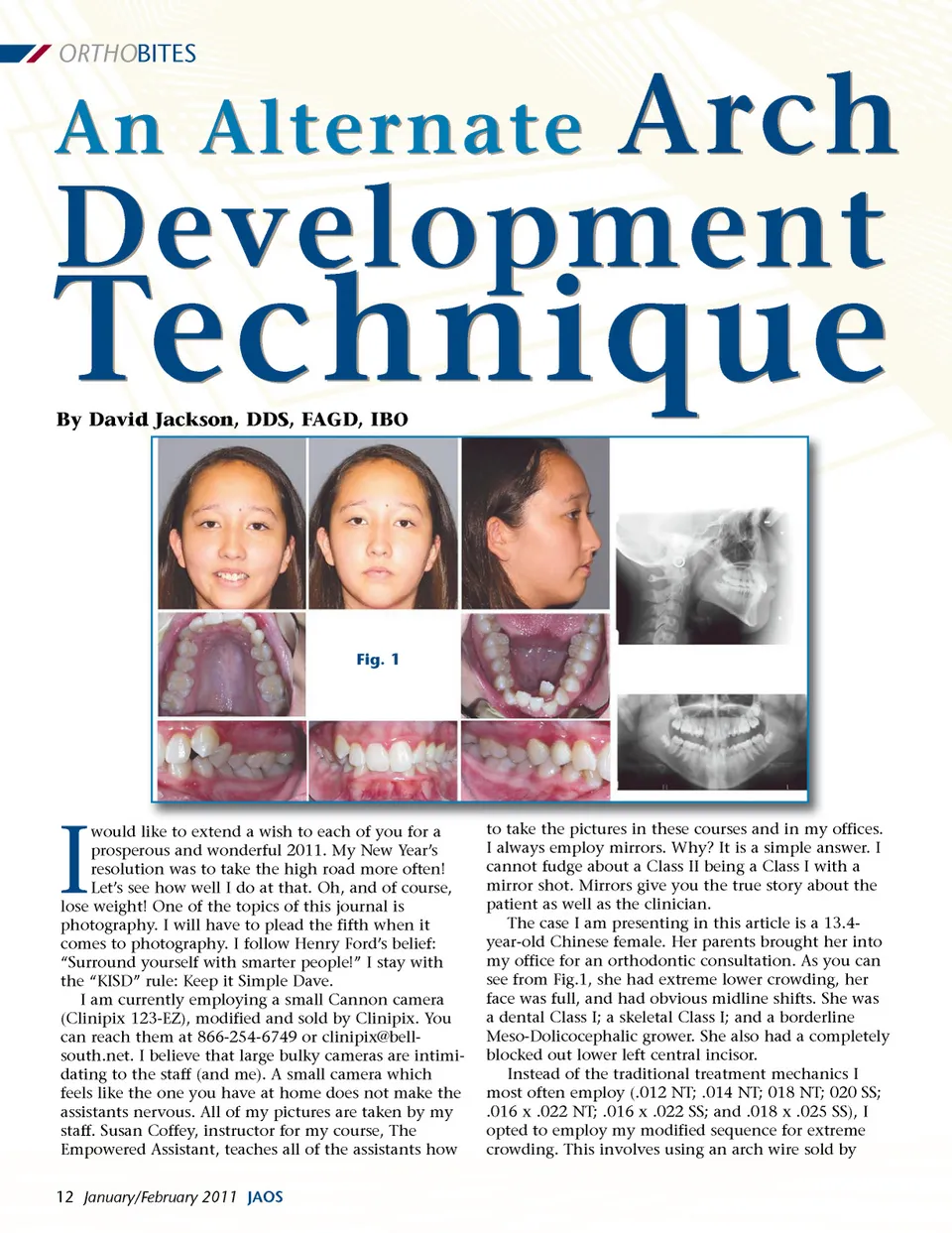
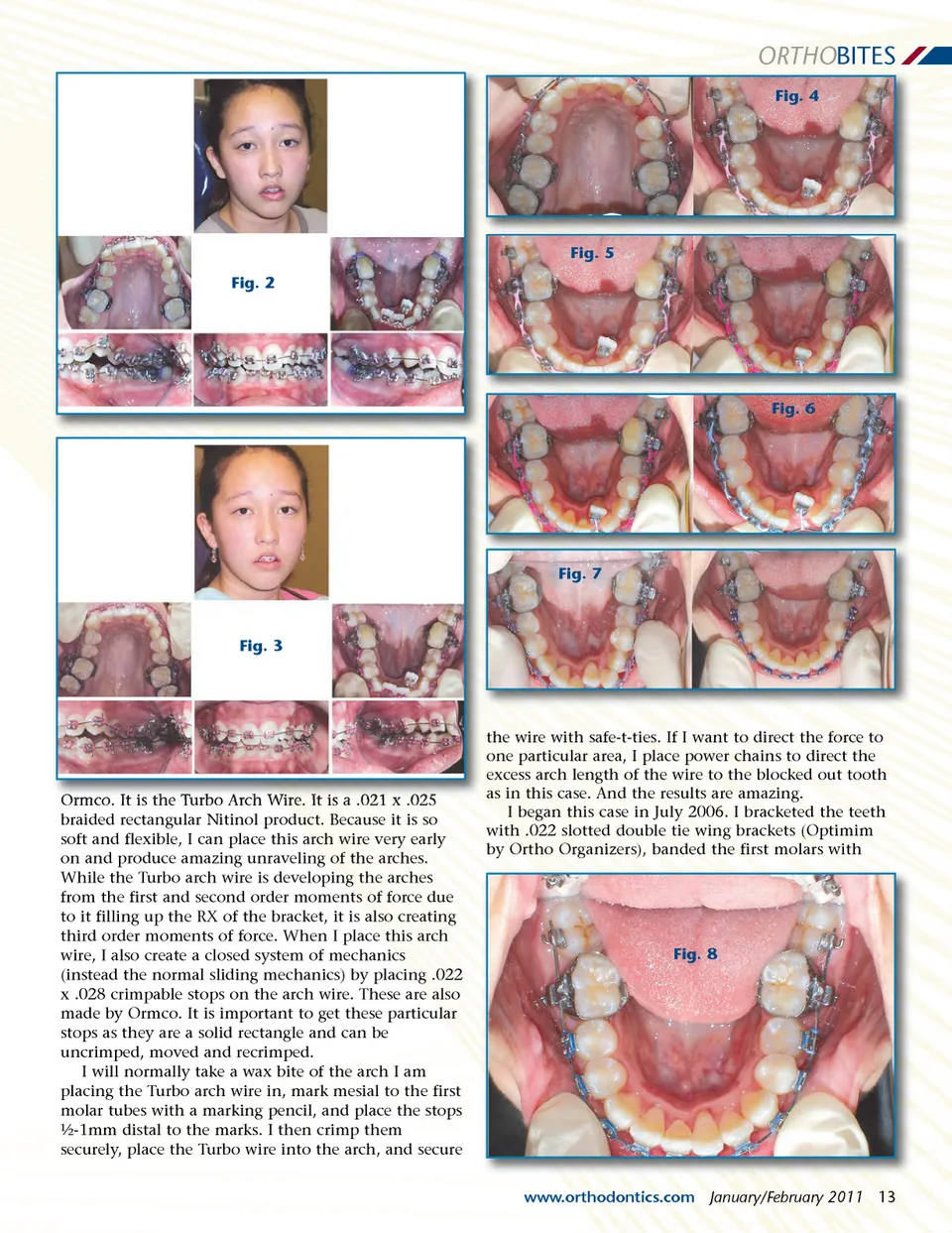
ORTHO BITES Arch Development An Alternate Technique By David Jackson, DDS, FAGD, IBO Fig. 1 I would like to extend a wish to each of you for a prosperous and wonderful 2011. My New Year’s resolution was to take the high road more often! Let’s see how well I do at that. Oh, and of course, lose weight! One of the topics of this journal is photography. I will have to plead the fifth when it comes to photography. I follow Henry Ford’s belief: “Surround yourself with smarter people!” I stay with the “KISD” rule: Keep it Simple Dave. I am currently employing a small Cannon camera (Clinipix 123-EZ), modified and sold by Clinipix. You can reach them at 866-254-6749 or clinipix@bell-south.net. I believe that large bulky cameras are intimi-dating to the staff (and me). A small camera which feels like the one you have at home does not make the assistants nervous. All of my pictures are taken by my staff. Susan Coffey, instructor for my course, The Empowered Assistant, teaches all of the assistants how to take the pictures in these courses and in my offices. I always employ mirrors. Why? It is a simple answer. I cannot fudge about a Class II being a Class I with a mirror shot. Mirrors give you the true story about the patient as well as the clinician. The case I am presenting in this article is a 13.4-year-old Chinese female. Her parents brought her into my office for an orthodontic consultation. As you can see from Fig.1, she had extreme lower crowding, her face was full, and had obvious midline shifts. She was a dental Class I; a skeletal Class I; and a borderline Meso-Dolicocephalic grower. She also had a completely blocked out lower left central incisor. Instead of the traditional treatment mechanics I most often employ (.012 NT; .014 NT; 018 NT; 020 SS; .016 x .022 NT; .016 x .022 SS; and .018 x .025 SS), I opted to employ my modified sequence for extreme crowding. This involves using an arch wire sold by 12 January/February 2011 JAOS
Journal of the American Orthodontic Society January - February 2011: Page 12