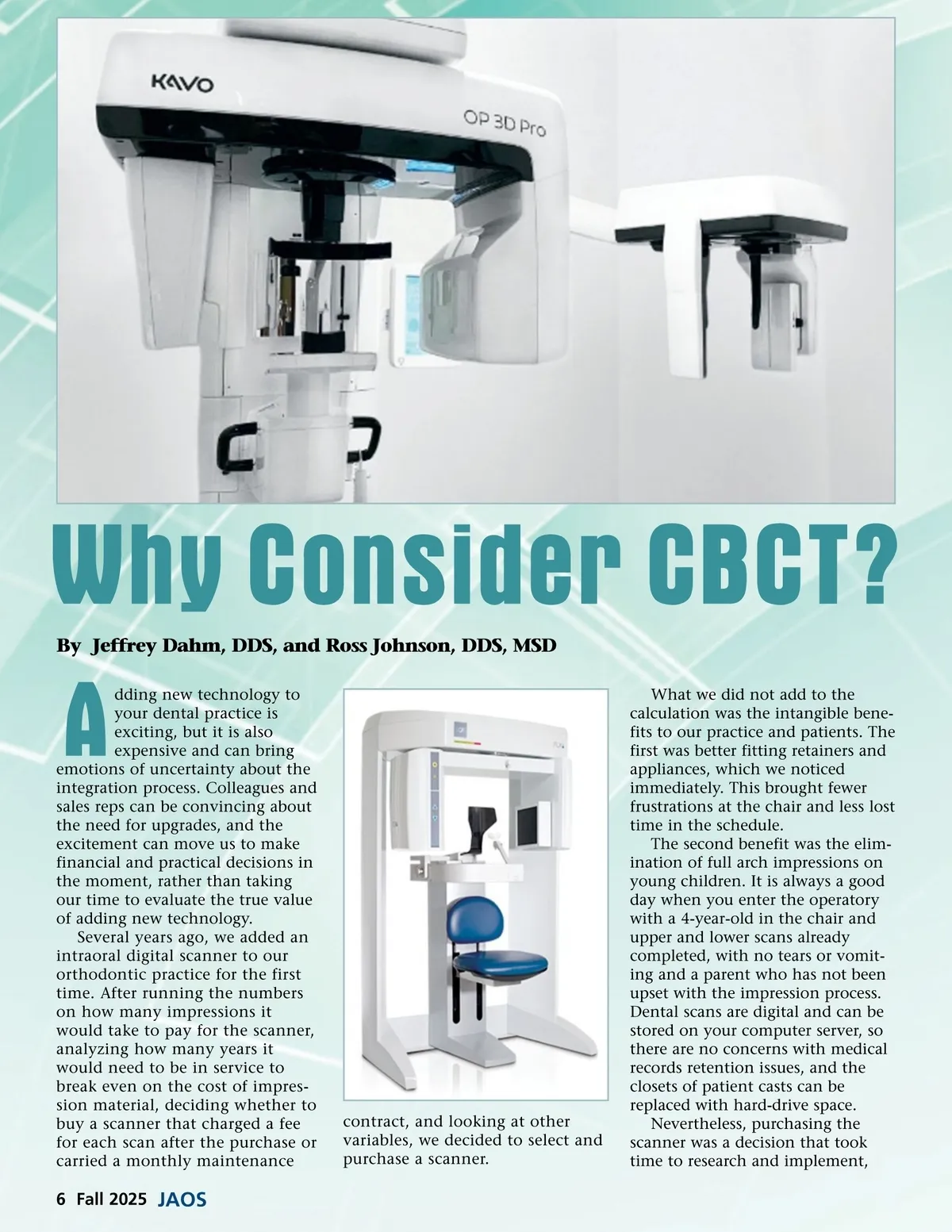
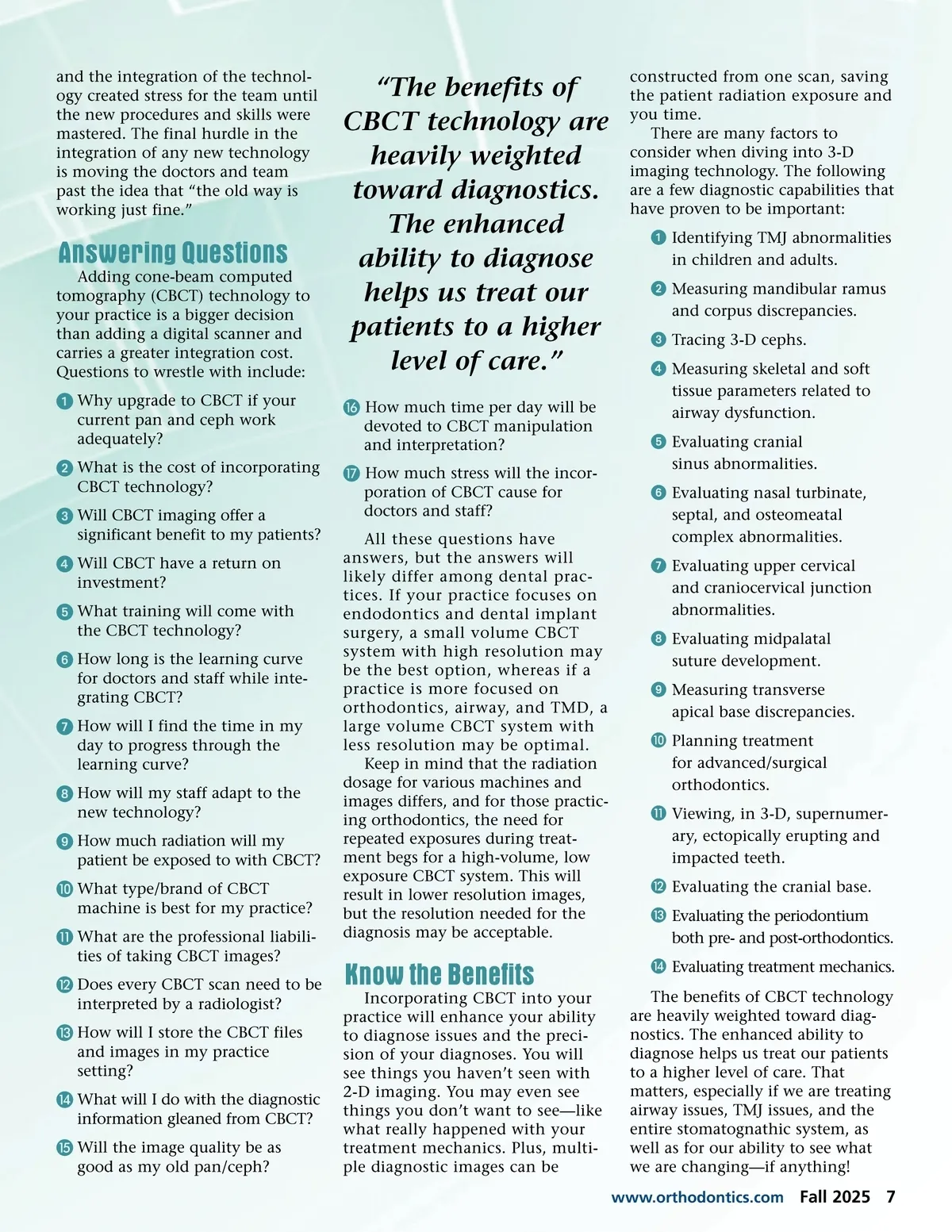
Why Consider CBCT? By Jeffrey Dahm, DDS, and Ross Johnson, DDS, MSD A dding new technology to your dental practice is exciting, but it is also expensive and can bring emotions of uncertainty about the integration process. Colleagues and sales reps can be convincing about the need for upgrades, and the excitement can move us to make financial and practical decisions in the moment, rather than taking our time to evaluate the true value of adding new technology. Several years ago, we added an intraoral digital scanner to our orthodontic practice for the first time. After running the numbers on how many impressions it would take to pay for the scanner, analyzing how many years it would need to be in service to break even on the cost of impres-sion material, deciding whether to buy a scanner that charged a fee for each scan after the purchase or carried a monthly maintenance contract, and looking at other variables, we decided to select and purchase a scanner. What we did not add to the calculation was the intangible bene-fits to our practice and patients. The first was better fitting retainers and appliances, which we noticed immediately. This brought fewer frustrations at the chair and less lost time in the schedule. The second benefit was the elim-ination of full arch impressions on young children. It is always a good day when you enter the operatory with a 4-year-old in the chair and upper and lower scans already completed, with no tears or vomit-ing and a parent who has not been upset with the impression process. Dental scans are digital and can be stored on your computer server, so there are no concerns with medical records retention issues, and the closets of patient casts can be replaced with hard-drive space. Nevertheless, purchasing the scanner was a decision that took time to research and implement, 6 Fall 2025 JAOS
Journal of the American Orthodontic Society Fall 2025: Page 6