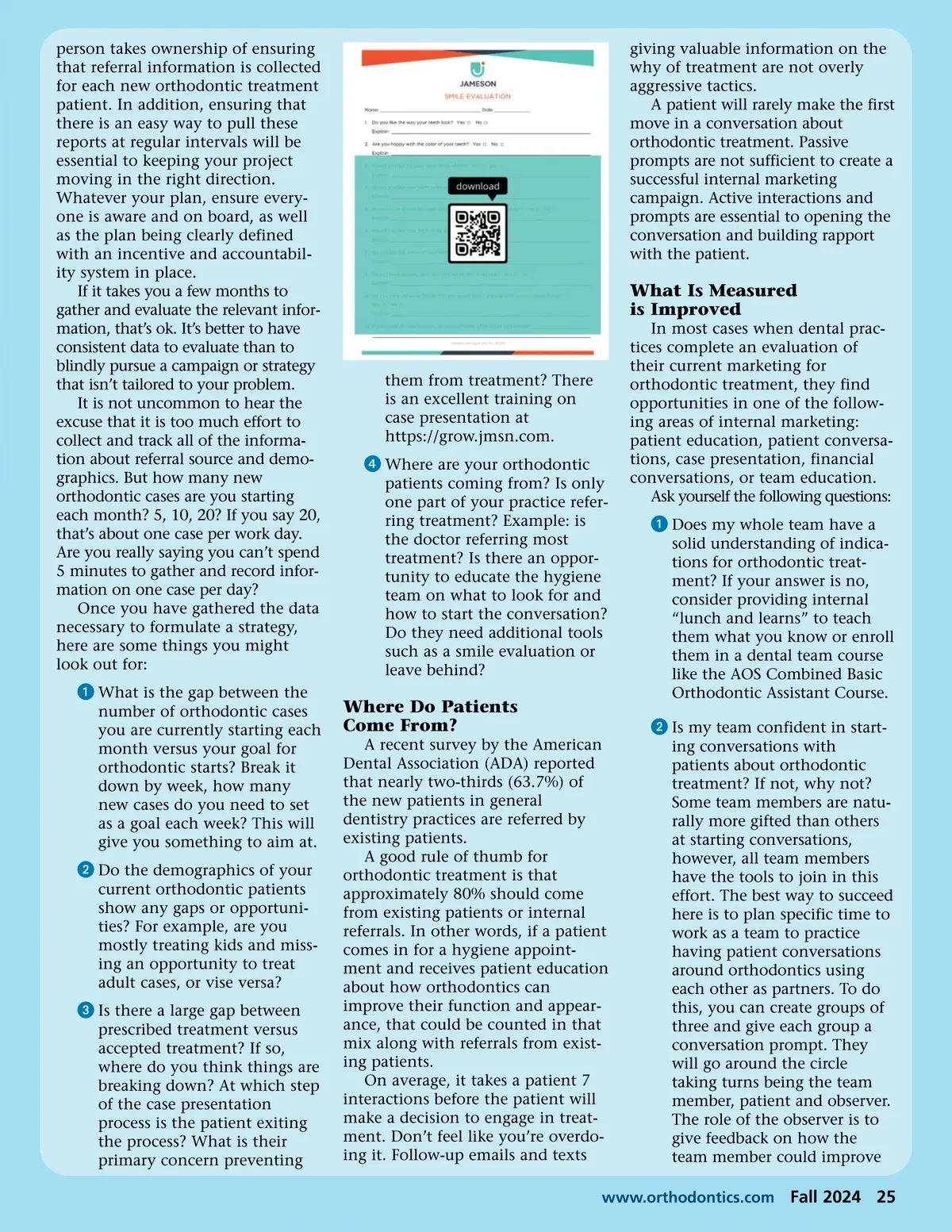
person takes ownership of ensuring that referral information is collected for each new orthodontic treatment patient. In addition, ensuring that there is an easy way to pull these reports at regular intervals will be essential to keeping your project moving in the right direction. Whatever your plan, ensure every-one is aware and on board, as well as the plan being clearly defined with an incentive and accountabil-ity system in place. If it takes you a few months to gather and evaluate the relevant infor-mation, that’s ok. It’s better to have consistent data to evaluate than to blindly pursue a campaign or strategy that isn’t tailored to your problem. It is not uncommon to hear the excuse that it is too much effort to collect and track all of the informa-tion about referral source and demo-graphics. But how many new orthodontic cases are you starting each month? 5, 10, 20? If you say 20, that’s about one case per work day. Are you really saying you can’t spend 5 minutes to gather and record infor-mation on one case per day? Once you have gathered the data necessary to formulate a strategy, here are some things you might look out for: giving valuable information on the why of treatment are not overly aggressive tactics. A patient will rarely make the first move in a conversation about orthodontic treatment. Passive prompts are not sufficient to create a successful internal marketing campaign. Active interactions and prompts are essential to opening the conversation and building rapport with the patient. What Is Measured is Improved In most cases when dental prac-tices complete an evaluation of their current marketing for orthodontic treatment, they find opportunities in one of the follow-ing areas of internal marketing: patient education, patient conversa-tions, case presentation, financial conversations, or team education. Ask yourself the following questions: them from treatment? There is an excellent training on case presentation at https://grow.jmsn.com. ᕤ Where are your orthodontic patients coming from? Is only one part of your practice refer-ring treatment? Example: is the doctor referring most treatment? Is there an oppor-tunity to educate the hygiene team on what to look for and how to start the conversation? Do they need additional tools such as a smile evaluation or leave behind? ᕡ Does my whole team have a solid understanding of indica-tions for orthodontic treat-ment? If your answer is no, consider providing internal “lunch and learns” to teach them what you know or enroll them in a dental team course like the AOS Combined Basic Orthodontic Assistant Course. ᕡ What is the gap between the number of orthodontic cases you are currently starting each month versus your goal for orthodontic starts? Break it down by week, how many new cases do you need to set as a goal each week? This will give you something to aim at. Where Do Patients Come From? A recent survey by the American Dental Association (ADA) reported that nearly two-thirds (63.7%) of the new patients in general dentistry practices are referred by existing patients. A good rule of thumb for orthodontic treatment is that approximately 80% should come from existing patients or internal referrals. In other words, if a patient comes in for a hygiene appoint-ment and receives patient education about how orthodontics can improve their function and appear-ance, that could be counted in that mix along with referrals from exist-ing patients. On average, it takes a patient 7 interactions before the patient will make a decision to engage in treat-ment. Don’t feel like you’re overdo-ing it. Follow-up emails and texts ᕢ Is my team confident in start-ing conversations with patients about orthodontic treatment? If not, why not? Some team members are natu-rally more gifted than others at starting conversations, however, all team members have the tools to join in this effort. The best way to succeed here is to plan specific time to work as a team to practice having patient conversations around orthodontics using each other as partners. To do this, you can create groups of three and give each group a conversation prompt. They will go around the circle taking turns being the team member, patient and observer. The role of the observer is to give feedback on how the team member could improve ᕢ Do the demographics of your current orthodontic patients show any gaps or opportuni-ties? For example, are you mostly treating kids and miss-ing an opportunity to treat adult cases, or vise versa? ᕣ Is there a large gap between prescribed treatment versus accepted treatment? If so, where do you think things are breaking down? At which step of the case presentation process is the patient exiting the process? What is their primary concern preventing www.orthodontics.com Fall 2024 25
Journal of the American Orthodontic Society Fall 2024: Page 25