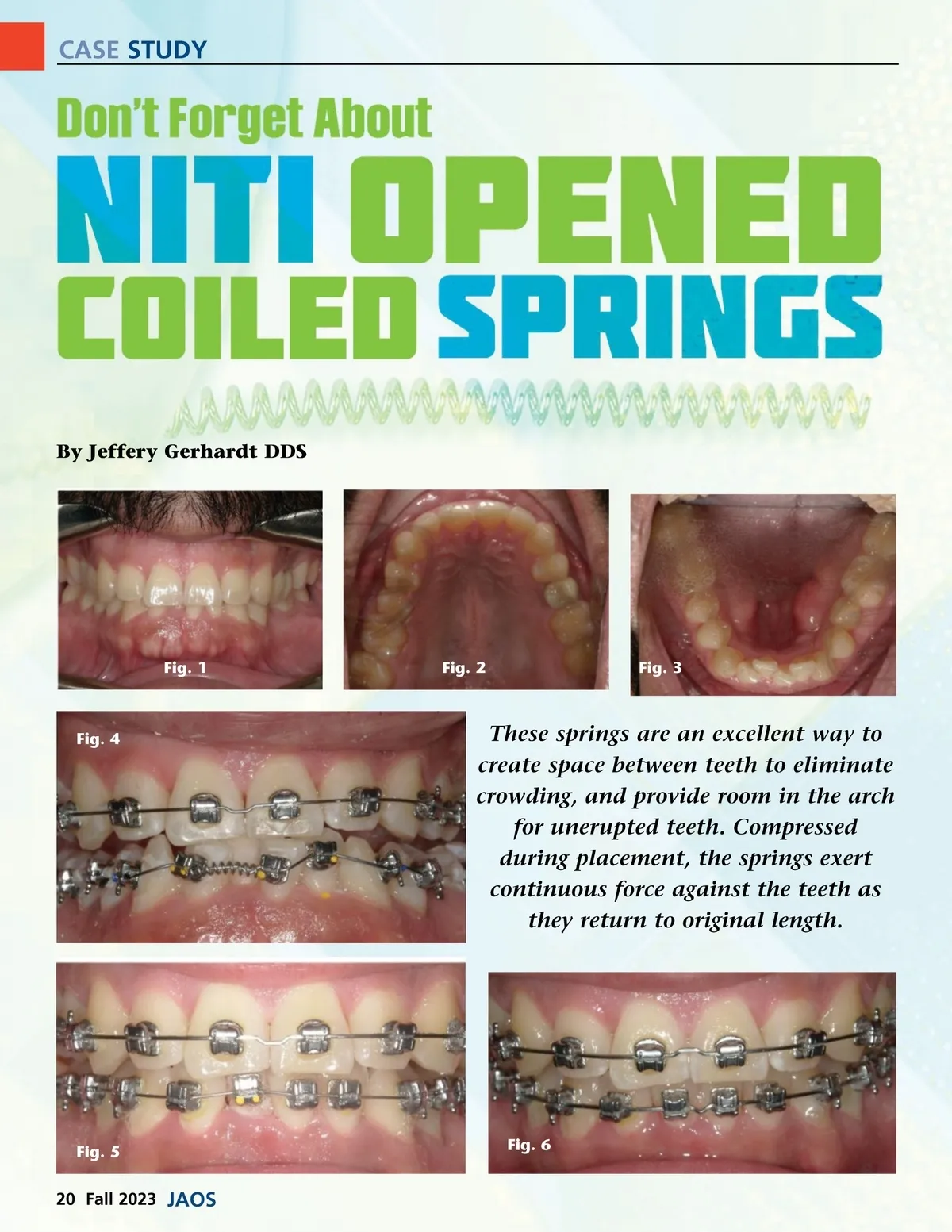
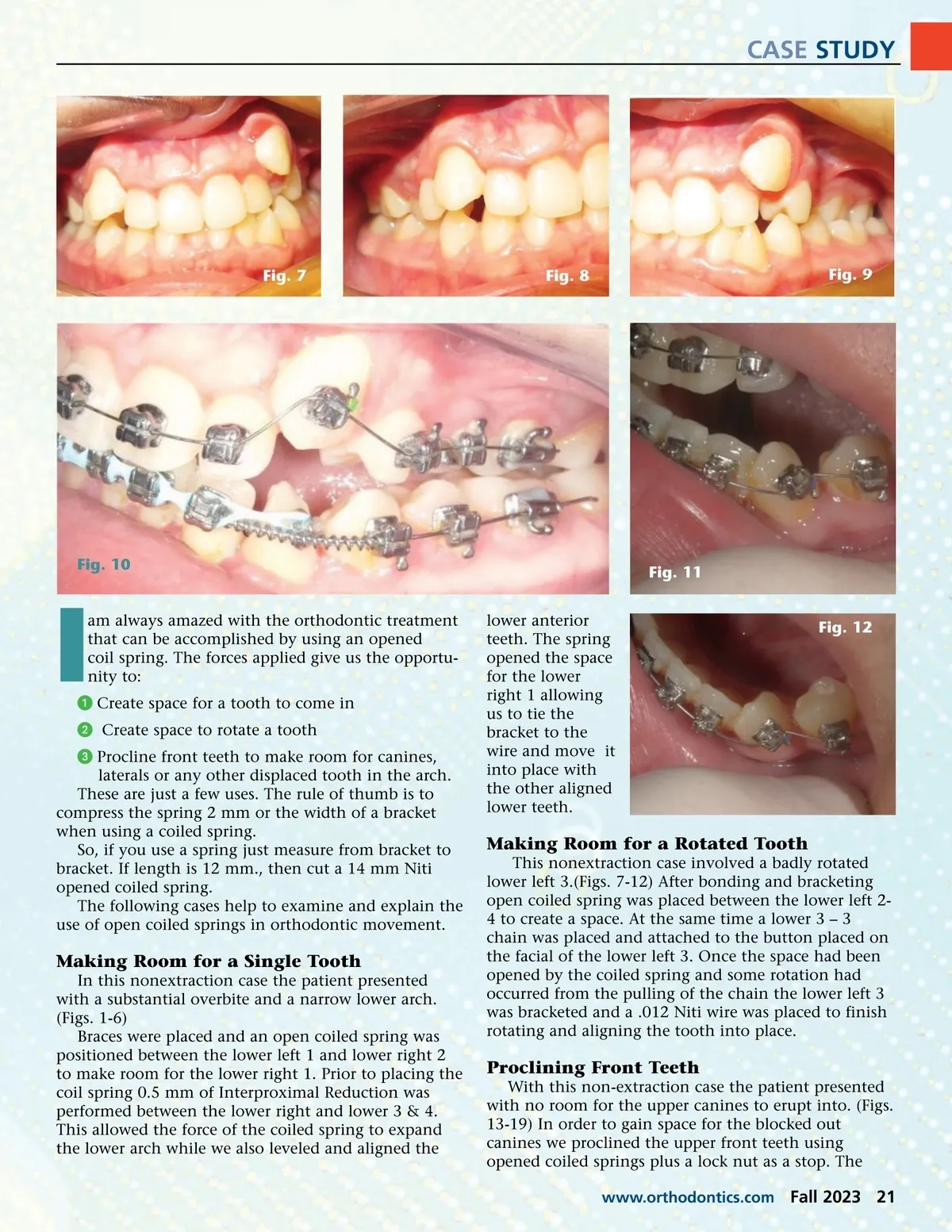
CASE STUDY Fig. 7 Fig. 8 Fig. 9 Fig. 10 Fig. 11 lower anterior teeth. The spring opened the space for the lower right 1 allowing us to tie the bracket to the wire and move it into place with the other aligned lower teeth. I am always amazed with the orthodontic treatment that can be accomplished by using an opened coil spring. The forces applied give us the opportu-nity to: Fig. 12 ᕡ Create space for a tooth to come in ᕢ Create space to rotate a tooth ᕣ Procline front teeth to make room for canines, laterals or any other displaced tooth in the arch. These are just a few uses. The rule of thumb is to compress the spring 2 mm or the width of a bracket when using a coiled spring. So, if you use a spring just measure from bracket to bracket. If length is 12 mm., then cut a 14 mm Niti opened coiled spring. The following cases help to examine and explain the use of open coiled springs in orthodontic movement. Making Room for a Rotated Tooth This nonextraction case involved a badly rotated lower left 3.(Figs. 7-12) After bonding and bracketing open coiled spring was placed between the lower left 2-4 to create a space. At the same time a lower 3 – 3 chain was placed and attached to the button placed on the facial of the lower left 3. Once the space had been opened by the coiled spring and some rotation had occurred from the pulling of the chain the lower left 3 was bracketed and a .012 Niti wire was placed to finish rotating and aligning the tooth into place. Making Room for a Single Tooth In this nonextraction case the patient presented with a substantial overbite and a narrow lower arch. (Figs. 1-6) Braces were placed and an open coiled spring was positioned between the lower left 1 and lower right 2 to make room for the lower right 1. Prior to placing the coil spring 0.5 mm of Interproximal Reduction was performed between the lower right and lower 3 & 4. This allowed the force of the coiled spring to expand the lower arch while we also leveled and aligned the Proclining Front Teeth With this non-extraction case the patient presented with no room for the upper canines to erupt into. (Figs. 13-19) In order to gain space for the blocked out canines we proclined the upper front teeth using opened coiled springs plus a lock nut as a stop. The www.orthodontics.com Fall 2023 21
Journal of the American Orthodontic Society Fall 2023: Page 21