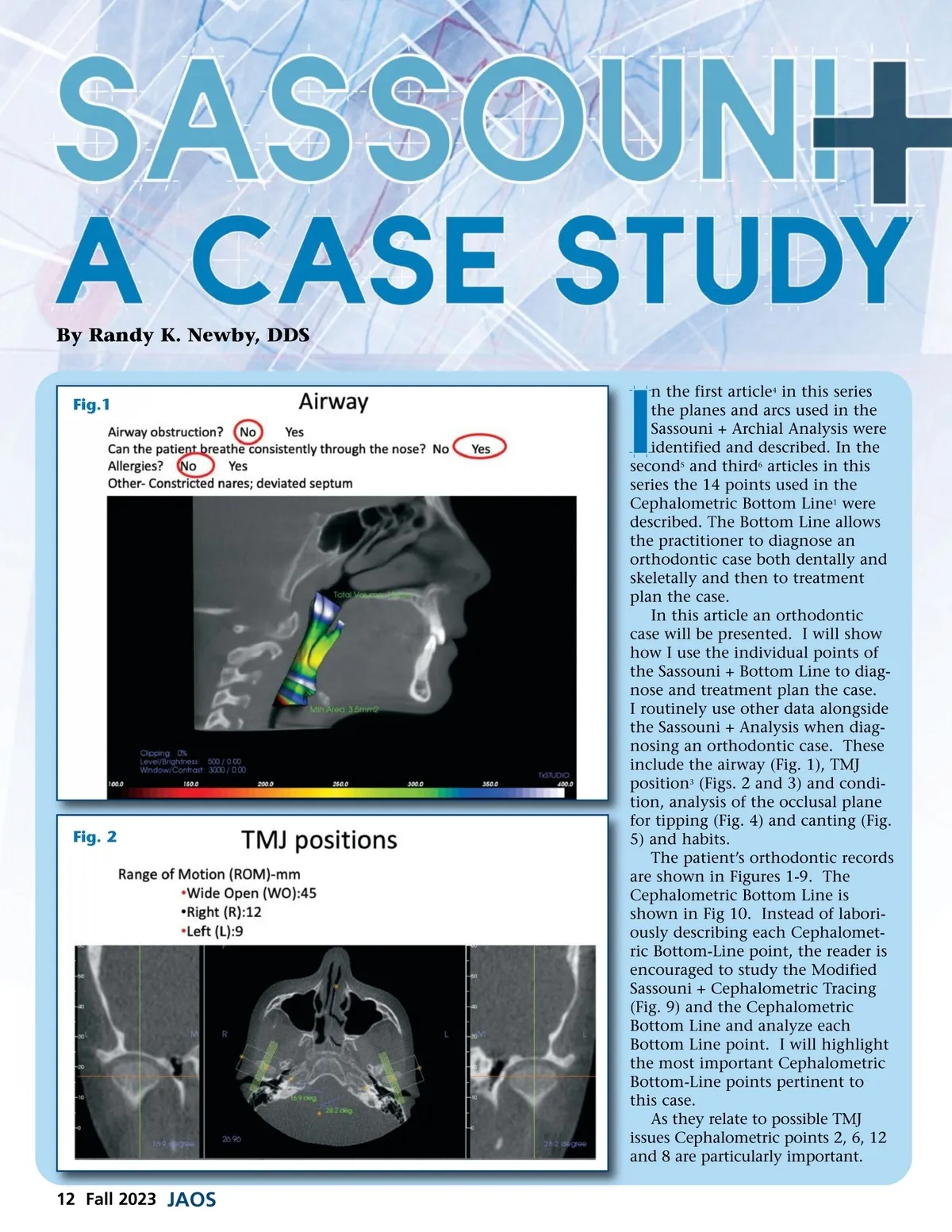
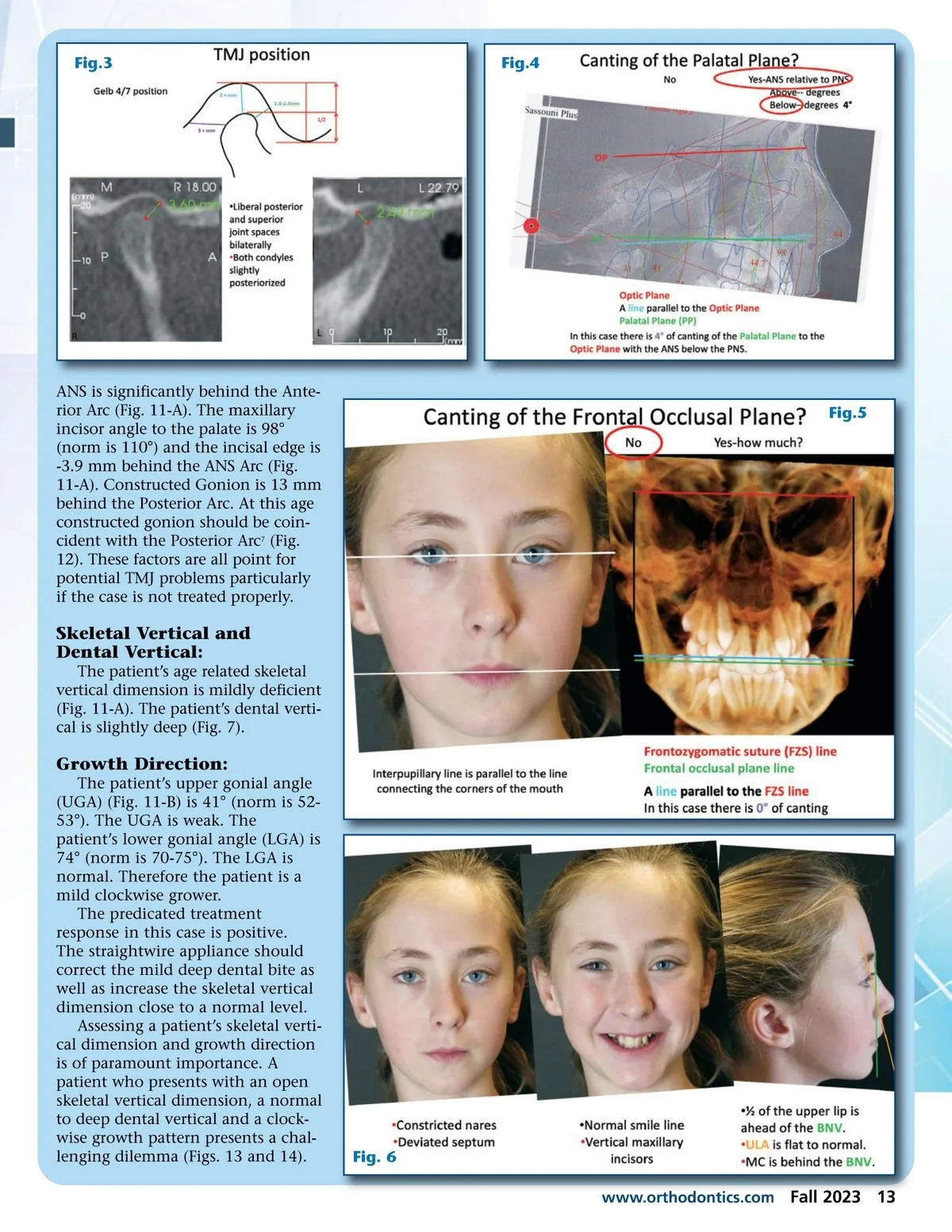
By Randy K. Newby, DDS Fig.1 I Fig. 2 n the first article 4 in this series the planes and arcs used in the Sassouni + Archial Analysis were identified and described. In the second 5 and third 6 articles in this series the 14 points used in the Cephalometric Bottom Line 1 were described. The Bottom Line allows the practitioner to diagnose an orthodontic case both dentally and skeletally and then to treatment plan the case. In this article an orthodontic case will be presented. I will show how I use the individual points of the Sassouni + Bottom Line to diag-nose and treatment plan the case. I routinely use other data alongside the Sassouni + Analysis when diag-nosing an orthodontic case. These include the airway (Fig. 1), TMJ position 3 (Figs. 2 and 3) and condi-tion, analysis of the occlusal plane for tipping (Fig. 4) and canting (Fig. 5) and habits. The patient’s orthodontic records are shown in Figures 1-9. The Cephalometric Bottom Line is shown in Fig 10. Instead of labori-ously describing each Cephalomet-ric Bottom-Line point, the reader is encouraged to study the Modified Sassouni + Cephalometric Tracing (Fig. 9) and the Cephalometric Bottom Line and analyze each Bottom Line point. I will highlight the most important Cephalometric Bottom-Line points pertinent to this case. As they relate to possible TMJ issues Cephalometric points 2, 6, 12 and 8 are particularly important. 12 Fall 2023 JAOS
Journal of the American Orthodontic Society Fall 2023: Page 12