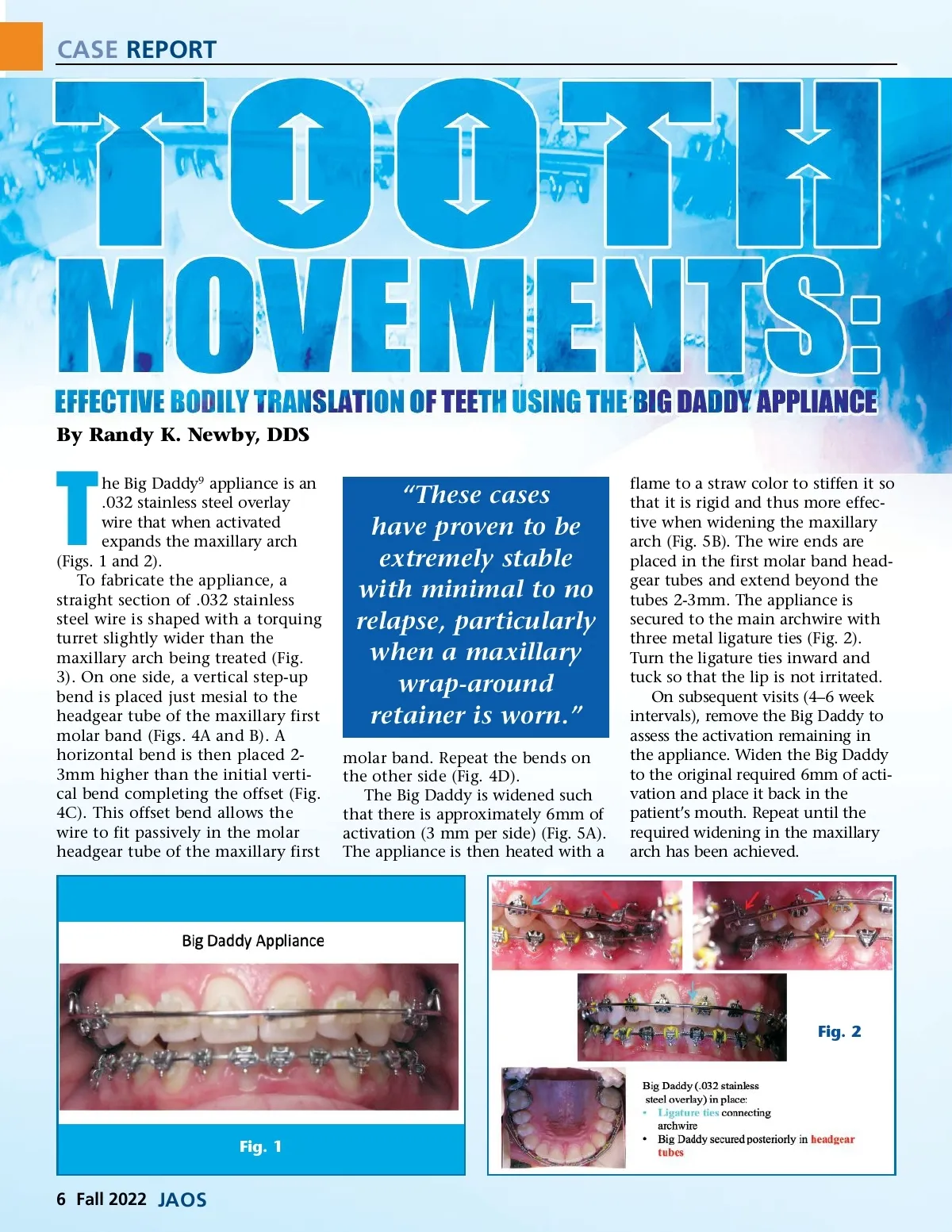
CASE REPORT Fig. 5 Fig. 3 Fig. 4 Fig. 6 Case #1: Big Daddy Used on Teenage Patient Fig. 6 shows the results of using the Big Daddy to widen the maxil-lary arch in a 13-year-old patient. As the widening of the maxilla occurs, note that proper axial incli-nation of the maxillary posterior teeth relative to the lower posterior teeth has been maintained. crowns are over rotated to the buccal resulting in an excessive curve of Monson. 7 Once the expansion forces are removed, the crowns of these teeth will re-upright over their respective roots resulting in minimal expan-sion of the maxillary arch. Fig. 7 Case #2: Big Daddy Used on Adult Patient Figs. 7 and 8 show the results of using the Big Daddy to widen the maxillary arch in an adult patient. Is this good treatment? No! The maxillary molar and bicuspid What is the problem --why was Case #1 successful and Case #2 was not? Let’s look at the physics of the mechanics employed. When using the Big Daddy appliance, the point of force application (PFA) 5 (Fig. 9A) is occlusal to the center of resistance (COR) of both maxillary first molars bilaterally (Figs. 9B and C). This creates a buccal rota-tion moment 7 (Fig. 9B) resulting in buccal crown tipping (Fig. 10). www.orthodontics.com Fall 2022 7
Journal of the American Orthodontic Society Fall 2022: Page 7