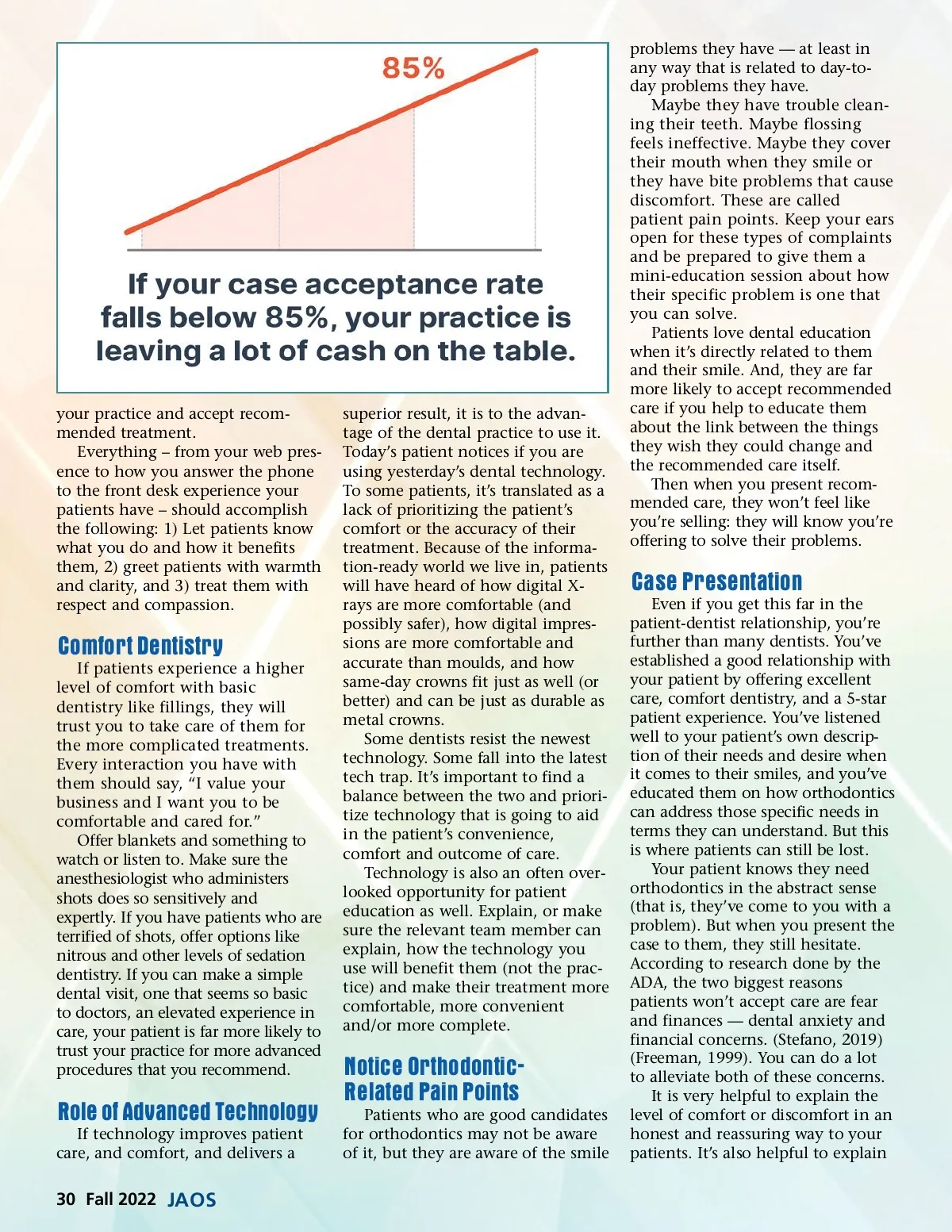
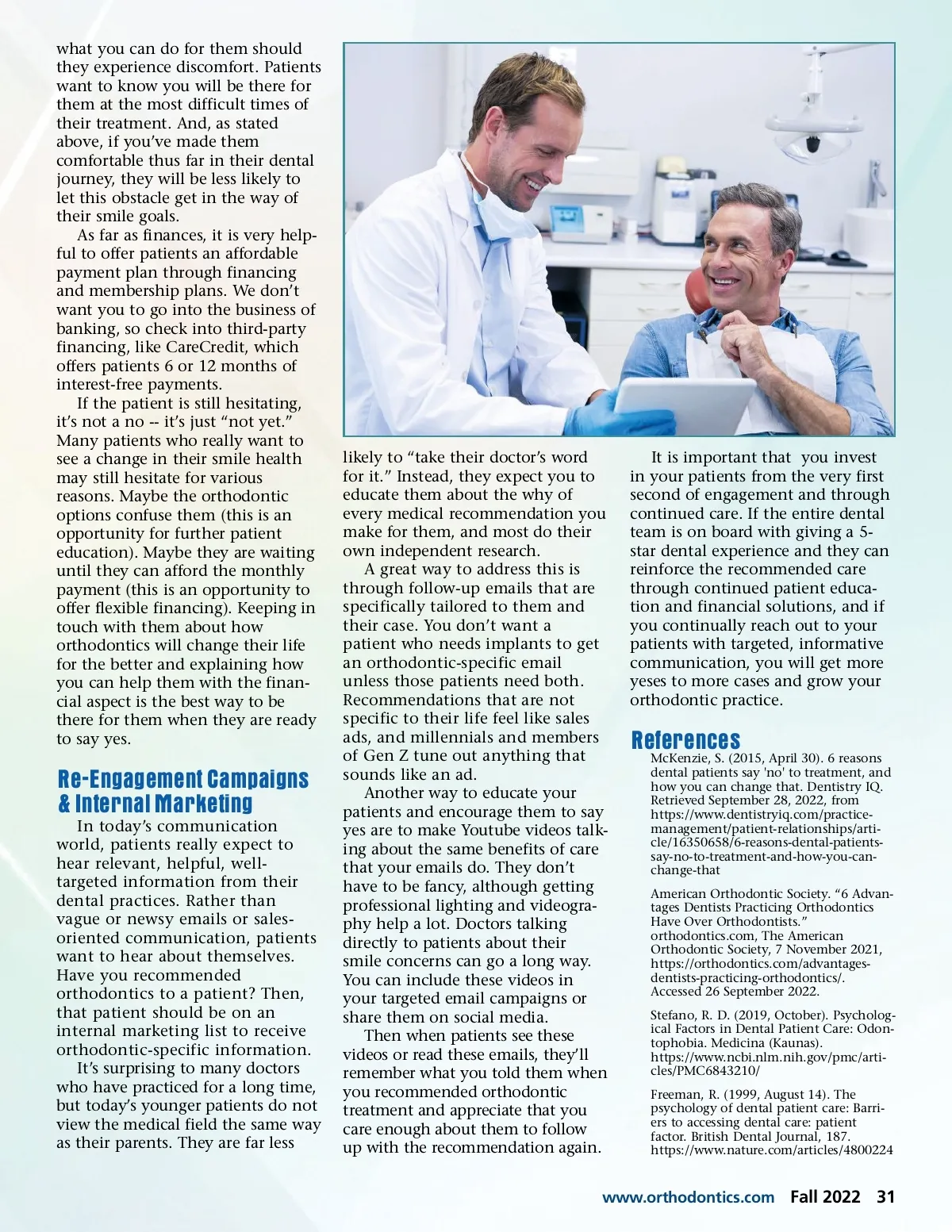
your practice and accept recom-mended treatment. Everything – from your web pres-ence to how you answer the phone to the front desk experience your patients have – should accomplish the following: 1) Let patients know what you do and how it benefits them, 2) greet patients with warmth and clarity, and 3) treat them with respect and compassion. Comfort Dentistry If patients experience a higher level of comfort with basic dentistry like fillings, they will trust you to take care of them for the more complicated treatments. Every interaction you have with them should say, “I value your business and I want you to be comfortable and cared for.” Offer blankets and something to watch or listen to. Make sure the anesthesiologist who administers shots does so sensitively and expertly. If you have patients who are terrified of shots, offer options like nitrous and other levels of sedation dentistry. If you can make a simple dental visit, one that seems so basic to doctors, an elevated experience in care, your patient is far more likely to trust your practice for more advanced procedures that you recommend. superior result, it is to the advan-tage of the dental practice to use it. Today’s patient notices if you are using yesterday’s dental technology. To some patients, it’s translated as a lack of prioritizing the patient’s comfort or the accuracy of their treatment. Because of the informa-tion-ready world we live in, patients will have heard of how digital X-rays are more comfortable (and possibly safer), how digital impres-sions are more comfortable and accurate than moulds, and how same-day crowns fit just as well (or better) and can be just as durable as metal crowns. Some dentists resist the newest technology. Some fall into the latest tech trap. It’s important to find a balance between the two and priori-tize technology that is going to aid in the patient’s convenience, comfort and outcome of care. Technology is also an often over-looked opportunity for patient education as well. Explain, or make sure the relevant team member can explain, how the technology you use will benefit them (not the prac-tice) and make their treatment more comfortable, more convenient and/or more complete. problems they have — at least in any way that is related to day-to-day problems they have. Maybe they have trouble clean-ing their teeth. Maybe flossing feels ineffective. Maybe they cover their mouth when they smile or they have bite problems that cause discomfort. These are called patient pain points. Keep your ears open for these types of complaints and be prepared to give them a mini-education session about how their specific problem is one that you can solve. Patients love dental education when it’s directly related to them and their smile. And, they are far more likely to accept recommended care if you help to educate them about the link between the things they wish they could change and the recommended care itself. Then when you present recom-mended care, they won’t feel like you’re selling: they will know you’re offering to solve their problems. Case Presentation Even if you get this far in the patient-dentist relationship, you’re further than many dentists. You’ve established a good relationship with your patient by offering excellent care, comfort dentistry, and a 5-star patient experience. You’ve listened well to your patient’s own descrip-tion of their needs and desire when it comes to their smiles, and you’ve educated them on how orthodontics can address those specific needs in terms they can understand. But this is where patients can still be lost. Your patient knows they need orthodontics in the abstract sense (that is, they’ve come to you with a problem). But when you present the case to them, they still hesitate. According to research done by the ADA, the two biggest reasons patients won’t accept care are fear and finances — dental anxiety and financial concerns. (Stefano, 2019) (Freeman, 1999). You can do a lot to alleviate both of these concerns. It is very helpful to explain the level of comfort or discomfort in an honest and reassuring way to your patients. It’s also helpful to explain Role of Advanced Technology If technology improves patient care, and comfort, and delivers a Notice Orthodontic-Related Pain Points Patients who are good candidates for orthodontics may not be aware of it, but they are aware of the smile 30 Fall 2022 JAOS
Journal of the American Orthodontic Society Fall 2022: Page 30