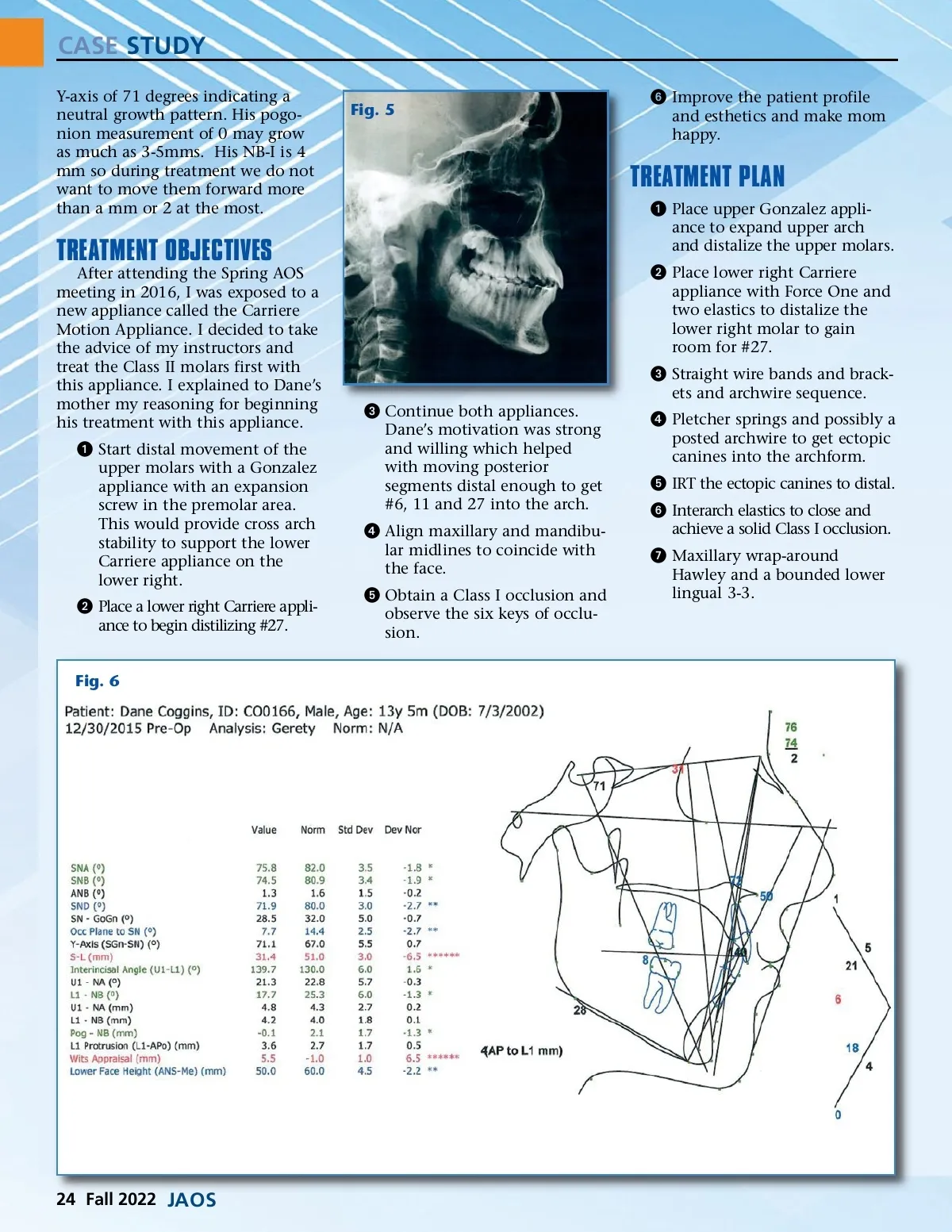
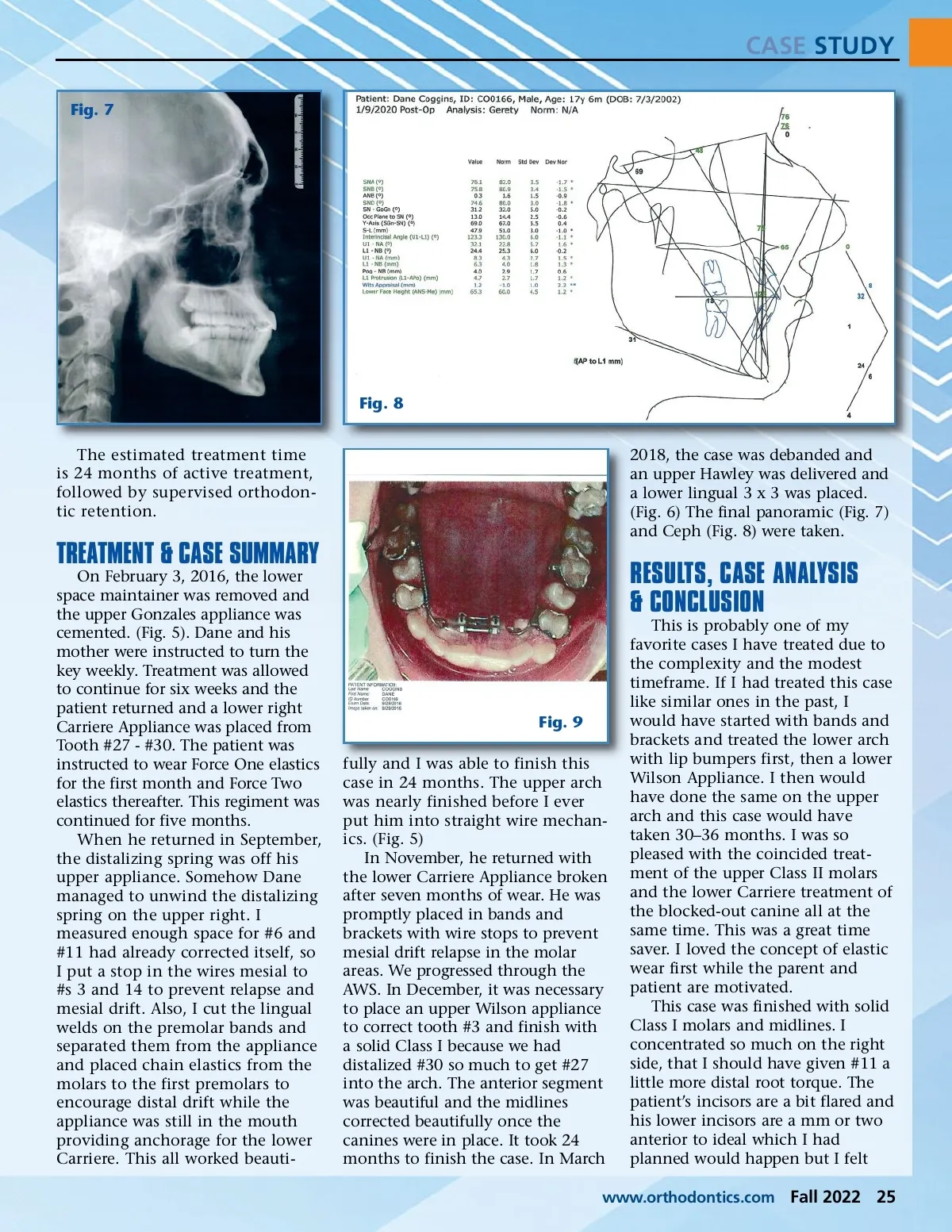
CASE STUDY Fig. 7 Fig. 8 The estimated treatment time is 24 months of active treatment, followed by supervised orthodon-tic retention. 2018, the case was debanded and an upper Hawley was delivered and a lower lingual 3 x 3 was placed. (Fig. 6) The final panoramic (Fig. 7) and Ceph (Fig. 8) were taken. TREATMENT & CASE SUMMARY On February 3, 2016, the lower space maintainer was removed and the upper Gonzales appliance was cemented. (Fig. 5). Dane and his mother were instructed to turn the key weekly. Treatment was allowed to continue for six weeks and the patient returned and a lower right Carriere Appliance was placed from Tooth #27 -#30. The patient was instructed to wear Force One elastics for the first month and Force Two elastics thereafter. This regiment was continued for five months. When he returned in September, the distalizing spring was off his upper appliance. Somehow Dane managed to unwind the distalizing spring on the upper right. I measured enough space for #6 and #11 had already corrected itself, so I put a stop in the wires mesial to #s 3 and 14 to prevent relapse and mesial drift. Also, I cut the lingual welds on the premolar bands and separated them from the appliance and placed chain elastics from the molars to the first premolars to encourage distal drift while the appliance was still in the mouth providing anchorage for the lower Carriere. This all worked beauti-RESULTS, CASE ANALYSIS & CONCLUSION This is probably one of my favorite cases I have treated due to the complexity and the modest timeframe. If I had treated this case like similar ones in the past, I would have started with bands and brackets and treated the lower arch with lip bumpers first, then a lower Wilson Appliance. I then would have done the same on the upper arch and this case would have taken 30–36 months. I was so pleased with the coincided treat-ment of the upper Class II molars and the lower Carriere treatment of the blocked-out canine all at the same time. This was a great time saver. I loved the concept of elastic wear first while the parent and patient are motivated. This case was finished with solid Class I molars and midlines. I concentrated so much on the right side, that I should have given #11 a little more distal root torque. The patient’s incisors are a bit flared and his lower incisors are a mm or two anterior to ideal which I had planned would happen but I felt Fig. 9 fully and I was able to finish this case in 24 months. The upper arch was nearly finished before I ever put him into straight wire mechan-ics. (Fig. 5) In November, he returned with the lower Carriere Appliance broken after seven months of wear. He was promptly placed in bands and brackets with wire stops to prevent mesial drift relapse in the molar areas. We progressed through the AWS. In December, it was necessary to place an upper Wilson appliance to correct tooth #3 and finish with a solid Class I because we had distalized #30 so much to get #27 into the arch. The anterior segment was beautiful and the midlines corrected beautifully once the canines were in place. It took 24 months to finish the case. In March www.orthodontics.com Fall 2022 25
Journal of the American Orthodontic Society Fall 2022: Page 25