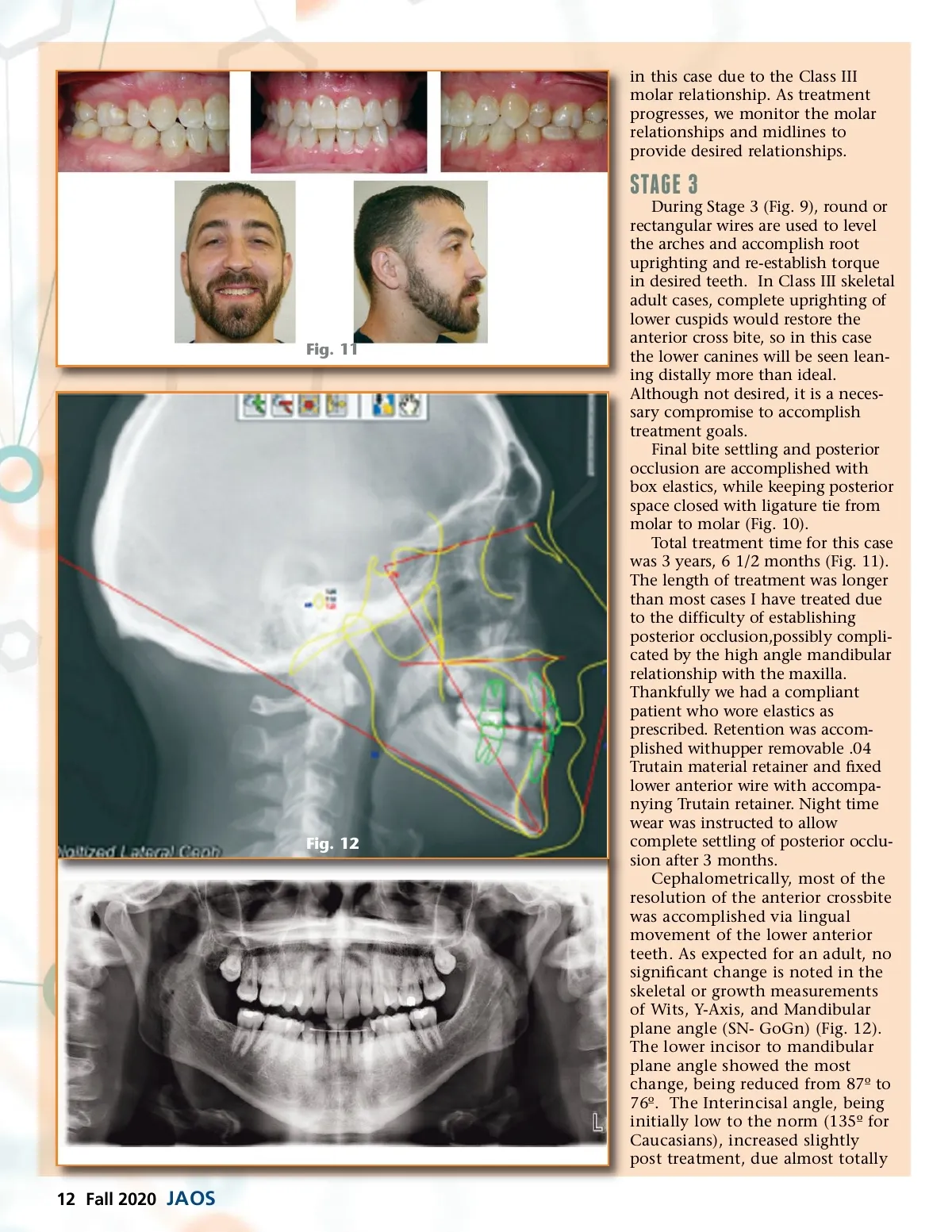
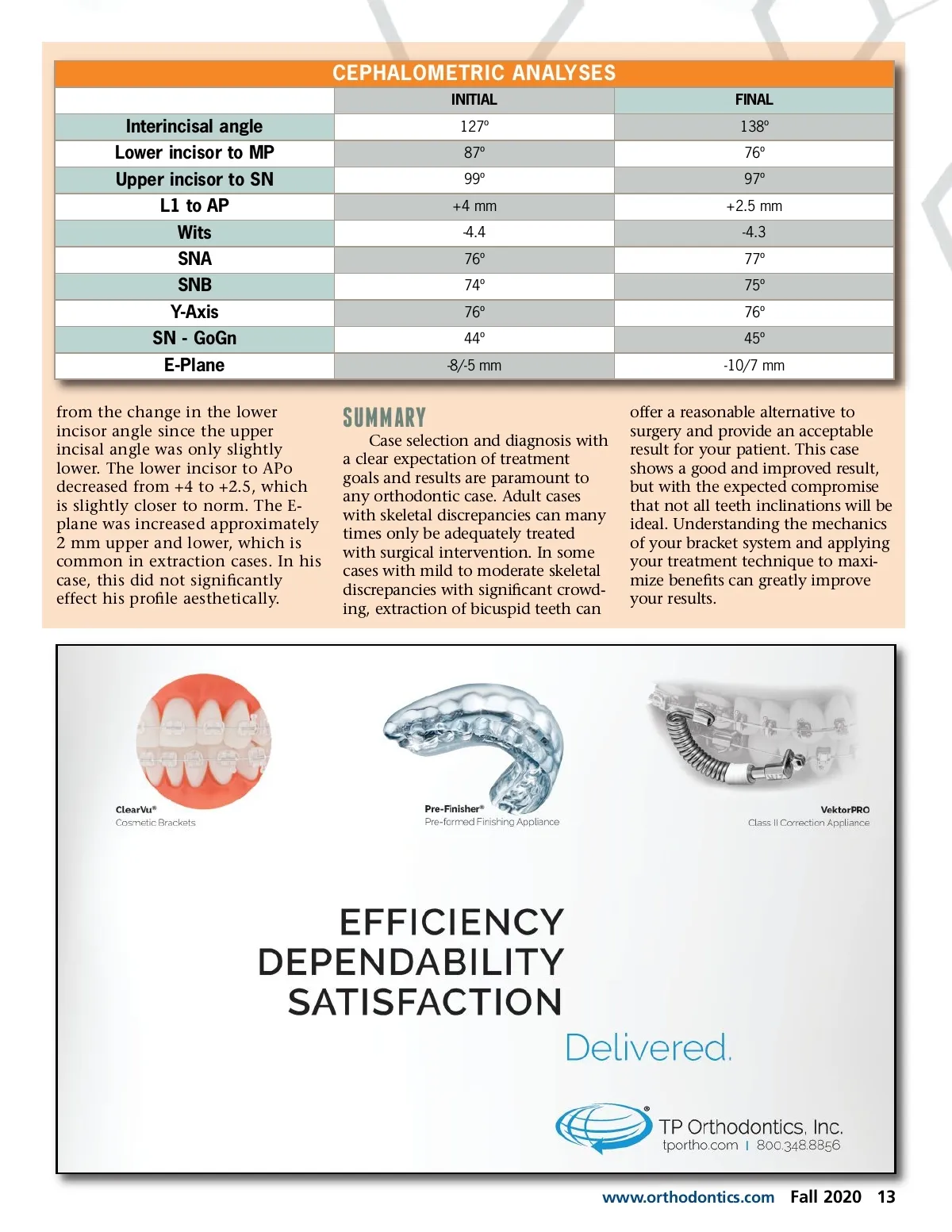
in this case due to the Class III molar relationship. As treatment progresses, we monitor the molar relationships and midlines to provide desired relationships. STAGE 3 During Stage 3 (Fig. 9), round or rectangular wires are used to level the arches and accomplish root uprighting and re-establish torque in desired teeth. In Class III skeletal adult cases, complete uprighting of lower cuspids would restore the anterior cross bite, so in this case the lower canines will be seen lean-ing distally more than ideal. Although not desired, it is a neces-sary compromise to accomplish treatment goals. Final bite settling and posterior occlusion are accomplished with box elastics, while keeping posterior space closed with ligature tie from molar to molar (Fig. 10). Total treatment time for this case was 3 years, 6 1/2 months (Fig. 11). The length of treatment was longer than most cases I have treated due to the difficulty of establishing posterior occlusion,possibly compli-cated by the high angle mandibular relationship with the maxilla. Thankfully we had a compliant patient who wore elastics as prescribed. Retention was accom-plished withupper removable .04 Trutain material retainer and fixed lower anterior wire with accompa-nying Trutain retainer. Night time wear was instructed to allow complete settling of posterior occlu-sion after 3 months. Cephalometrically, most of the resolution of the anterior crossbite was accomplished via lingual movement of the lower anterior teeth. As expected for an adult, no significant change is noted in the skeletal or growth measurements of Wits, Y-Axis, and Mandibular plane angle (SN-GoGn) (Fig. 12). The lower incisor to mandibular plane angle showed the most change, being reduced from 87º to 76º. The Interincisal angle, being initially low to the norm (135º for Caucasians), increased slightly post treatment, due almost totally Fig. 11 Fig. 12 12 Fall 2020 JAOS
Journal of the American Orthodontic Society Fall 2020: Page 12