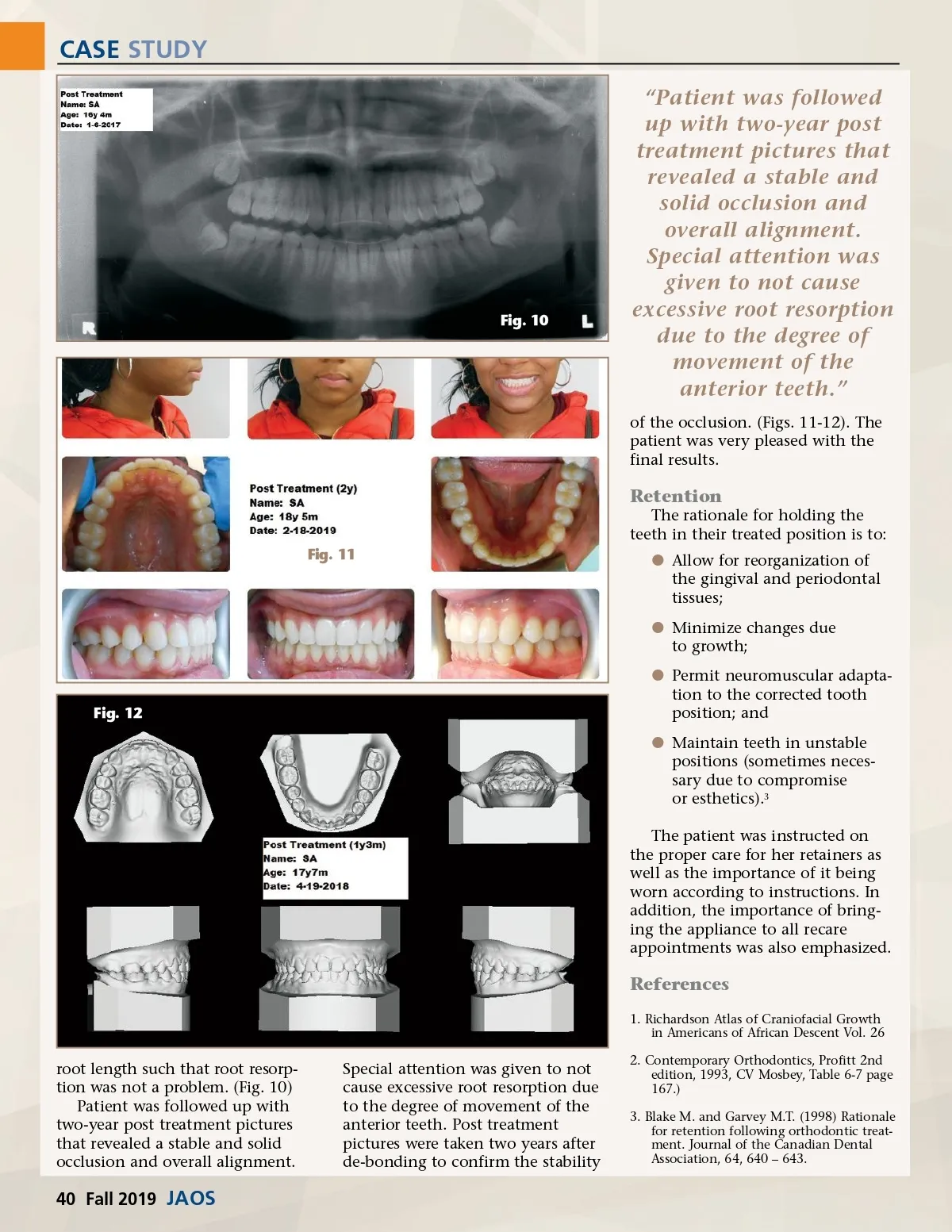
CASE STUDY “Patient was followed up with two-year post treatment pictures that revealed a stable and solid occlusion and overall alignment. Special attention was given to not cause excessive root resorption due to the degree of movement of the anterior teeth.” of the occlusion. (Figs. 11-12). The patient was very pleased with the final results. Fig. 10 Retention The rationale for holding the teeth in their treated position is to: Fig. 11 b Allow for reorganization of the gingival and periodontal tissues; b Minimize changes due to growth; b Permit neuromuscular adapta-tion to the corrected tooth position; and b Maintain teeth in unstable positions (sometimes neces-sary due to compromise or esthetics). 3 The patient was instructed on the proper care for her retainers as well as the importance of it being worn according to instructions. In addition, the importance of bring-ing the appliance to all recare appointments was also emphasized. Fig. 12 References 1. Richardson Atlas of Craniofacial Growth in Americans of African Descent Vol. 26 root length such that root resorp-tion was not a problem. (Fig. 10) Patient was followed up with two-year post treatment pictures that revealed a stable and solid occlusion and overall alignment. Special attention was given to not cause excessive root resorption due to the degree of movement of the anterior teeth. Post treatment pictures were taken two years after de-bonding to confirm the stability 2. Contemporary Orthodontics, Profitt 2nd edition, 1993, CV Mosbey, Table 6-7 page 167.) 3. Blake M. and Garvey M.T. (1998) Rationale for retention following orthodontic treat-ment. Journal of the Canadian Dental Association, 64, 640 – 643. 40 Fall 2019 JAOS
Journal of the American Orthodontic Society Fall 2019: Page 40