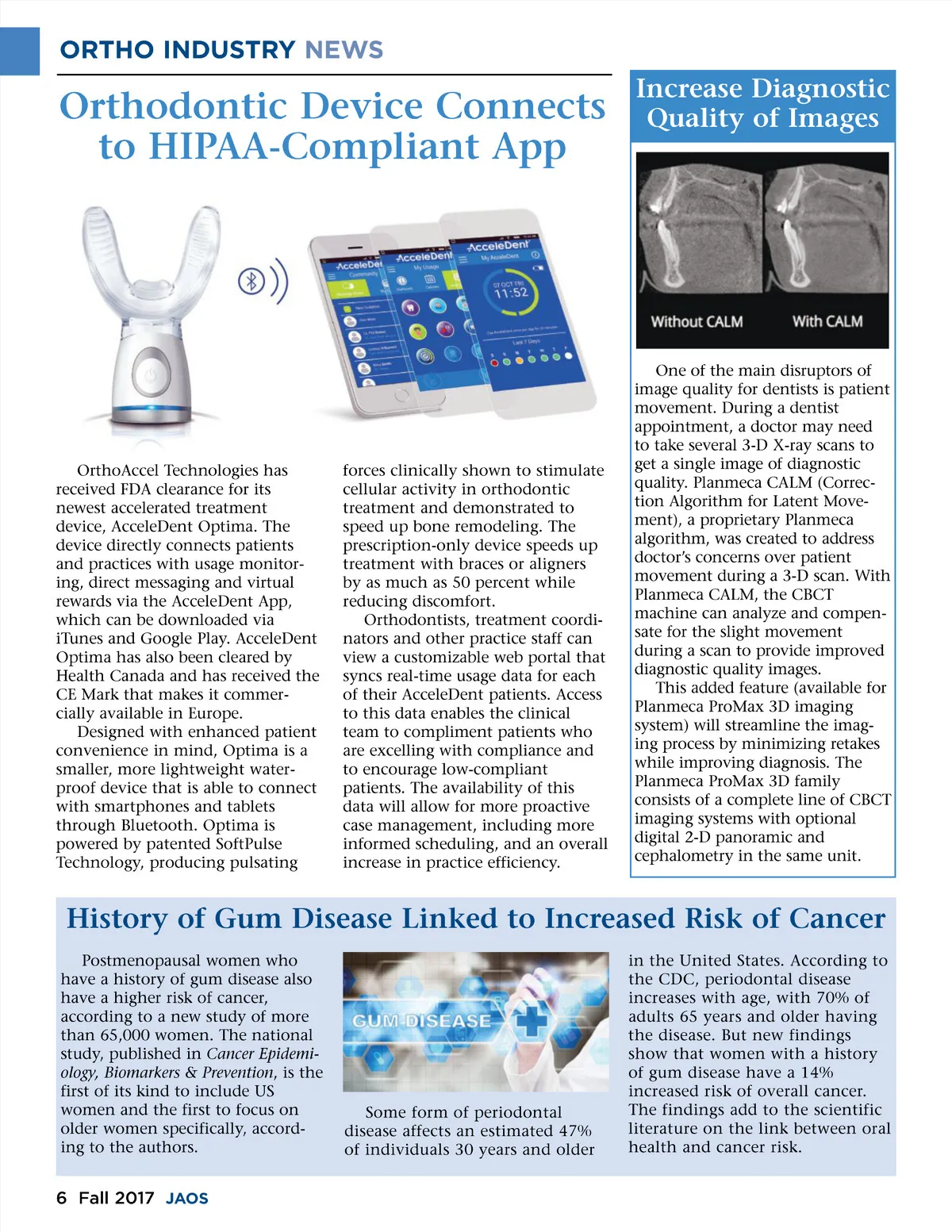
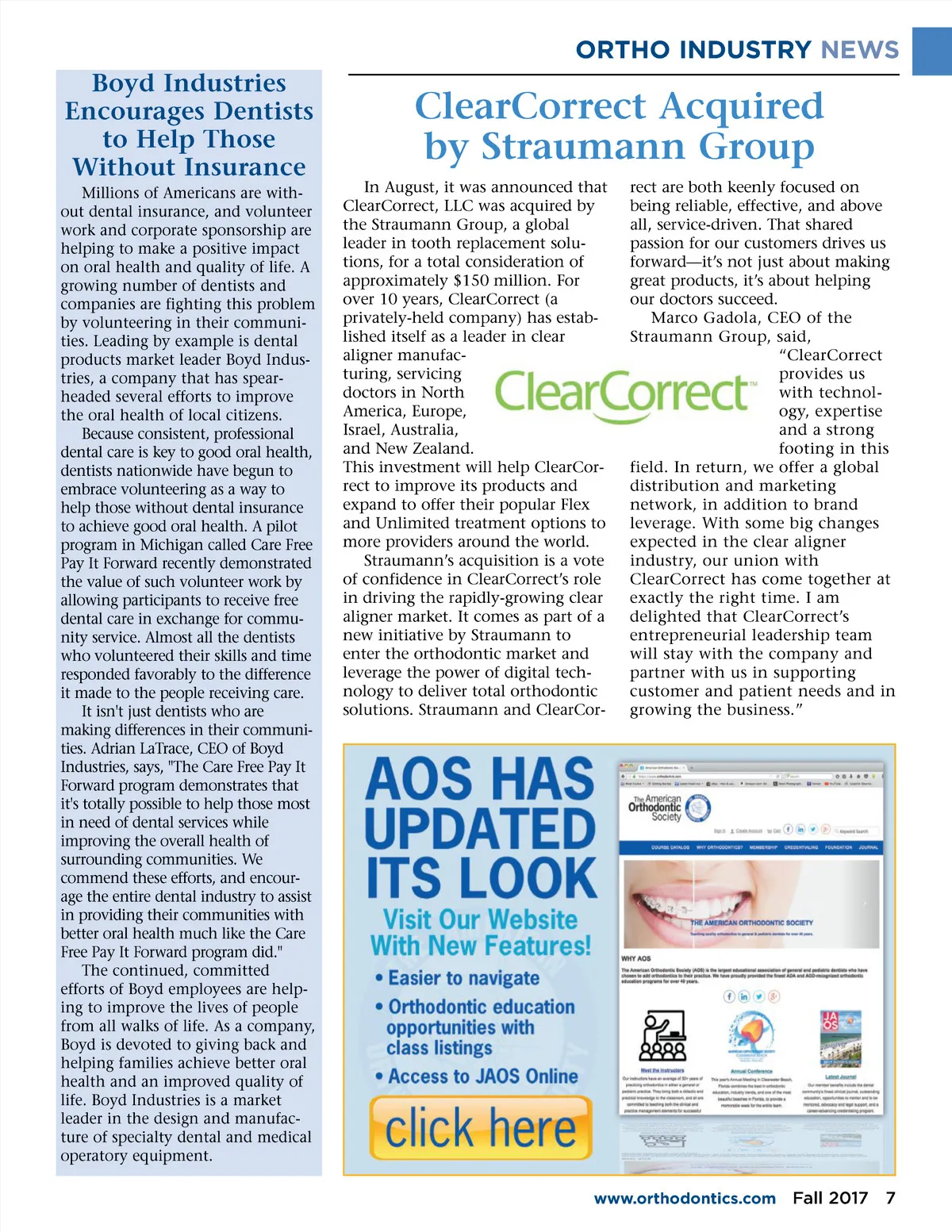
ORTHO INDUSTRY NEWS Orthodontic Device Connects to HIPAA-Compliant App Increase Diagnostic Quality of Images OrthoAccel Technologies has received FDA clearance for its newest accelerated treatment device, AcceleDent Optima. The device directly connects patients and practices with usage monitor-ing, direct messaging and virtual rewards via the AcceleDent App, which can be downloaded via iTunes and Google Play. AcceleDent Optima has also been cleared by Health Canada and has received the CE Mark that makes it commer-cially available in Europe. Designed with enhanced patient convenience in mind, Optima is a smaller, more lightweight water-proof device that is able to connect with smartphones and tablets through Bluetooth. Optima is powered by patented SoftPulse Technology, producing pulsating forces clinically shown to stimulate cellular activity in orthodontic treatment and demonstrated to speed up bone remodeling. The prescription-only device speeds up treatment with braces or aligners by as much as 50 percent while reducing discomfort. Orthodontists, treatment coordi-nators and other practice staff can view a customizable web portal that syncs real-time usage data for each of their AcceleDent patients. Access to this data enables the clinical team to compliment patients who are excelling with compliance and to encourage low-compliant patients. The availability of this data will allow for more proactive case management, including more informed scheduling, and an overall increase in practice efficiency. One of the main disruptors of image quality for dentists is patient movement. During a dentist appointment, a doctor may need to take several 3-D X-ray scans to get a single image of diagnostic quality. Planmeca CALM (Correc-tion Algorithm for Latent Move-ment), a proprietary Planmeca algorithm, was created to address doctor’s concerns over patient movement during a 3-D scan. With Planmeca CALM, the CBCT machine can analyze and compen-sate for the slight movement during a scan to provide improved diagnostic quality images. This added feature (available for Planmeca ProMax 3D imaging system) will streamline the imag-ing process by minimizing retakes while improving diagnosis. The Planmeca ProMax 3D family consists of a complete line of CBCT imaging systems with optional digital 2-D panoramic and cephalometry in the same unit. History of Gum Disease Linked to Increased Risk of Cancer Postmenopausal women who have a history of gum disease also have a higher risk of cancer, according to a new study of more than 65,000 women. The national study, published in Cancer Epidemi-ology, Biomarkers & Prevention , is the first of its kind to include US women and the first to focus on older women specifically, accord-ing to the authors. in the United States. According to the CDC, periodontal disease increases with age, with 70% of adults 65 years and older having the disease. But new findings show that women with a history of gum disease have a 14% increased risk of overall cancer. The findings add to the scientific literature on the link between oral health and cancer risk. Some form of periodontal disease affects an estimated 47% of individuals 30 years and older 6 Fall 2017 JAOS
Journal of the American Orthodontic Society Fall 2017: Page 6