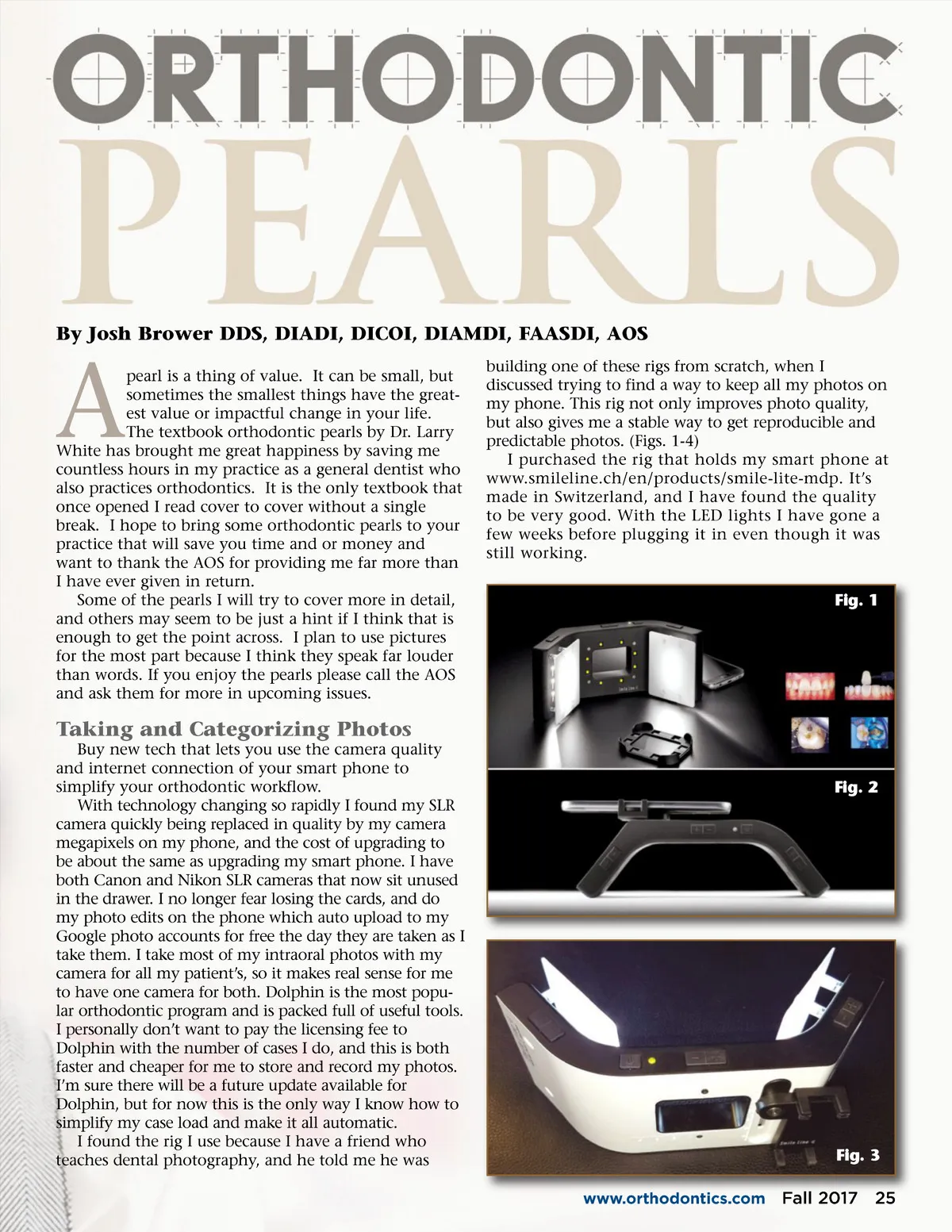
By Josh Brower DDS, DIADI, DICOI, DIAMDI, FAASDI, AOS A pearl is a thing of value. It can be small, but sometimes the smallest things have the great-est value or impactful change in your life. The textbook orthodontic pearls by Dr. Larry White has brought me great happiness by saving me countless hours in my practice as a general dentist who also practices orthodontics. It is the only textbook that once opened I read cover to cover without a single break. I hope to bring some orthodontic pearls to your practice that will save you time and or money and want to thank the AOS for providing me far more than I have ever given in return. Some of the pearls I will try to cover more in detail, and others may seem to be just a hint if I think that is enough to get the point across. I plan to use pictures for the most part because I think they speak far louder than words. If you enjoy the pearls please call the AOS and ask them for more in upcoming issues. building one of these rigs from scratch, when I discussed trying to find a way to keep all my photos on my phone. This rig not only improves photo quality, but also gives me a stable way to get reproducible and predictable photos. (Figs. 1-4) I purchased the rig that holds my smart phone at www.smileline.ch/en/products/smile-lite-mdp. It’s made in Switzerland, and I have found the quality to be very good. With the LED lights I have gone a few weeks before plugging it in even though it was still working. Fig. 1 Taking and Categorizing Photos Buy new tech that lets you use the camera quality and internet connection of your smart phone to simplify your orthodontic workflow. With technology changing so rapidly I found my SLR camera quickly being replaced in quality by my camera megapixels on my phone, and the cost of upgrading to be about the same as upgrading my smart phone. I have both Canon and Nikon SLR cameras that now sit unused in the drawer. I no longer fear losing the cards, and do my photo edits on the phone which auto upload to my Google photo accounts for free the day they are taken as I take them. I take most of my intraoral photos with my camera for all my patient’s, so it makes real sense for me to have one camera for both. Dolphin is the most popu-lar orthodontic program and is packed full of useful tools. I personally don’t want to pay the licensing fee to Dolphin with the number of cases I do, and this is both faster and cheaper for me to store and record my photos. I’m sure there will be a future update available for Dolphin, but for now this is the only way I know how to simplify my case load and make it all automatic. I found the rig I use because I have a friend who teaches dental photography, and he told me he was www.orthodontics.com Fig. 2 Fig. 3 Fall 2017 25
Journal of the American Orthodontic Society Fall 2017: Page 25