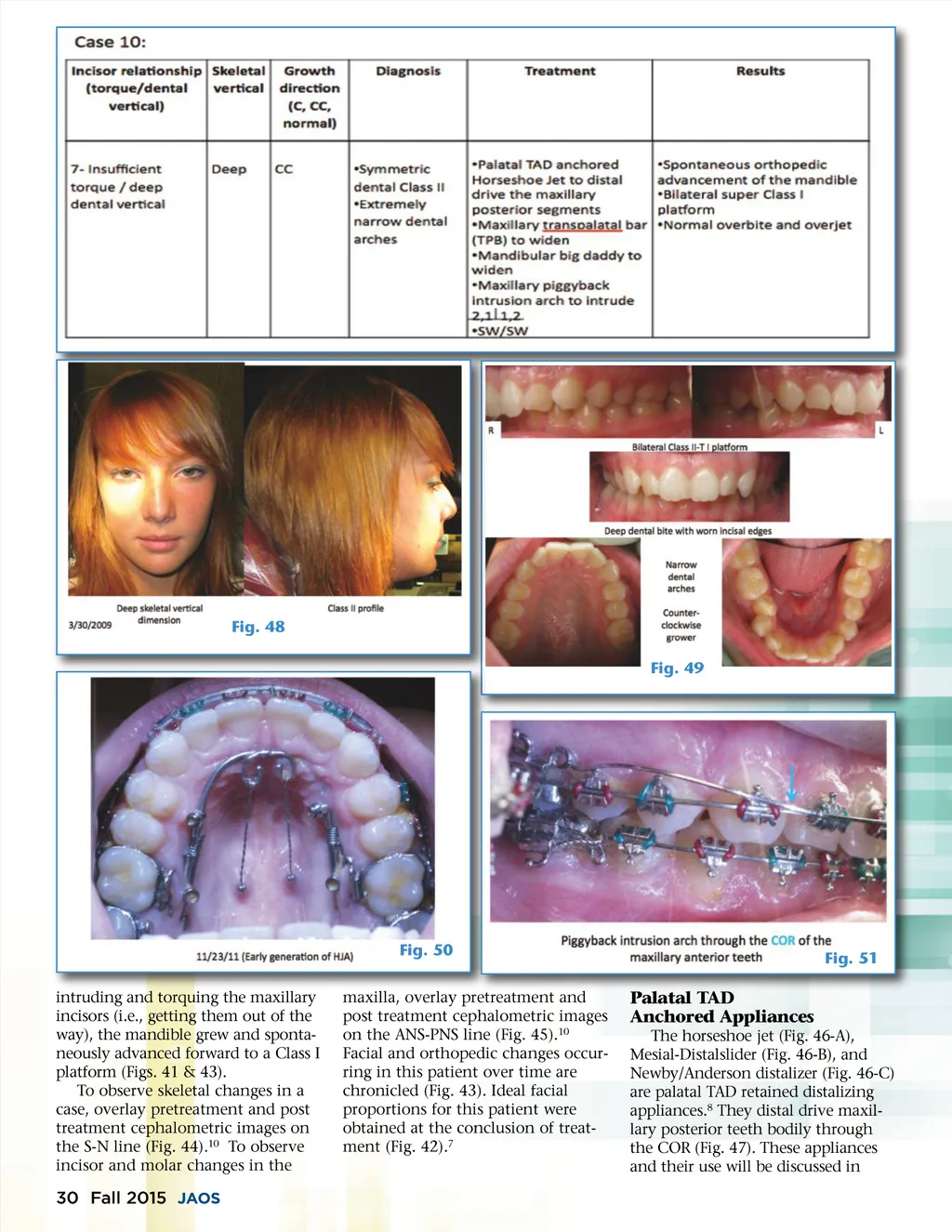
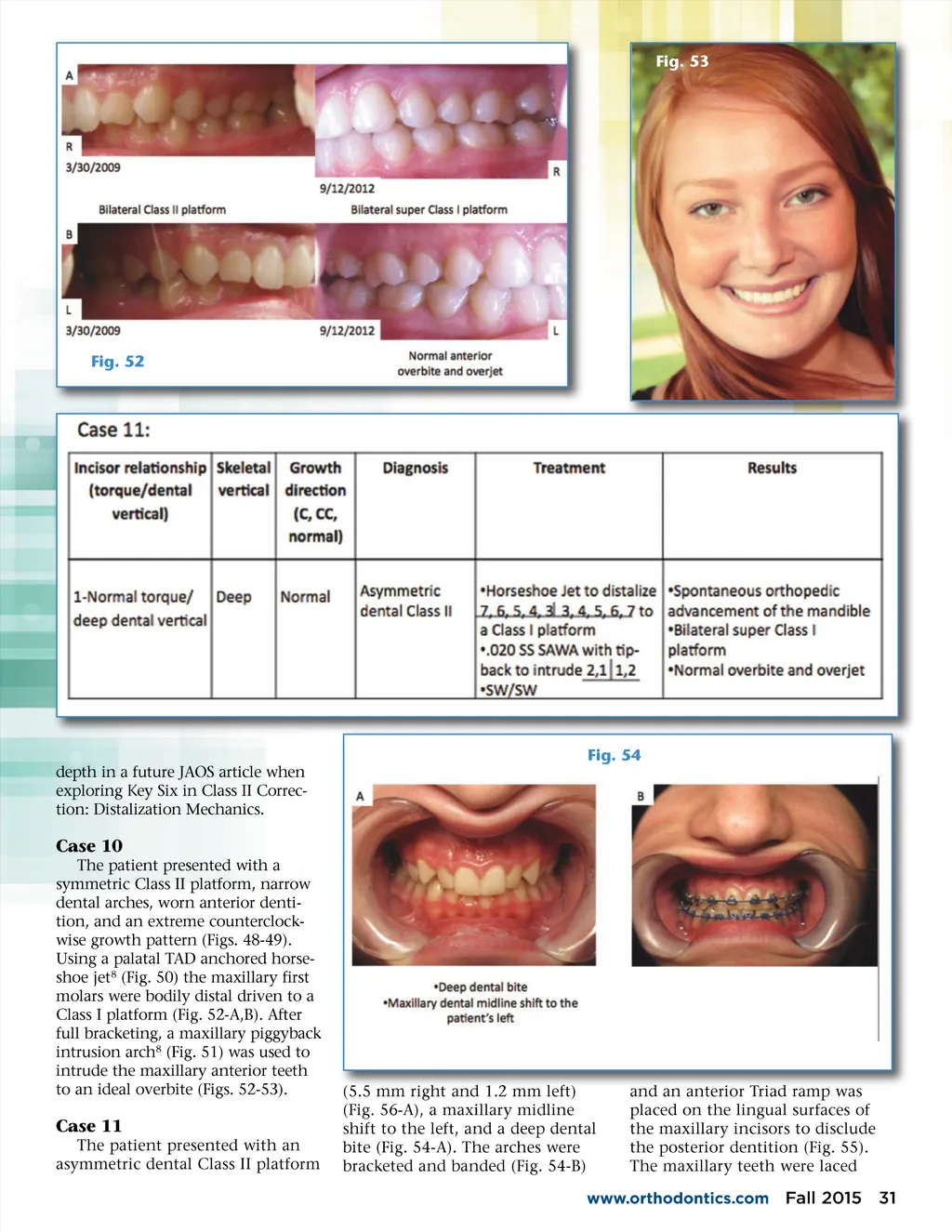
Fig. 53 Fig. 52 Fig. 54 depth in a future JAOS article when exploring Key Six in Class II Correc-tion: Distalization Mechanics. Case 10 The patient presented with a symmetric Class II platform, narrow dental arches, worn anterior denti-tion, and an extreme counterclock-wise growth pattern (Figs. 48-49). Using a palatal TAD anchored horse-shoe jet 8 (Fig. 50) the maxillary first molars were bodily distal driven to a Class I platform (Fig. 52-A,B). After full bracketing, a maxillary piggyback intrusion arch 8 (Fig. 51) was used to intrude the maxillary anterior teeth to an ideal overbite (Figs. 52-53). Case 11 The patient presented with an asymmetric dental Class II platform (5.5 mm right and 1.2 mm left) (Fig. 56-A), a maxillary midline shift to the left, and a deep dental bite (Fig. 54-A). The arches were bracketed and banded (Fig. 54-B) and an anterior Triad ramp was placed on the lingual surfaces of the maxillary incisors to disclude the posterior dentition (Fig. 55). The maxillary teeth were laced www.orthodontics.com Fall 2015 31
Journal of the American Orthodontic Society Fall 2015: Page 31