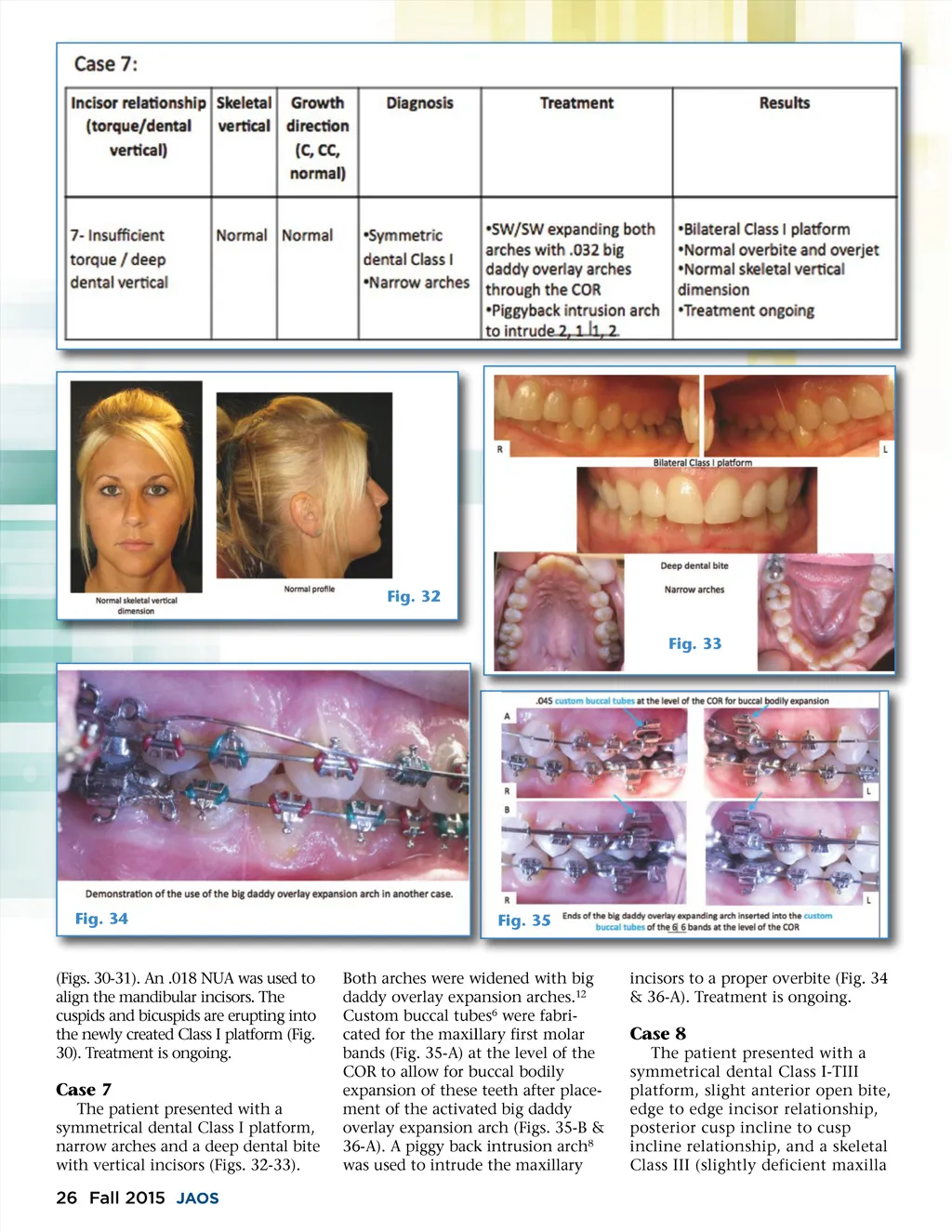
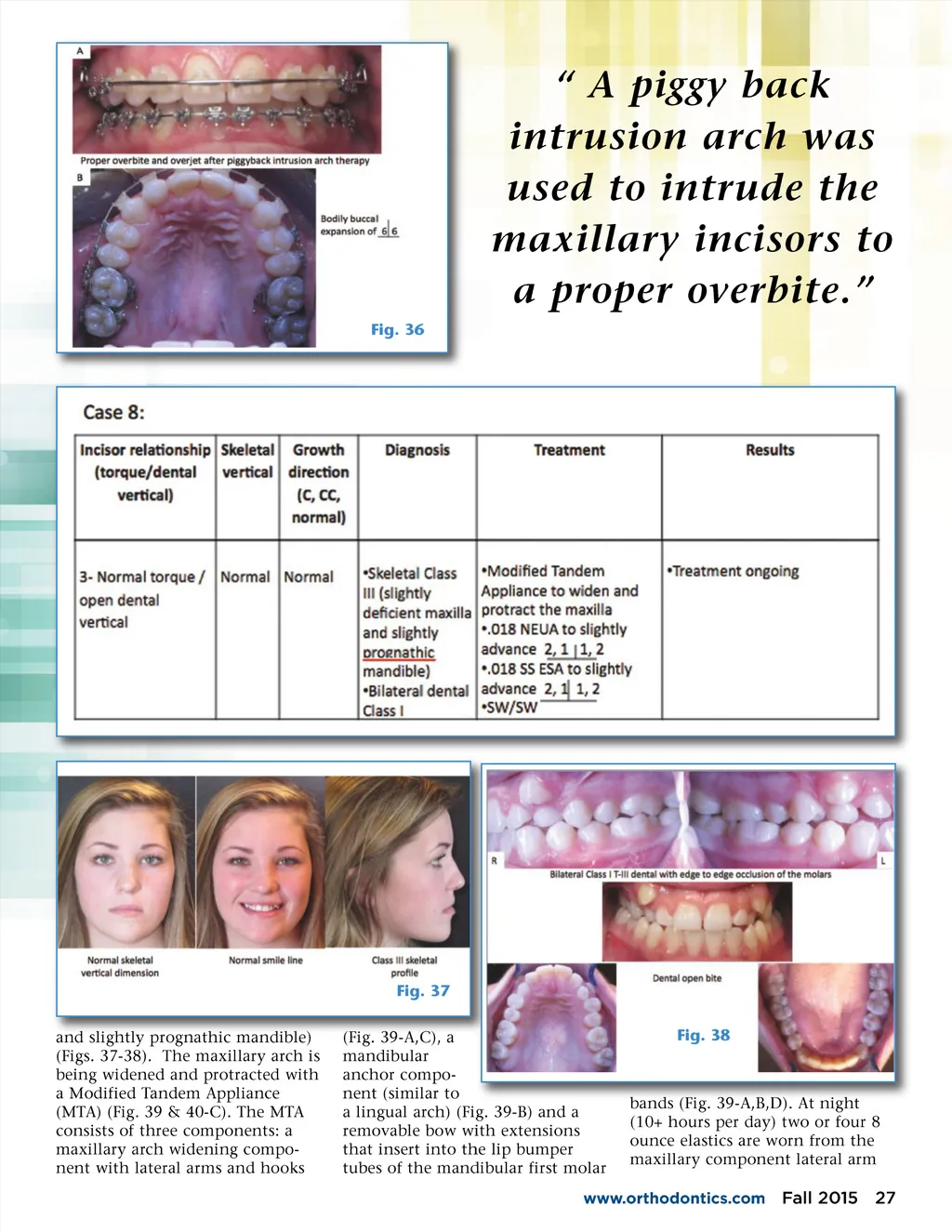
Fig. 32 Fig. 33 Fig. 34 Fig. 35 (Figs. 30-31). An .018 NUA was used to align the mandibular incisors. The cuspids and bicuspids are erupting into the newly created Class I platform (Fig. 30). Treatment is ongoing. Case 7 The patient presented with a symmetrical dental Class I platform, narrow arches and a deep dental bite with vertical incisors (Figs. 32-33). Both arches were widened with big daddy overlay expansion arches. 12 Custom buccal tubes 6 were fabri-cated for the maxillary first molar bands (Fig. 35-A) at the level of the COR to allow for buccal bodily expansion of these teeth after place-ment of the activated big daddy overlay expansion arch (Figs. 35-B & 36-A). A piggy back intrusion arch 8 was used to intrude the maxillary incisors to a proper overbite (Fig. 34 & 36-A). Treatment is ongoing. Case 8 The patient presented with a symmetrical dental Class I-TIII platform, slight anterior open bite, edge to edge incisor relationship, posterior cusp incline to cusp incline relationship, and a skeletal Class III (slightly deficient maxilla 26 Fall 2015 JAOS
Journal of the American Orthodontic Society Fall 2015: Page 26